



Isocetyl laurate: properties, uses, pros, cons, safety
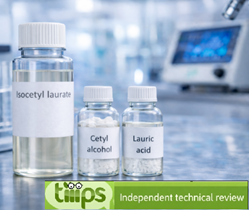
Isocetyl laurate is an ester obtained from the reaction between lauric acid (dodecanoic acid) and isocetyl alcohol (a branched C16 alcohol). In cosmetics it is mainly used as an emollient and skin conditioning agent, because it improves slip, silkiness, and spreadability, often with a touch perceived as “drier” than heavier emollients.
Definition
From a chemical standpoint it is the ester 14-methylpentadecyl dodecanoate (i.e., dodecanoic acid, isohexadecyl ester). It is a typically lipophilic raw material used to modulate the oil phase and sensoriality, and to support pigment wetting in make-up and sunscreen products.
Production process
It is generally produced by esterification of lauric acid with isocetyl alcohol in the presence of a catalyst, with removal of the reaction water. This is followed by purification steps (e.g., stripping/deodorization, filtration) to reduce traces of free acid, free alcohol, and odor-causing compounds, and to meet cosmetic-grade color/odor specifications.
Key constituents
The main component is the isocetyl laurate ester. Trace amounts (within specification) may include residual lauric acid, residual isocetyl alcohol, and minor fractions related to the typical distribution of the starting materials (depending on supplier and refining grade). These traces mainly affect odor, oxidative stability, and sensorial compatibility.
Identification data and specifications
| Characteristic | Value | Note |
|---|---|---|
| INCI name | Isocetyl laurate | cosmetic denomination |
| Functions (cosmetic use) | Skin conditioning; Skin conditioning – emollient | primary function: emollient |
| Technical synonyms | dodecanoic acid, isohexadecyl ester | chemical nomenclature |
| CAS number | 89527-28-6 | substance identification |
| EC number (EINECS) | available in regulatory databases | verify supplier SDS |
| Molecular formula | C₂₈H₅₆O₂ | ester |
| Molecular weight | 424.74 g/mol | theoretical value |
Physicochemical properties (indicative)
| Characteristic | Indicative value | Note |
|---|---|---|
| Physical state | oily liquid | may be more viscous at low T |
| Color | colorless–pale yellow | depends on refining grade |
| Odor | slight | influenced by purity/deodorization |
| Water solubility | very low | typical of fatty esters |
| Oil solubility | high | miscible with many oil phases |
| Polarity | low–medium (lipophilic) | useful for “silky” sensoriality |
| Stability | good when well refined | consider oxidation control in sensitive formulas |
Main uses
Cosmetics
Common in:
face/body creams and lotions to increase silkiness and slip
make-up (foundations, concealers, lip products) to improve spreadability and feel
sunscreens and after-sun as an oil-phase emollient
selected haircare (leave-on) when a light, gliding emollient is needed
INCI functions
Skin conditioning agent - Emollient. Emollients have the characteristic of enhancing the skin barrier through a source of exogenous lipids that adhere to the skin, improving barrier properties by filling gaps in intercorneocyte clusters to improve hydration while protecting against inflammation. In practice, they have the ability to create a barrier that prevents transepidermal water loss. Emollients are described as degreasing or refreshing additives that improve the lipid content of the upper layers of the skin by preventing degreasing and drying of the skin. The problem with emollients is that many have a strong lipophilic character and are identified as occlusive ingredients; they are oily and fatty materials that remain on the skin surface and reduce transepidermal water loss. In cosmetics, emollients and moisturisers are often considered synonymous with humectants and occlusives.
As an emollient, it spreads on the skin surface forming a thin lipid film that reduces friction and improves the perception of softness. In pigmented formulas it can increase wetting and dispersion, supporting uniformity and slip. In some systems it also acts as a carrier for lipophilic components (fragrance, filters, oil-soluble actives), improving their handling in the oil phase.
Pros and cons
Pros
Silky feel and good spreadability, useful to elevate cosmetic elegance.
Good compatibility with many oil phases and make-up systems (supports pigment wetting).
A “clean” functional profile: mainly a technological/sensorial ingredient, easy to integrate into many bases.
Cons
In very reactive skin types, excessive emollient load may feel occlusive or poorly tolerated (depends on the overall formula).
Possible variability across commercial grades (odor/color) if refining is insufficient.
Like many esters, in formulas highly sensitive to oxidation it may require an antioxidant strategy and raw material control.
Safety, regulatory, and environmental aspects
Safety profile (practical)
It is an alkyl ester long used as an emollient. Family safety assessments for alkyl esters in cosmetics generally indicate a profile compatible with use, provided products are designed to be non-irritating and the raw material meets purity specifications.
Allergen
It is not a typical fragrance allergen. Any reactions are more likely related to irritation or individual intolerance to the finished formula rather than classic fragrance sensitization.
Contraindications and cautions
Use caution in products intended for users with very sensitive skin or impaired barrier, especially if the formula also contains potentially aggressive surfactants/solvents. In product development, always verify finished-product stability, compatibility, and tolerability.
Conclusion
Isocetyl laurate is a highly useful ester emollient to improve slip, silkiness, and application performance, particularly attractive in make-up and emulsions where a more elegant touch is desired. The main points of attention are choosing a well-refined grade and balancing the oil phase to avoid an overly occlusive feel for some target users.
Mini-glossary
Ester: a compound formed by reacting an acid and an alcohol; often used as an emollient.
Emollient: an ingredient that improves skin softness and slip by reducing surface friction.
Pigment wetting: the ability of an oil/emollient to “wet” and disperse pigments well, improving uniformity and payoff.

