



Polyquaternium-14: INCI functions, hair care use, formulation compatibility, and safety
Polyquaternium-14
Polyquaternium-14 – cationic quaternary polymer (homopolymer of quaternized methacrylic derivatives with sulfate/methyl sulfate counterion)
Synonyms: ethanaminium, N,N,N-trimethyl-2-[(2-methyl-1-oxo-2-propenyl)oxy]-, methyl sulfate, homopolymer; trimethylaminoethyl methacrylate homopolymer (technical designation)
INCI / functions: antistatic, film forming, hair fixative (styling support), supports combability and flyaway control
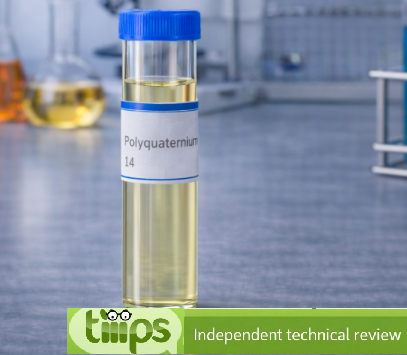
Definition
Polyquaternium-14 is a cationic polymer belonging to the polyquaternium family: polymers bearing quaternary ammonium groups along the chain. From a compositional standpoint, the ingredient consists of repeating units of a quaternized methacrylic monomer (a “methacrylate + quaternary ammonium” structure) with a sulfate/methyl sulfate counterion; chain length (degree of polymerization) varies by commercial grade.
Main uses (brief, by sector):
Food: not intended (cosmetic ingredient; not a food additive).
Cosmetics: hair care and nail care as film former and antistatic; contributes to sensory conditioning (reduced static and improved discipline).
Medicine: not typical as a standard medical ingredient; may appear in specialized/research contexts as a cationic polymer.
Pharmaceutical: not common as a broad-use excipient; where present, it depends on specific technical use and supplier dossier.
Industrial use: applications as a cationic polymer (surface/film functions), varying by sector and technical specification.
| Identifier | Value |
|---|---|
| INCI name | Polyquaternium-14 |
| CAS | 27103-90-8 |
| EC number | Not consistently reported for the polymeric form (depends on database/registration) |
| Chemical type | polymeric quaternary ammonium salt (cationic polymer) |
| Commercial form | often aqueous solution or powder/solid (grade-dependent) |
| Solubility | typically water-soluble/dispersible; not compatible with many purely oil phases without appropriate systems |
| Charge | cationic (substantivity on keratin surfaces) |
Functional role and practical mechanism of action
Antistatic: the positive charge reduces electrostatic build-up on hair and surfaces, limiting “flyaway” and improving manageability during drying/brush-out.
Film forming: forms a thin, continuous surface film on hair (and, in some products, on nails), contributing to a sense of more body, discipline, and superficial mechanical protection.
Typical formulation effect: in shampoos/conditioners it can support deposition and improved wet/dry comb feel; in styling it can support hold and frizz control in synergy with other film formers.
Formulation compatibility
Because Polyquaternium-14 is cationic, attention is required for electrostatic interactions and ionic strength. In cleansing systems based on anionic surfactants, it can remain functional, but compatibility depends on polymer charge density, electrolyte level, and surfactant profile (high-salt systems may reduce clarity or increase haze). In aqueous gels or emulsions it is generally stable when pH and ionic strength match the selected grade; however, it can interact with anionic polymers (e.g., carbomers/anionic acrylates), leading to complexation, viscosity loss, or flocculation. With high salt loads, challenging fragrances, or elevated solvent levels, it is recommended to verify clarity, viscosity stability, and sensory performance on wet and dry hair.
Common handling guidance: add into the water phase under agitation, avoiding localized “shock” (high point concentration) that can cause lumping or opalescence; pre-dilution is often beneficial when supplied as a viscous solution.
Use guidelines (indicative)
| Application | Typical range | Technical note |
|---|---|---|
| Shampoo / hair cleansing products | 0.05–0.30% | antistatic and sensorial contribution without heavy feel |
| Conditioners / masks | 0.10–0.80% | increases discipline and film; monitor build-up |
| Styling (mousse, spray, gel) | 0.20–2.00% | supports hold and flyaway control; test across hair types |
| Nail care (if aligned to concept) | 0.10–1.00% | film former in dedicated aqueous systems |
(Percentages depend on the commercial grade and the active solids concentration of the raw material.)
Typical applications
Hair care: reduced static, improved combability, improved discipline and surface film.
Styling: fixation/hold support and frizz reduction, often in synergy with other film formers.
Nail care: use as a film former in dedicated formulations (less common than hair care).
Quality, grades and specifications
In cosmetics, grades may differ in active solids (solutions) and viscosity/performance profile. Typical QC parameters include: solids/actives, viscosity (if supplied as a solution), grade pH, impurity profile, and microbiological suitability per supplier specification. For regulatory and finished-product safety assessment, potential residual monomers should be managed through specifications and the manufacturer’s technical documentation.
Safety, regulatory and environment
From a cosmetic safety perspective, Polyquaternium-14 is covered within group assessments of quaternary/polymeric ingredients and is generally considered acceptable under cosmetic conditions of use when finished products are formulated to be non-irritating. In practice, the most realistic concerns are eye irritation/stinging on direct contact (especially in cleansing products) and respiratory irritation only in scenarios of uncontrolled exposure to dust/aerosols (a general consideration for many polymer powders). In the EU, use falls under Regulation (EC) 1223/2009 and the finished-product safety assessment; it is not an IFRA substance (not a fragrance material). Environmentally, as with many cationic polymers, a precautionary approach is appropriate regarding aquatic impact if releases are not controlled; good practice focuses on responsible use and effluent management in industrial settings.
Formulation troubleshooting
| Issue | Likely cause | Recommended action |
|---|---|---|
| Haze/opalescence in clear shampoo | complexation with surfactants/electrolytes or grade incompatibility | reduce dose, change grade, pre-dilute, optimize salts and addition order |
| Viscosity loss in gels with anionic polymers | cationic–anionic interaction | separate systems (polymer choice), reduce anionics, consider compatible nonionics |
| Build-up or heavy feel | overly persistent film or high dosage | lower dose, balance with lighter conditioning agents, improve rinse-off profile |
| Weak antistatic effect on treated hair | competition with other film formers or insufficient level | check synergies, adjust dose slightly, verify pH/ionic strength and surfactant system |
Conclusion
Polyquaternium-14 is a functional, versatile cationic polymer for hair care, operating primarily as an antistatic and film former, with a tangible impact on discipline and static control. Formulation success depends largely on electrostatic compatibility (interactions with anionics), salt management, and correct addition order. From a cosmetic safety standpoint, the correct approach is finished-product based: formulate to be non-irritating and verify stability and performance with the most suitable grade.
Mini-glossary
INCI: International Nomenclature of Cosmetic Ingredients; the standardized naming system for cosmetic labeling.
Quaternary ammonium: a permanent cationic center (positive charge) supporting substantivity on hair/skin.
Film forming: ability to deposit a continuous film on a surface, influencing protection and sensorial profile.
GMP: Good Manufacturing Practice; quality systems ensuring consistent manufacturing and control.
HACCP: Hazard Analysis and Critical Control Points; a systematic approach to hazard analysis and control of critical points (most common in food chains, but relevant as a process-control concept in regulated contexts).

