



Aluminum Starch Octenylsuccinate: properties, uses, pros, cons, safety
Aluminum Starch Octenylsuccinate - Starch aluminum octenyl succinate (Aluminum Starch Octenylsuccinate) is obtained by the reaction of octenylsuccinic anhydride with starch and is the aluminium salt of the product of this reaction.
The name describes the structure of the molecule
- Starch refers to the starch, which is the primary raw material used as a base for the compound.
- aluminum indicates the presence of aluminum, which can act as a binding or treatment agent in production.
- octenyl refers to octenyl, which is a functional group used as an ester in the chemical structure.
- succinate indicates the presence of succinic acid, which is a functional group used as part of the ester.
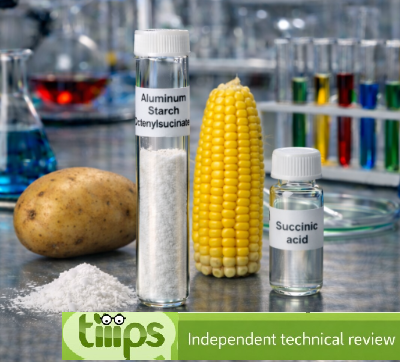
Description of raw materials and their functions:
Starch is the main raw material and is used as a source of carbohydrates for polymer formation.
Aluminum may be added as a compound or catalyst to facilitate the chemical reaction.
Succinic acid is used as a reagent to form the succinate ester in starch.
Step-by-step summary of the industrial chemical synthesis process:
- Starch Preparation. Raw starch is extracted from natural sources such as corn or potatoes and purified.
- Starch Modification. Starch is treated with succinic acid in the presence of aluminum as a catalyst. This chemical reaction forms the succinate ester of starch.
- Refinement and Separation. The obtained product is refined to remove any impurities and subsequently separated from the catalyst and other by-products.
- Drying. The resulting compound is dried to remove residual moisture.
- Milling. The dry product is ground to achieve the desired form, which can be either a powder or granular form.
What it is used for and where
Cosmetics
Absorbent. Absorbs substances dispersed or dissolved in aqueous solutions, water/oil, oil/water.
Anticaking agent. This chemical compound facilitates free flow and prevents aggregation or clumping of substances in a formulation by reducing the tendency of certain particles to stick together.
Viscosity control agent. It controls and adapts viscosity to the required level for optimal chemical and physical stability of the product and dosage in gels, suspensions, emulsions, solutions.
Normalmente viene inserito nelle creme in una percentuale che non supera il 30%.
Food
The compound "Starch Aluminium Octenyl Succinate" is commonly used in the food and pharmaceutical industries as a coating agent, binding agent, or stabilizer to enhance consistency, stability, and solubility characteristics of the final products.
It is also used in the food industry as a modified food starch and is subject to certain restrictions with regard to heavy metal residues.
In the list of European food additives, aluminium starch octenyl succinate has the number E1452 as a thickener.
Safety
The EFSA Panel on Food Additives and Nutrient Sources Added to Food considers that there is no safety concern for the use of modified starches as food additives at the uses and use levels declared for the general population and that a numerical ADI is not necessary (1).
A warning should be given about the risk of aluminum intake, which cannot be ruled out as this ingredient can be found both in cosmetic products and in widely consumed foodstuffs such as bread, various baked goods (2)
In the minute quantities in which it is included in food or cosmetics, it is not a cause for concern. However, aluminium is a possible endocrine disruptor, so monitor any cumulative intake.
- Molecular Formula
- Molecular Weight
- CAS 9087-61-0
- UNII
- EC Number 618-671-9

