



Cetyl glycol: properties, INCI functions, cosmetic use, and safety
2-hydroxycetyl Alcohol / 1,2-hexadecanediol – C₁₆H₃₄O₂
Synonyms: 1,2-dihydroxyhexadecane, 1,2-hexadecanediol, 1,2-hexadecylene glycol
INCI / functions: hair conditioning, skin conditioning (emollient), viscosity increasing (in aqueous and non-aqueous systems)
Definition
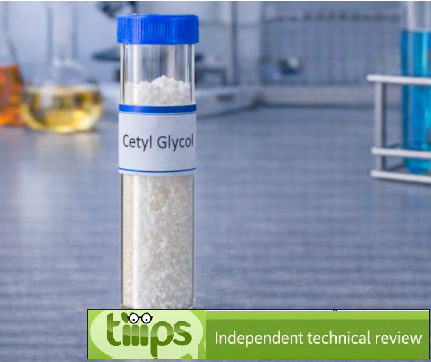
Cetyl glycol) is a long-chain (C16) 1,2-diol bearing two –OH groups on carbon 1 and 2 (a “glycol-type” structure with a lipophilic backbone). From a compositional standpoint, the ingredient essentially corresponds to the single molecule 1,2-hexadecanediol (often present as a racemic mixture due to a stereogenic center at C2); technical grades may contain typical process-related traces (closely related chain-length impurities). In cosmetic formulation it behaves as a co-emollient/structurant and a rheology modifier in lipophilic systems or emulsions, contributing to sensory and product body.
Main uses (brief): Food: not relevant. Cosmetics: emollient, conditioning, viscosity increasing. Medicine: mainly laboratory/research use (not as an active). Pharmaceutical: potential use as a lipophilic excipient/consistency aid (case-dependent). Industrial use: intermediate and additive in fine chemistry/materials.
Identification data and specifications
| Parameter | Value | Notes |
|---|---|---|
| Molecular formula | C₁₆H₃₄O₂ | C16 diol |
| Linear formula (indicative) | CH₃(CH₂)₁₃CH(OH)CH₂OH | 1,2-diol structure |
| Molar mass | 258.44 g/mol | |
| CAS | 6920-24-7 | |
| EC (EINECS) | 230-030-1 |
Physicochemical properties (indicative)
| Property | Value | Notes |
|---|---|---|
| Physical state | waxy/crystalline solid | typical of long-chain diols |
| Water solubility (25 °C) | ~0.000067 g/L | practically insoluble in water |
| Density (20 °C) | ~0.897 g/cm³ | |
| Melting point | ~75–76 °C | |
| Boiling point | ~356 °C (760 Torr) | indicative/reference value |
| Flash point | ~152 °C | |
| logP (25 °C) | ~5.567 | high lipophilicity |
| pKa (25 °C) | ~14.19 | alcohol: very weak acid |
Functional role in formulation
Emolliency and sensoriality: the lipophilic backbone contributes to slip and skin softness, reducing application friction.
Skin/hair conditioning: improves cosmetic perception, with potential support to combability and feel (system-dependent).
Viscosity increasing: can help structure the oil phase or modulate rheology in emulsions (formulation-dependent).
Practical note: due to very low water solubility, it should be handled as a lipophilic component (oil phase) or pre-solubilized in compatible solvents/oils.
Formulation compatibility
Overall behavior is consistent with a lipophilic co-formulant: it integrates well with ester oils, cosmetic hydrocarbons, silicones, and many anhydrous bases; in emulsions it works synergistically with emulsifiers and structurants (fatty alcohols, waxes, rheology polymers), contributing to body and mechanical stability. In highly aqueous systems it is not an ingredient to “solubilize” directly: the correct approach is to add it to the oil phase and assess potential crystallization (risk of “grainy feel” if the thermal profile or structurant package is not optimized). With surfactants, compatibility is generally good in rinse-off products, but the impact on viscosity and sensoriality should be verified with hot/cold stability testing.
Use guidelines (indicative)
Emulsions (creams/lotions): 0.1–3.0% as a co-emollient/structurant (tune based on texture and stability).
Anhydrous (balms, sticks, gelled oils): 0.2–5.0% to modulate body and slip.
Process sequence (practical): add to the oil phase, heat above the melting point, homogenize, then control the cooling curve to reduce the risk of coarse recrystallization.
Typical applications
Skin care: creams and balms where a richer and more silky sensory profile is needed without excessive greasiness.
Hair care: conditioners and masks to support feel and conditioning (in combination with quats/polymers).
Make-up and anhydrous bases: improved spreadability and microstructure (depends on the wax/powder system).
INCI Functions
Hair conditioning agent.
A large number of ingredients with specific purposes can co-exist in a hair shampoo: cleansers, conditioners, thickeners, mattifying agents, sequestering agents, fragrances, preservatives, special additives. However, the indispensable ingredients are the cleansers and conditioners as they are necessary and sufficient for hair cleansing and manageability. The others act as commercial and non-essential auxiliaries such as: appearance, fragrance, colouring, etc. Hair conditioning agents have the task of increasing shine, manageability and volume, and reducing static electricity, especially after treatments such as colouring, ironing, waving, drying and brushing. They are, in practice, dispersing agents that may contain cationic surfactants, thickeners, emollients, polymers. The typology of hair conditioners includes: intensive conditioners, instant conditioners, thickening conditioners, drying conditioners.
Emollient
Emollients have the characteristic of enhancing the skin barrier through a source of exogenous lipids that adhere to the skin, improving barrier properties by filling gaps in intercorneocyte clusters to improve hydration while protecting against inflammation. In practice, they have the ability to create a barrier that prevents transepidermal water loss. Emollients are described as degreasing or refreshing additives that improve the lipid content of the upper layers of the skin by preventing degreasing and drying of the skin. The problem with emollients is that many have a strong lipophilic character and are identified as occlusive ingredients; they are oily and fatty materials that remain on the skin surface and reduce transepidermal water loss. In cosmetics, emollients and moisturisers are often considered synonymous with humectants and occlusives.
Viscosity Enhancing Agent, aqueous and non-aqueous.
Since viscosity is important for increasing the chemical and physical stability of the product, Viscosity Enhancing Agent, is an important dosage factor in gels, suspensions, emulsions, solutions. Increasing viscosity makes formulations less sedimentary and more homogeneously thickened.
Quality, grades and specifications
Available in technical and high-purity grades; typical QC parameters include assay, impurity profile, melting point, color/clarity when molten, and (when required) limits for metals and process residues. For grades intended for finished products, it is common practice to also verify residual odor and behavior in accelerated stability.
Safety, regulation and environment (discursive section)
At typical cosmetic use levels, 1,2-glycols (including cetyl glycol/2-hydroxycetyl alcohol) are evaluated as safe under the conditions of use considered by industry bodies, with the usual emphasis on formulating finished products to be non-irritating and controlling occupational exposure to dust/fumes only in industrial settings. As with many lipophilic organic solids, raw material handling requires standard safety practices (avoid aerosols/dust; eye protection when there is risk of hot splashes). From an environmental perspective, impact depends primarily on quantities and effluent management associated with the overall formulation; apply local regulatory requirements and good manufacturing practice for waste and wash water handling.
Formulation troubleshooting
Graininess / perceptible crystals (“grainy”): increase hot-phase homogenization, review the cooling curve, evaluate co-structurants and wax/fatty alcohol ratios.
Emulsion instability (separation/creaming): check HLB/emulsifier system, continuous-phase viscosity, droplet size; consider lowering the dose or adjusting the emollient blend.
Unwanted opacity in gels/oils: possible microcrystallization; test more compatible solvents/oils or reduce the load.
Conclusion
Cetyl glycol (2-hydroxycetyl alcohol / 1,2-hexadecanediol) is a C16 lipophilic diol functioning as a co-emollient, conditioning agent, and rheology modifier, particularly useful when increased body and sensorial quality are required in emulsions or anhydrous systems. The key to successful use is managing its water-insoluble nature correctly (oil phase and thermal processing), preventing recrystallization phenomena to ensure consistent stability and performance.

