



Potassium cocoyl glycinate: properties, uses, pros, cons, safety
Potassium Cocoyl Glycinate – “amino acid–based” anionic surfactant (potassium salt of N-acyl glycine from “coco” fatty acids) used for mild cleansing, creamy foam, and good performance in clear formulas (within an appropriate pH window)
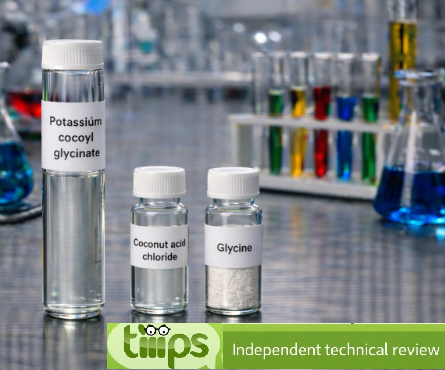
Potassium cocoyl glycinate is an organic compound, potassium salt of the amide produced from the reaction of coconut acid chloride and glycine. Amino Acid Alkyl Amide.
Synonyms: potassium N-cocoyl glycinate, glycine N-coco acyl derivatives (potassium salts), potassium lauroyl glycinate (main “type” component), Amilite® GCK-12H (reference trade name)
INCI / Functions: hair conditioning, surfactant – cleansing
Definition
Potassium Cocoyl Glycinate is the potassium salt of a mixture of N-acyl glycinate species, where “cocoyl” indicates an acyl-chain distribution derived from coconut-type fatty acids (typically rich in C12). From a compositional perspective, it is not a single molecule: the raw material contains multiple species with different chain lengths; in industrial and regulatory contexts it is often described as “glycine, N-coco acyl derivs., potassium salts”.
In cosmetic formulation, it behaves as a mild anionic surfactant: the carboxylate (as a salt) provides solubility and cleansing capacity, while the amino-acid headgroup and the mixed acyl distribution typically support a more creamy foam and a cleansing profile that is often perceived as less stripping than stronger anionics, for the same system and dose. A key point is the pH window: as a salt, solubility can drop below certain pH values (risk of haze/precipitation and loss of performance), while under neutral to alkaline conditions it generally performs better in clarity and foam quality.
The potassium counterion is often associated with better “clear-formula” compatibility than the sodium version, provided pH is kept consistent with the salt form and the overall surfactant package.
Main uses
Food.
Not typically intended for food use; its application is primarily cosmetic/technical.
Cosmetics.
It is used as a primary surfactant or co-surfactant in cleansing products positioned as gentle, often in “sulfate-free” formulas or where effective cleansing is required with softer sensoriality. In facial cleansers (gels, foams, pastes), it is used to generate fine, creamy foam, supporting a clean feel without excessive perceived dryness—especially when supported by humectants and amphoteric/nonionic co-surfactants.
In body washes and hand cleansers, it can be included to improve foam quality and glide during massage, reducing the tight after-feel typical of more aggressive bases. In shampoos, it can act as a primary surfactant in very gentle systems or—more commonly—as part of the surfactant blend to improve foam creaminess and post-rinse combability; in some cases it also contributes to a more “disciplined” hair feel, especially when the formula includes compatible conditioning polymers.
A relevant practical driver is use in clear formulations: many commercial grades (often supplied as ~30% active solutions) are designed to work well in transparent systems, provided pH is appropriate and electrolytes and polymer compatibility are controlled.
INCI Functions
Hair conditioning agent.. A large number of ingredients with specific purposes can co-exist in a hair shampoo: cleansers, conditioners, thickeners, mattifying agents, sequestering agents, fragrances, preservatives, special additives. However, the indispensable ingredients are the cleansers and conditioners as they are necessary and sufficient for hair cleansing and manageability. The others act as commercial and non-essential auxiliaries such as: appearance, fragrance, colouring, etc. Hair conditioning agents have the task of increasing shine, manageability and volume, and reducing static electricity, especially after treatments such as colouring, ironing, waving, drying and brushing. They are, in practice, dispersing agents that may contain cationic surfactants, thickeners, emollients, polymers. The typology of hair conditioners includes: intensive conditioners, instant conditioners, thickening conditioners, drying conditioners.
Surfactant. Cleansing agent. Cosmetic products used to cleanse the skin utilise the surface-active action that produces a lowering of the surface tension of the stratum corneum, facilitating the removal of dirt and impurities.
Identification data and specifications
| Identifier | Value |
|---|---|
| INCI name | Potassium Cocoyl Glycinate |
| Chemical name (regulatory/technical) | Glycine, N-coco acyl derivs., potassium salts |
| CAS number | 301341-58-2 |
| EC/EINECS number | 620-582-5 |
| Formula (practical representation) | RCONHCH₂COOK (mixture; R = “coco” chains) |
| Formula (main “type” component, lauroyl) | C₁₄H₂₆KNO₃ (indicative, for the main N-lauroyl glycinate) |
| Molecular weight | variable (mixture); ~295.45 g/mol (main “type” component, lauroyl) |
| Typical commercial appearance | aqueous solution ~28–32% active or powder (grade-dependent) |
Chemical-physical properties (indicative)
| Property | Value | Note |
|---|---|---|
| Nature | anionic surfactant (amino acid–based) | behavior depends on pH and ionic strength |
| pH (10% solution, typical spec) | ~8.0–10.5 | indicative range, grade-dependent |
| Water solubility | high (at suitable pH) | haze/precipitation possible if pH is too low |
| Foam quality | creamy and stable | strongly dependent on surfactant package and electrolytes |
| System stability | good in a coherent pH window | test robustness with hard water, salt, and thermal cycles |
Functional role and practical mechanism
| Function | What it does in formula | Technical note |
|---|---|---|
| Surfactant – cleansing | removes sebum/soil via micelles and wetting | perceived mildness if properly balanced |
| Foam boosting (formulation effect) | contributes to fine, creamy foam | often valued in facial cleansers and body washes |
| Mildness co-surfactant | reduces harsh feel of stronger systems | synergistic with amphoterics/nonionics |
| Support for “clear” formulas | enables transparent aesthetics at suitable pH | control salinity and polymer compatibility |
Formulation compatibility
Potassium cocoyl glycinate is generally compatible with amphoteric surfactants (e.g., betaines) and nonionic surfactants, where it tends to improve foam creaminess and sensoriality. In systems containing stronger anionics, it can be used to modulate perceived mildness, but the actual effect depends on the full architecture: surfactant ratios, ionic strength, presence of oils/solubilizers, and rheology strategy.
The most critical parameter is pH: as a salt, too low a pH can reduce solubility and cause haze or precipitates (impacting viscosity, foam, and stability). For clear formulas, good practice is to define a target pH window and verify stability under thermal cycling, including compatibility with fragrance and preservatives.
Electrolytes (salt used for thickening, water hardness) also influence rheology and micellar behavior: they may improve or worsen viscosity and clarity depending on the system. With cationic conditioning polymers, compatibility is often better than with some more reactive anionic/cationic pairs, but haze and viscosity over time should still be checked.
In multi-active products, consider potential changes in CMC and foam response: co-surfactants and polymers can modify micellization and perceived irritation, making an experimental approach essential (dose–pH–salt mapping).
Use guidelines (indicative)
| Application | Typical range | Technical note |
|---|---|---|
| Facial cleansers (gels/foams) | 2–10% (as surfactant active) | modulate with amphoterics for foam stability and comfort |
| Body wash / hand cleanser | 3–12% (as active) | balance pH and salt for viscosity and clarity |
| Mild / sulfate-free shampoos | 1–8% (as active) | often in blends; verify performance on sebum and styling residues |
| Co-surfactant in anionic systems | 1–5% (as active) | useful for creamier foam and reduced stripping feel |
Quality, grades, and specifications
| QC parameter | What to check |
|---|---|
| Identity | INCI, CAS/EC alignment and documentation (SDS/CoA) |
| Active content | basis for dosing and performance repeatability |
| Specification pH | lot-to-lot consistency and compatibility with target formula |
| Chlorides / salts | impact on rheology, clarity, and plant corrosion |
| Impurities (free fatty acids, insolubles) | haze/odor/instability risk |
| Color | quality indicator and process control |
| Microbiology (if in solution) | limits and grade preservation |
Safety, regulatory, and environment
As a rinse-off surfactant, safety management for Potassium cocoyl glycinate is primarily linked to concentration, contact time, finished-product pH, and synergies with other surfactants/solubilizers. In well-designed formulas it is typically used to achieve a gentler cleansing profile; however, as with any surfactant, eye and mucosal contact may be irritating if the system is not optimized. Assessment must be performed on the finished product (use scenario, population, frequency) in line with the applicable regulatory framework.
For product formats that may generate aerosols (not typical for this ingredient but possible in certain mousse or special mist formats), the key point is to avoid meaningful inhalation exposure to respirable droplets/particles and ensure rheology and delivery are consistent with intended use.
In manufacturing, applying GMP (Good manufacturing practice; first occurrence) improves control and repeatability; benefit: reduces variability and operational risk. Where used as a control approach, HACCP (Hazard analysis and critical control points; first occurrence) supports proactive identification of sensitive points; benefit: strengthens prevention and quality control at critical process points.
Formulation troubleshooting
| Problem | Possible cause | Recommended intervention |
|---|---|---|
| Haze / precipitation | pH too low for salt form; incompatibility with fragrance/electrolytes | realign pH, reduce ionic strength, retune solubilizers, thermal-cycle stress testing |
| Weak or unstable foam | unbalanced surfactant package; high salinity; hard water | add amphoterics/nonionics, optimize salt, test across water hardness levels |
| Unstable viscosity | salt window not centered; micellar interactions | map viscosity vs NaCl/electrolytes, evaluate compatible thickeners |
| Dry feel | overall cleansing power too high | reduce total actives, add mild co-surfactants, include compatible humectants/re-fatting |
| Haze after fragrance addition | insufficient solubilization | increase solubilizer, change fragrance or micellar architecture, assess cloud point behavior |
Conclusion
Potassium cocoyl glycinate is an amino acid–based anionic surfactant that is particularly useful when the goal is combining effective cleansing with softer sensoriality and creamy foam, while maintaining the ability to formulate clear systems at an appropriate pH. Formulation success depends mainly on pH control, ionic strength management, fragrance compatibility, and correct surfactant-package balancing. When supported by robust stability testing, it is a strong option for facial cleansers, body washes, and gentle shampoos.
Mini-glossary
Anionic surfactant: surfactant that carries a negative charge in water and forms micelles.
Micelle: surfactant aggregate that traps oils/soil to facilitate removal.
CMC: critical micelle concentration; threshold above which micelles form markedly.
Surfactant package: combination of multiple surfactants to optimize cleansing, foam, and tolerability.
GMP: Good manufacturing practice; benefit: reduces variability and contamination.
HACCP: Hazard analysis and critical control points; benefit: strengthens prevention and control at critical process points.

