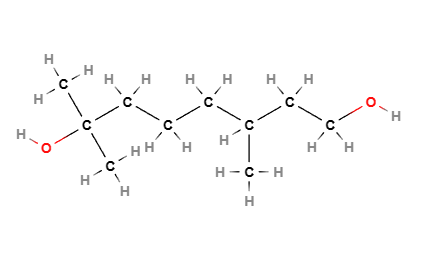
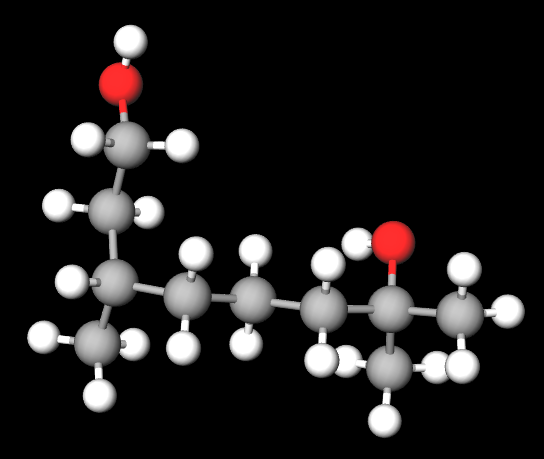
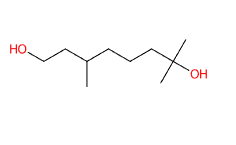
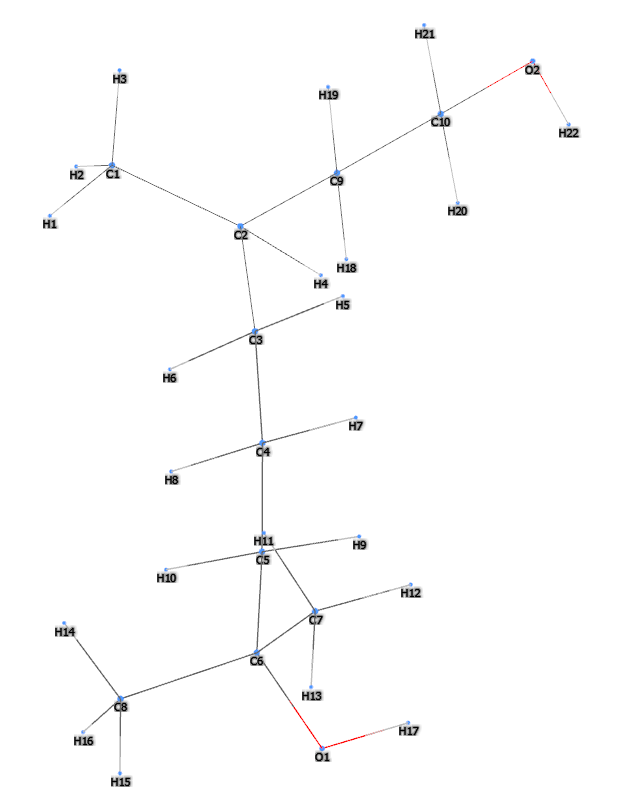
Hydroxycitronellol (3,7-dimethyloctane-1,7-diol) è un composto chimico, un alcol alifatico
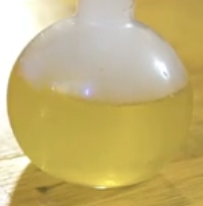
Si presenta in forma di liquido incolore a giallo pallido con un profumo floreale, simile alla rosa.
A cosa serve e dove si usa
Cosmetica
Profumo. A differenza della fragranza che può contenere anche odori leggermente meno gradevoli o caratteristici, la dizione profumo indica soltanto le profumazioni molto gradevoli. Utilizzato per profumi e materie prime aromatiche.
Sicurezza
Come per la maggior parte dei profumi, anche Hydroxycitronellol si è dimostrato potenzialmente allergenico anche se in misura minore rispetto agli allergeni più noti.
- Formula molecolare C10H22O2
- Peso molecolare 174.28 g/mol
- CAS 107-74-4
- UNII R0B4U2I48W
- EC Number 203-517-1
- Nikkaji Number J26.180G
Bibliografia_____________________________________________________________________
Larsen W, Nakayama H, Fischer T, Elsner P, Frosch P, Burrows D, Jordan W, Shaw S, Wilkinson J, Marks J, Sugawara M, Nethercott M, Nethercott J. Fragrance contact dermatitis - a worldwide multicenter investigation (Part III). Contact Dermatitis. 2002 Mar;46(3):141-4. doi: 10.1034/j.1600-0536.2002.460302.x.
Abstract. The purpose of this study was to determine the frequency of responses to selected fragrance materials in patients who were fragrance sensitive. 218 fragrance sensitive subjects were evaluated in eight centres worldwide with a fragrance mixture (FM) and 17 less well-studied fragrance materials. Reaction to the fragrance mixture (FM) occurred in 76% of the subjects. The (FM) detected all reactions to nerol and hydroxycitronellol and 93% of the reactions to clove bud oil. Ten fragrance materials were not detected by the FM and deserve further study: benzenepropanol, beta, beta, 3-trimethyl, hexyl-salicylate, dl-citronellol, synthetic ylang ylang oil, benzyl mixture, cyclohexyl-acetate, eugenyl methyl ether, isoeugenyl methyl ether, 3-phenyl-1-propanol, and 3, 7-dimethyl-7-methoxyoctan-2-ol.