



Betamethasone is a chemical compound, a synthetic corticosteroid. The class of steroid hormones, corticosteroids, produced by the adrenal cortex, consists of glucocorticoids and corticosteroids.
Glucocorticoids (cortisone, cortisol and corticosterone) represent one of the two types of corticosteroids or steroid hormones that are produced by the adrenal cortex and are generated from the zona fasciculata of the adrenal cortex, the second of the two types being corticosteroids that are generated from both the zona fasciculata and the zona glomerulosa of the adrenal cortex. But while glucocorticoids are a single type of corticosteroid, corticosteroids are both glucocorticoids and mineralocorticoids.
- Glucocorticoids control the metabolism of proteins, fats, carbohydrates.
- Corticosteroids control the body's water balance, aldosterone, electrolytes
Appears in the form of a white or whitish powder, incompatible with strong oxidising agents.

What it is used for and where
Take only under medical supervision
Medical
Inflammation is a reaction induced by physical, chemical or biological agents, locally, of vascular tissues characterised, in the extravascular or interstitial environment, by the loss of blood and liquid cells.
Betamethasone has anti-inflammatory, metabolic, immunosuppressive and anti-asthmatic long-acting properties. Specific intracellular glucocorticoid receptors are intercepted by Betamethasone, which binds to DNA, inhibiting the synthesis of certain inflammatory mediators and reducing autoimmune reactions and chronic inflammation. It is administered orally, intravenously, intramuscularly and subcutaneously.
It is used locally as a contrast to inflammatory skin conditions such as eczema, to manage autoimmune disorders, ophthalmic irritations with negligible mineralocorticoid activity. In cases of anaphylactic and allergic reactions, soft tissue lesions, Alzheimer's disease and Addison's disease it is also able to modulate gene expression for anti-inflammatory activity, suppressing the immune system response, however corticosteroids have a tendency to mask some symptoms of infection and overlapping infections may occur during their use (1). The efficacy of betamethasone in nano-betamethasone form in treating experimental nickel-induced contact dermatitis has been shown to be superior to betamethasone (2)
Eye infections are often treated with corticosteroids and antibacterial eye drops containing betamethasone, which helps relieve redness of the eye by reducing inflammation (3).
The US Food and Drug Administration (FDA) has banned the injection of epidural steroids, a non-surgical option to relieve spinal pain, with particulate steroids. This study confirms the efficacy of betamethasone as an appropriate non-particulate steroid for this particular type of injection (4).
Recently, a hydrogel of silk fibroin, a natural fibre of a protein nature produced by certain insects, together with betamethasone encapsulated and injected into intra-articular cavities increased therapeutic efficacy in the inflamed joints of patients with rheumatoid arthritis, a rheumatic disease currently without curative treatment (5).
Some esters, salts and derivatives of this compound also have similar properties, namely: betamethasone-17,21-dipropionate, betamethasone-17-valerate, betamethasone-21-valerate e betamethasone disodium phosphate.
Safety
The long-term use of corticosteroids administered in high doses poses some concern due to side effects. Like all drugs it can cause side effects. Always ask the physician.
The most relevant studies and their abstracts have been selected to explore this in more depth:
| Appearance | White powder |
| Boiling Point | 568.2±50.0°C at 760 mmHg |
| Melting Point | 235-237°C |
| Flash Point | 297.5±30.1°C |
| Density | 1.3±0.1 g/cm3 |
| PSA | 94.83000 |
| LogP | 1.87 |
| Refraction Index | 1.592 |
| Vapor Pressure | 0.0±3.5 mmHg at 25°C |
| Safety | 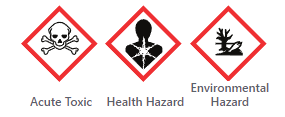 |
 |  |
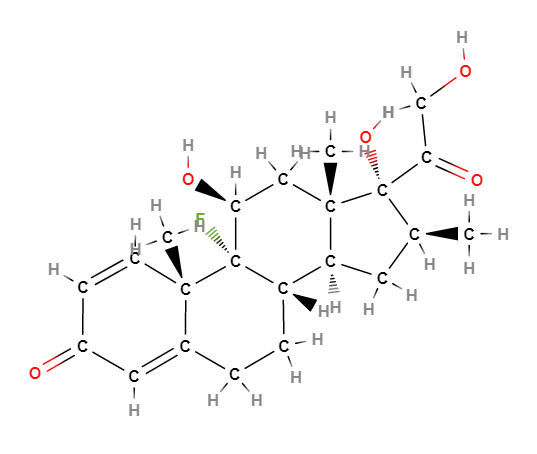 | 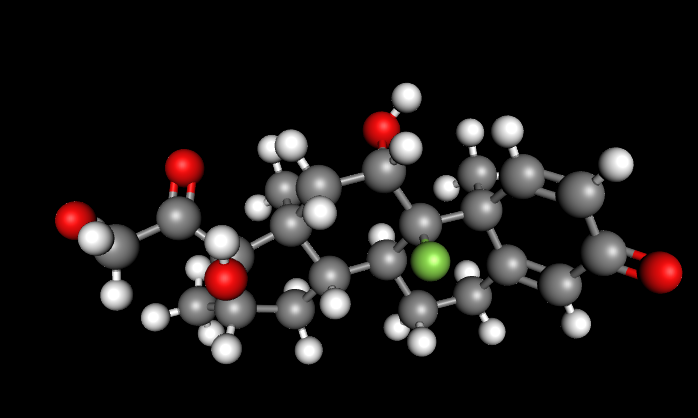 |
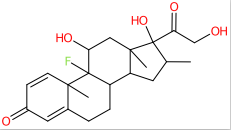
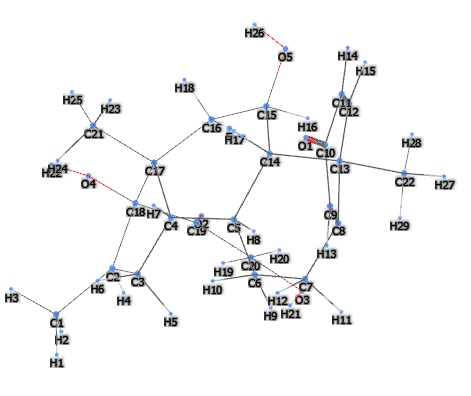
- Molecular Formula C22H29FO5
- Molecular Weight 392.5
- Exact Mass 392.199890
- CAS 378-44-9
- UNII 9842X06Q6M
- EC Number 206-825-4
- DSSTox Substance ID DTXSID3022667
- IUPAC (8S,9R,10S,11S,13S,14S,16S,17R)-9-fluoro-11,17-dihydroxy-17-(2-hydroxyacetyl)-10,13,16-trimethyl-6,7,8,11,12,14,15,16-octahydrocyclopenta[a]phenanthren-3-one
- InChI=1S/C22H29FO5/c1-12-8-16-15-5-4-13-9-14(25)6-7-19(13,2)21(15,23)17(26)10-20(16,3)22(12,28)18(27)11-24/h6-7,9,12,15-17,24,26,28H,4-5,8,10-11H2,1-3H3/t12-,15-,16-,17-,19-,20-,21-,22-/m0/s1
- InChl Key UREBDLICKHMUKA-DVTGEIKXSA-N
- SMILES CC1CC2C3CCC4=CC(=O)C=CC4(C3(C(CC2(C1(C(=O)CO)O)C)O)F)C
- MDL number MFCD00062969
- PubChem Substance ID 329823372
- ChEBI 3077
- NCI C303
- Beilstein 3176546
- RXCUI 1514
- RTECS TU4000000
Synonyms
- Betadexamethasone
- Betamethazone
- Betafluorene
- 9α-Fluoro-16β-methyl-11β,17α,21-trihydroxy-1,4-pregnadiene-3,20-dione
- 9α-Fluoro-16β-methylprednisolone

