



Bathyl alcohol is a biologically active, ether lipid compound that occurs naturally in the oil of some fish such as sharks and marine organisms such as Elasmobranchs, Sarcophyton trocheliophorum, Lobophytum and others. It can also be obtained industrially from the marrow of cattle bones. It is a long-chain alkyl glycerol (glycerol alkyl ethers) with 16 and 18 carbon atoms, saturated in the case of bathyl alcohol. synonymous with 3-(octa-decyloxy)-1,2-propanediol and the monooctadecyl ether of glycerin.
The name defines the structure of the molecule
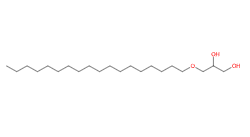
Batyl Alcohol (1-O-Octadecanol) is similar in structure to a fatty alcohol with an 18-carbon chain and two hydroxyl groups. It is a waxy solid at room temperature.
Description of raw materials used in production
Squalene. Batyl alcohol is found in fish oils, especially in shark liver oils.
Step-by-step summary of its industrial chemical synthesis process.
- Fractional Distillation. Fractional distillation is used to separate batyl alcohol from other components of fish oil.
- Oxidation of Squalene. Controlled oxidation of squalene can produce batyl alcohol.
- Extraction from Fish Oils. Batyl alcohol is extracted from fish oils, especially squalene, through a series of separation processes.
- Purification. Purification may include processes like distillation and crystallization to obtain a pure product.
- Chemical Oxidation. Batyl alcohol can also be obtained through the chemical oxidation of squalene, using catalysts and controlled conditions.
It appears as a colourless transparent crystalline liquid.
AWhat it is used for and where
Medical and Pharmaceuticals
Common disorders such as Alzheimer's disease or ischaemic heart disease are also caused by a deficiency of membrane phospholipid plasmalogens. Oral supplementation of bathyl alcohol for two months led to normalisation of cardiac plasmalogen levels (1).
This study considers that bathyl alcohol by plasmalogen enrichment may represent a valid therapeutic strategy to prevent atherosclerosis and reduce the risk of cardiovascular disease (2).
The structure of long-chain alkyl alcohols has demonstrated a clear permeation effect on human skin such that, together with alkylglycerols, it is considered a new class of modulators of skin penetration (3).
Cosmetics
Surfactant - Emulsifying agent. Emulsions are thermodynamically unstable. Emulsifiers have the property to reduce the oil/water or water/oil interfacial tension, improve emulsion stability and also directly influence the stability, sensory properties and surface tension of sunscreens by modulating their filmometric performance.
Skin conditioning agent - Occlusive. This ingredient has the task of modifying the condition of the skin when it is damaged or dry by reducing flaking and restoring elasticity. It has a strong lipophilic character and is identified as an occlusive ingredient; it is generally composed of oily and fatty materials that remain on the skin surface and reduce trans epidermal water loss.
For more information:
Typical commercial product characteristics Batilol
| Appearance | Transparent colorless crystalline liquid |
| Boiling Point | 471.1ºC at 760 mmHg |
| Melting Point | 71-73 °C |
| Flash Point | 238.7ºC |
| Density | 0.914g/cm3 |
| PSA | 49.69000 |
| LogP | 5.61770 |
| Refraction Index | 1.464 |
| Storage | -15°C |
| Safety |  |
 |  |
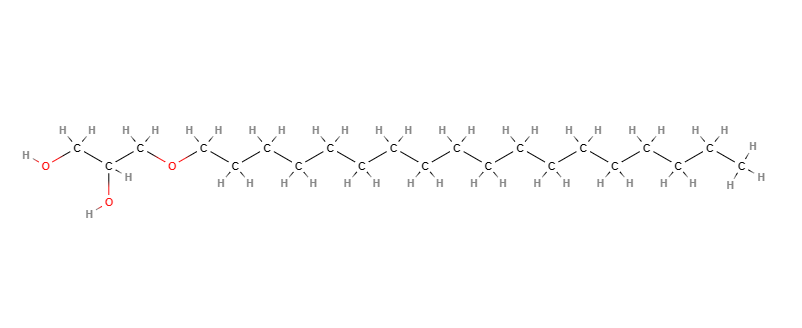 | 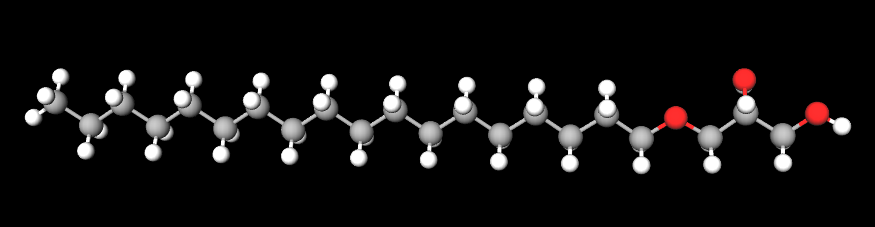 |
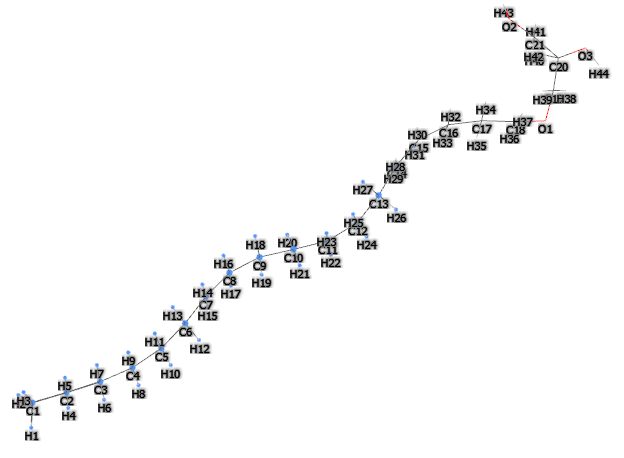
- Molecular Formula C21H44O3 CH3(CH2)17OCH2CH(OH)CH2OH
- Molecular Weight 344.6
- Exact mass 344.32900
- CAS 544-62-7
- UNII 39YR661C4U
- EC Number 273-607-3 208-874-7
- DSSTox Substance ID DTXSID5028956 DTXSID0047799
- IUPAC 3-octadecoxypropane-1,2-diol
- InChI=1S/C21H44O3/c1-2-3-4-5-6-7-8-9-10-11-12-13-14-15-16-17-18-24-20-21(23)19-22/h21-23H,2-20H2,1H3
- InChl Key OGBUMNBNEWYMNJ-UHFFFAOYSA-N
- SMILES CCCCCCCCCCCCCCCCCCOCC(CO)O
- MDL number MFCD00004720
- PubChem Substance ID 24891746
- ChEBI 34117
- Beilstein 1725677
- NSC 284200 8716
- RTECS TZ0960000
- NACRES NA.22
Synonyms
- Batilol
- Stearyl monoglyceride
- 1,2-Propanediol, 3-(octadecyloxy)-
- Glycerine 1-monostearyl ether
- Batilolum
- Batylol
- 3-(octadecyloxy)propane-1,2-diol

