



Usnea (Usnea barbata)
Usnea barbata is a fruticose lichen formed by a symbiosis between a fungus and a green alga. It typically appears as a hanging, filamentous mass with a branched, hair-like structure, often described as “beard-like.” The thallus is usually grey-green to yellowish-green, with thin, elastic branches that can reach several centimetres in length. When gently stretched, the outer cortex may break, revealing a characteristic white, elastic central cord, a useful macroscopic feature for recognising the genus Usnea.
This lichen grows mainly on the bark of trees, both conifers and broadleaves, in cool, humid environments with good air circulation. It is particularly frequent in forests with low levels of atmospheric pollution, and for this reason it is often considered a useful bioindicator of air quality. The growth rate of Usnea barbata is generally slow, and the development of noticeable tufts indicates stable ecological conditions over time. It does not feed on the host tree: it is an epiphyte, anchored to the bark but obtaining water and nutrients directly from rain, fog and airborne particles.
From a structural point of view, Usnea barbata shows a typical lichen organisation with an outer cortex, an algal layer, a medulla and the central cord. The surface can be finely papillose or slightly rough, and the branching pattern is often more or less dichotomous. The lichen can host various secondary metabolites, among which usnic acid is one of the most characteristic. This compound, together with other lichen substances, contributes to the typical colour and influences some of the biological properties associated with the species.
Ecologically, Usnea barbata participates in nutrient cycles by intercepting particles from the atmosphere and slowly releasing them to the ecosystem through decomposition. Its presence is associated with well-preserved forest habitats and relatively stable microclimatic conditions, making it of interest in ecological monitoring and environmental assessment.
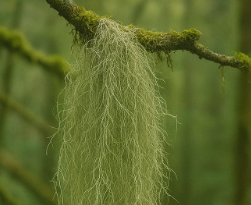 | 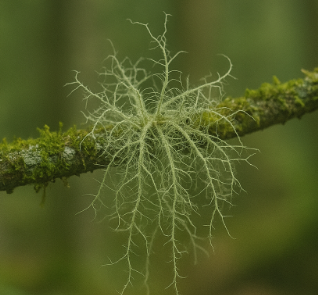 |
Botanical classification
Common name: old man’s beard / beard lichen
Clade: Ascomycota
Order: Lecanorales
Family: Parmeliaceae
Genus: Usnea
Species: Usnea barbata (L.) F.H.Wigg.
Cultivation and growth conditions
Climate
Usnea barbata is typical of temperate and cold regions, characterized by clean air, high atmospheric humidity and moderate temperature ranges. It grows in forests, valleys and mountainous areas with little or no air pollution. It tolerates frost, long periods of moisture and low direct radiation, while it suffers in environments that are excessively hot, dry or contaminated by pollutants.
Exposure
The species prefers shaded or semi-shaded positions, such as woodland with diffuse light. Excessive, direct solar radiation can induce desiccation of the thallus, whereas moderate, constant light combined with sufficient humidity supports regular growth.
Soil
Usnea barbata does not use the soil as a source of nutrients. It attaches to bark of conifers and broadleaves, to rocks or dead wood. Soil properties act indirectly, through their effect on the host vegetation. Healthy trunks with bark that is neither too smooth nor heavily treated (e.g. with chemicals) favour thallus attachment and development.
Irrigation
No artificial irrigation is required. Water supply comes from the atmosphere (rain, fog, dew). High air humidity is fundamental for metabolic activity; very dry air causes thallus dehydration and slows growth. Natural cycles of wetting and drying form part of the normal physiology of lichens.
Temperature
The species tolerates low temperatures and prolonged cold periods. Optimal conditions fall within a broad range, roughly 4–18 °C. Persistent heat, low humidity and air pollution reduce the photosynthetic efficiency of the algal partner within the lichen and limit growth.
Fertilization
No fertilization is needed. As with other lichens, essential nutrients are obtained from the air, from precipitation and from slow mineralization of suspended particles deposited on the thallus. Direct nutrient inputs or fertilizers are unnecessary and may even alter the delicate physiological balance of the symbiosis.
Crop care
True “cultivation” is difficult, since the species depends on very specific environmental conditions. Management is essentially limited to preserving intact habitats, with clean air, high humidity and undamaged host vegetation. Natural lichen communities do not require direct interventions; in human-impacted areas, conservation of woodland and reduction of atmospheric pollution are the main protective measures.
Harvesting
Traditional harvesting consists of collecting mature thalli from their substrates, taking care not to damage the bark of the host and leaving part of the material in place to allow regeneration. The harvested thalli are cleaned of wood fragments and debris, then dried in a shaded, well-ventilated area. Because growth is slow, harvesting should be moderate and sustainable.
Propagation
Propagation occurs mainly by fragmentation of the thallus: small pieces detached by wind, snow or mechanical movement can be transported to new substrates, where they re-attach and regenerate a new lichen individual. Sexual reproduction via spores is also possible but requires stable environmental conditions, constant humidity and long time spans. For controlled colonization, small thallus fragments can be placed on healthy, untreated bark in humid, shaded sites and left to adhere and grow gradually over several years.
Indicative nutritional values per 100 g
(dried material – approximate)
Energy: ~ 200–260 kcal
Water: ~ 6–10 g
Total carbohydrates: ~ 30–45 g (mostly structural polysaccharides)
Dietary fibre: high
Protein: ~ 7–12 g
Total fat: ~ 2–4 g
Minerals: calcium, magnesium, iron, zinc, copper, manganese
Vitamins: traces of antioxidant compounds and water-soluble micronutrients
Values are indicative and strongly influenced by habitat, host tree, and environmental conditions.
Key constituents
Lichen acids: usnic acid (major component), protocetraric acid
Structural polysaccharides and fibre
Polyphenols
Triterpenes
Trace minerals (Ca, Mg, Fe, Zn, Mn)
Trace amounts of essential oil components and natural volatiles
Production process
(for dried crude drug, powders, extracts)
Harvesting
manual collection in clean forest areas
selection of intact, uncontaminated thalli
Cleaning
removal of bark fragments, needles, and wood particles
discarding dark, degraded, or mouldy material
Drying
slow drying in shaded, ventilated conditions
moderate temperatures to preserve usnic acid and other lichen acids
Fragmentation and cutting
tea-cut for herbal use or milling to obtain herbal powders
Optional extraction
hydroalcoholic or hot-water extraction
filtration and concentration for standardized extracts
Storage and packaging
dry, cool, dark conditions
airtight packaging to protect from moisture and oxidation
Physical properties
filamentous, elastic, branched thallus
pale grey-green colour
compact, slightly rubbery texture
pronounced hygroscopic behaviour
typical fruticose lichen aspect (hair- or beard-like tufts)
Sensory and technological properties
mild woodland, slightly resinous aroma
herbal, slightly bitter taste
infusion colour: pale yellow to yellow-green
high water retention capacity of the lichen fragments
suitable for low-dose inclusion in herbal blends
Food applications
(very restricted and essentially herbal)
component of herbal tea blends in very small amounts
traditional herbal infusions based on dried lichen
occasional use in complex phytobotanical preparations
Note: It is not used as a conventional food; use as a household ingredient without expertise is discouraged.
Nutrition and health
The technical and scientific interest focuses mainly on lichen acids, especially usnic acid, as well as polyphenolic fractions and structural fibre. Polysaccharides contribute to the nutritional profile of the dried material, and minerals support cellular and enzymatic functions.
Modern use is essentially herbal, in controlled and dosed preparations. Duration and dosage should follow recognized technical guidelines and professional recommendations.
Portion note
There is no traditional “food portion”.
In herbal tea practice, approximately 1 g of dried Usnea barbata per cup is sometimes used, unless different professional instructions are given.
Allergens and intolerances
not classified as a typical food allergen
possible individual sensitivity to polyphenols or usnic acid
prolonged or high-dose use without professional guidance is not recommended
in topical use, may cause irritation in individuals with very sensitive skin
Storage and shelf-life
store in cool, dry, dark conditions
avoid direct light exposure
close containers carefully after opening
typical shelf-life: about 12–30 months under suitable conditions
Safety and regulatory aspects
not considered a common food
use restricted to herbal and phytoderived preparations
presence of usnic acid requires caution: industrial formulations must declare standardization and technical limits where applicable
compliance with regulations on purity, contaminants, drying processes, traceability, and proper labelling
doses and uses in food supplements must follow applicable regulations and safety evaluations
Labelling
For approved herbal products, labels should state:
name: Usnea / Usnea barbata
plant part used (thallus)
country/area of origin
batch number and expiry or best-before date
directions for use
warnings
any stated standardization in usnic acid or other lichen acids
Troubleshooting
In infusion
weak aroma → slightly increase maceration time (keeping dose controlled)
too bitter taste → reduce the amount or blend with milder herbs
poor clarity → filter through fine mesh or paper filter
In storage
earthy or musty odour → sign of residual or absorbed moisture
marked discolouration → likely due to light exposure or prolonged storage
Main INCI functions (cosmetics)
Usnea barbata Extract may be used as:
skin conditioning component
botanical functional ingredient in “natural concept” products
plant-identity ingredient in herbal-inspired cosmetic lines
Conclusion
Usnea barbata is a fruticose lichen with a distinctive filamentous, “beard-like” appearance and a strong connection to forest ecosystems. Its content of usnic acid, polyphenols, structural fibre, and minerals gives it a technically interesting profile for herbal and cosmetic applications.
Although it is not a direct food ingredient, it can be used in carefully dosed herbal infusions and plant-based formulations, always within the limits defined by regulations and good practice. When harvested responsibly and stored under proper conditions, it represents a light, discreet botanical material consistent with European phytotherapeutic tradition.
Mini-glossary
Usnic acid – major lichen acid in Usnea species, with marked bioactivity; requires careful control of dose and exposure.
Polyphenols – antioxidant plant compounds that contribute to chemical stability and potential biological effects.
Skin conditioning – cosmetic function that improves skin softness, comfort, and surface balance.
Studies
Among its components, the usnic acid, a component that can also induce toxicity (1), is used in supplements for weight loss, dandruff and more.
The aqueous methanolic extract of Usnea barbata has been successfully used as an antibiotic therapeutic agent against infections caused by Lactococcus garvieae on rainbow trout (2).
The extract has demonstrated antifungal properties at concentrations of 10mg ml-1 against Alternaria alternaria, a parasite ascomycetes fungus that attacks the leaves and damages the crops of about 350 plant species and can induce allergies in humans (3).

