Cavolo cappuccio
(Da Brassica oleracea var. capitata, famiglia Brassicaceae)
Descrizione
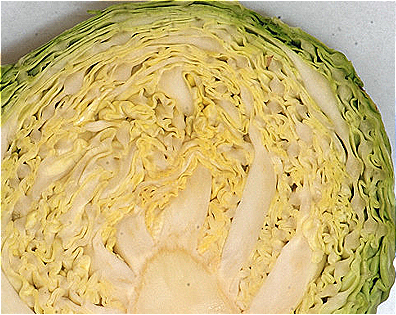
Il cavolo cappuccio è una varietà di Brassica oleracea caratterizzata da una testa compatta formata da foglie sovrapposte e serrate.
Può essere verde o rosso/viola, con sapore da dolce e delicato (varietà verdi) a più deciso e leggermente pungente (varietà rosse).
È consumato crudo (insalate, coleslaw), cotto (stufati, minestre, saltati) o fermentato (crauti, kimchi).
Valori nutrizionali indicativi per 100 g
(cavolo cappuccio crudo)
Energia: 22–30 kcal
Carboidrati: 4–6 g
Fibre: 2–3 g
Proteine: 1–1,5 g
Lipidi: 0,1–0,3 g
Vitamine: vitamina C elevata, vitamina K, folati, piccole quantità di B6
Minerali: potassio, calcio, fosforo, tracce di ferro e magnesio
I valori cambiano in base alla varietà e al metodo di cottura.
Principali sostanze contenute
Glucosinolati (glucobrassicina, sinigrina)
Isotiocianati (prodotti dalla degradazione dei glucosinolati)
Antociani (nel cavolo rosso)
Vitamina C
Vitamina K
Fibre alimentari
Minerali (K, Ca, P)
Processo di produzione
Coltivazione e crescita
Raccolta e selezione
Lavaggio e cernita
Taglio / lavorazioni successive
intero, a spicchi, affettato, julienne, pronto da cuocere o per insalate.
Processi industriali opzionali:
fermentazione per crauti/kimchi;
pastorizzazione per basi cotte;
surgelazione per prodotti pronti.
Confezionamento
Tutte le fasi seguono GMP/HACCP.
Proprietà fisiche
Aspetto: testa compatta di foglie sovrapposte.
Colore: verde chiaro/scuro o rosso–violaceo.
Consistenza: croccante da crudo, morbida dopo cottura.
Umidità: 90–92%.
Proprietà sensoriali e tecnologiche
Impieghi alimentari
Crudo: insalate, coleslaw, contorni.
Cotto: zuppe, stufati, brasati, saltati in padella.
Fermentato: crauti, kimchi, conserve acide.
Industria alimentare: mix di verdure, zuppe pronte, ripieni per ravioli, estratti vegetali.
Nutrizione e salute
Ricco di vitamina C, fibra e composti solforati tipici delle Brassicaceae.
I glucosinolati e i loro derivati (es. isotiocianati) hanno potenziali effetti benefici nel contesto di una dieta equilibrata.
Basso contenuto calorico, adatto a diete ipocaloriche.
Fonte di vitamina K, utile per la coagulazione (attenzione in caso di terapia con anticoagulanti).
Può causare gonfiore in soggetti sensibili ai FODMAP o ai composti solforati.
Nota porzione
Allergeni e intolleranze
Non è un allergene maggiore.
Possibili reazioni in soggetti con allergie crociate alle Brassicaceae.
Possibile fastidio gastrointestinale in soggetti sensibili ai FODMAP.
Conservazione e shelf-life
Fresco intero: 1–3 settimane in frigorifero (0–4 °C).
Affettato/IV gamma: 3–7 giorni in ATM.
Surgelato: 12–24 mesi a –18 °C.
Fermentato: fino a 12 mesi se pastorizzato; 3–6 mesi se non pastorizzato.
Sicurezza e regolatorio
Controlli su:
Per prodotti fermentati: monitoraggio pH, sale, carica lattica.
Produzione secondo GMP/HACCP.
Etichettatura
Troubleshooting
Imbrunimento foglie: ossidazione → ridurre esposizione all’aria, usare ATM.
Odori solforati intensi: cottura troppo lunga → preferire cotture brevi.
Perdita croccantezza: eccesso di umidità → migliorare drenaggio e confezionamento.
Sostenibilità e filiera
Coltura robusta e tipica dei climi temperati.
Impatti principali: consumo d’acqua e uso di fitofarmaci.
Scarti di foglie valorizzabili per compost o mangimistica.
Processi industriali: gestione dei reflui con indicatori BOD/COD.
Principali funzioni INCI (cosmesi)
(come “Brassica Oleracea Capitata Leaf Extract”)
Antiossidante
Skin conditioning
Lenitivo leggero
Purificante
Conclusione
Il cavolo cappuccio è un ingrediente versatile, leggero e ricco di composti funzionali, adatto al consumo fresco, cotto o fermentato.
Grazie al suo profilo nutrizionale e alla buona stabilità in filiera, è molto utilizzato sia nell’alimentazione quotidiana sia nell’industria alimentare.
In filiere controllate secondo GMP/HACCP, rappresenta un ingrediente sicuro, stabile e di elevata qualità.
Mini-glossario
SFA – Saturated Fatty Acids (acidi grassi saturi): da limitare nella dieta; il cavolo ne contiene quantità minime.
MUFA – acidi grassi monoinsaturi: presenti in tracce.
PUFA – acidi grassi polinsaturi: presenti in tracce.
TFA – acidi grassi trans: non presenti naturalmente.
GMP/HACCP – sistemi di gestione per qualità e sicurezza alimentare.
BOD/COD – indicatori dell’impatto dei reflui industriali.
Bibliografia__________________________________________________________________________
Kapusta-Duch J, Kopeć A, Piatkowska E, Borczak B, Leszczyńska T. The beneficial effects of Brassica vegetables on human health. Rocz Panstw Zakl Hig. 2012;63(4):389-95.
Abstract. The products of plant origin are a rich source of biologically active substances, both nutritive and referred as anti-nutritive. A large group of these compounds are substances with antioxidant activity that fights against free radicals. In the family of Brassicaceae vegetables, Brassica, is the largest and most widely consumed a group of plants in Europe and all over the world. They are characterized by different levels of nutrients. However because of their large and frequent consumption, they may become a significant source of nutrients and bioactive compounds in the daily diet. The beneficial effects of Brassica vegetables on human health have been somewhat linked to phytochemicals. They prevent oxidative stress, induce detoxification enzymes, stimulate immune system, decrease the risk of cancers, inhibit malignant transformation and carcinogenic mutations, as well as, reduce proliferation of cancer cells. Brassica vegetables contain a lot of valuable metabolites, which are effective in chemoprevention of cancer, what has been already documented by numerous studies. Due to the presence of vitamins C and E, carotenoids and antioxidant enzymes such as catalase, superoxide dismutase (SOD) and peroxidase, these vegetables are considerable source ofantioxidants, and due to the presence of polyphenols and the sulfur-organic compounds exert also antimutagenic action. Moreover, these vegetables are also rich in glucosinolates, which are unstable compounds and undergo degradation into biologically active indoles and isothiocyanates under the influence of enzyme presented in plant tissues- myrosynase. These substances through the induction of enzymatic systems I and II phase of xenobiotics metabolism may affect the elimination or neutralization of carcinogenic and mutagenic factors, and consequently inhibit DNA methylation and cancer development. Despite many healthy benefits upon eating of cruciferous vegetables, it has been also seen a negative impact of their certain ingredients on the human body.
Rokayya S, Li CJ, Zhao Y, Li Y, Sun CH. Cabbage (Brassica oleracea L. var. capitata) phytochemicals with antioxidant and anti-inflammatory potential. Asian Pac J Cancer Prev. 2014 Jan;14(11):6657-62. doi: 10.7314/apjcp.2013.14.11.6657.
Abstract. Background: The objective of this study was to investigate antioxidant and anti-inflammatory activity of cabbage phytochemicals. Materials and methods: Color coordinates were evaluated by colorimetry, and the antioxidant and anti-inflammatory activities were analyzed by spectrophotometer for some common cabbage varieties. Results: Red heads had the highest total antioxidant contents followed by Savoy, Chinese and green heads. The Chinese variety had the highest ABTS (2,2-azino-di-(3-ethylbenzthiazoline-sulfonic acid) antioxidant activity, was 5.72 μmol TE/g fw (Trolox equivalent). The green variety had the highest DPPH (free radical scavenging activity) antioxidant activity, which was 91.2 μmol TE/g fw. The red variety had the highest FRAP (ferric reducing antioxidant power) antioxidant activity, which was 80.8 μmol TE/g fw. The total phenol amounts were 17.2-32.6 mM trolox equivalent antioxidant capacity (TEAC) and the total flavonoid amounts were 40.0-74.2 mg quercetin per gram. Methanolic extracts of different cabbage heads showed different anti-inflammatory activity values. Chinese, Savoy and green heads had the highest anti-inflammatory activity, while red heads had the lowest. Conclusions: The results suggest that these varieties of cabbage heads could contribute as sources of important antioxidant and anti-inflammatory related to the prevention of chronic diseases associated to oxidative stress, such as in cancer and coronary artery disease.
Lučić D, Pavlović I, Brkljačić L, Bogdanović S, Farkaš V, Cedilak A, Nanić L, Rubelj I, Salopek-Sondi B. Antioxidant and Antiproliferative Activities of Kale (Brassica oleracea L. Var. acephala DC.) and Wild Cabbage (Brassica incana Ten.) Polyphenolic Extracts. Molecules. 2023 Feb 15;28(4):1840. doi: 10.3390/molecules28041840.
Abstract. Brassicaceae are rich in healthy phytochemicals that have a positive impact on human health. The aim of this study was to analyze the phenolic compounds and antioxidant and anticancer potential of traditional Croatian kale (Brassica oleracea L. var. acephala DC.) and wild cabbage (Brassica incana Ten.) extracts. The phenolic groups and antioxidant activity were determined by spectrophotometry, selected phenolic compounds (ferulic acid, sinapic acid, salicylic acid, kaempferol, and quercetin) were analyzed by LC-MS/MS, and anticancer potential was evaluated in vitro using HeLa cells. The extracts of both plant species are rich in phenolic compounds and showed significant antioxidant activity at similar levels. LC-MS/MS detected sinapic acid as the most abundant phenolic acid, followed by ferulic acid, while salicylic acid was present at lower concentrations. A comparative analysis showed that wild cabbage contained significantly more sinapic acid, while kale contained more kaempferol and quercetin. Both Brassica extracts at a concentration of 50 µg mL-1 showed an antiproliferative effect on HeLa cells, while they did not affect the proliferation of normal human skin fibroblasts. Wild cabbage extract also showed an antiproliferative effect on HeLa cells at a lower applied concentration of 10 µg mL-1 of extracts. The clonogenic analysis also revealed the inhibitory effect of the extracts on HeLa colony growth.
Morales-López J, Centeno-Álvarez M, Nieto-Camacho A, López MG, Pérez-Hernández E, Pérez-Hernández N, Fernández-Martínez E. Evaluation of antioxidant and hepatoprotective effects of white cabbage essential oil. Pharm Biol. 2017 Dec;55(1):233-241. doi: 10.1080/13880209.2016.1258424.
Abstract. Context: There have been no reports of the extraction of essential oil (EO) from white cabbage [Brassica oleracea L. var. capitata (L.) Alef. f. alba DC. (Brassicaceae)] (Bocfal) or its chemical composition, antioxidant activity, or hepatoprotective effects. Objective: To extract Bocfal EO, to identify and quantify its chemical components, to assess their antioxidant capacity, and to evaluate the hepatoprotective properties of Bocfal EO. Materials and methods: Bocfal EO was obtained using hydrodistillation (200 mm Hg/58 °C). The chemical composition was analyzed using GC-MS and was quantified using GC-FID. The antioxidant activity of Bocfal EO and its main constituents was evaluated using TBARS in rat brain homogenates. A Bocfal EO hepatoprotective effect (192 mg/kg) on acute carbon tetrachloride (CT)-induced liver damage was determined in rats using biochemical markers and histological analysis. Diallyl disulphide (DADS) (1 mmol/kg) was used as a control for comparison. Results: Bocfal EO contained organic polysulphides (OPSs), such as dimethyl trisulphide (DMTS) 65.43 ± 4.92% and dimethyl disulphide (DMDS) 19.29 ± 2.16% as major constituents. Bocfal EO and DMTS were found to be potent TBARS inhibitors with IC50 values of 0.51 and 3 mg/L, respectively. Bocfal EO demonstrated better hepatoprotective properties than did DADS (p < 0.05), although both slightly affected the hepatic parenchyma per se, as observed using histopathology. Discussion and conclusion: The antioxidant properties of Bocfal EO and DMTS may be the mechanism of hepatoprotective action; the parenchymal disturbances by Bocfal EO or DADS alone may be related to the high doses used.




