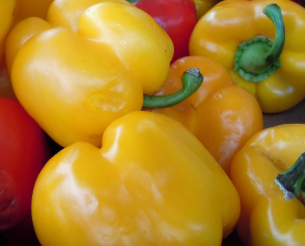
Peperone giallo (Capsicum annuum)
Frutto della famiglia Solanaceae, raccolto in stadi di maturazione diversi (verde = immaturo; giallo/arancio/rosso = maturo). Comprende tipologie blocchetti/bell, corniformi/corallo, quadrangolari e varietà a polpa sottile (da essiccazione). È impiegato fresco, arrostito/affumicato, conservato (grigliato in olio, in salamoia/sott’aceto), essiccato (es. paprika) e come estratto colorante.
Valore calorico (per 100 g, parte edibile)
~20–31 kcal • Acqua ~90–93 g • Carboidrati ~4–6 g (prevalenza glucosio/fruttosio) • Fibre ~1,5–2,5 g • Proteine ~0,9–1,3 g • Grassi ~0,2–0,4 g • Sodio ~2–5 mg.
Vitamina C molto elevata (verde ~80–120 mg, rosso ~120–150+ mg/100 g); carotenoidi provitamina A più alti nei rossi/arancio.
Principali sostanze contenute
Carotenoidi: nei rossi capsantina, capsorubina, β-carotene; nei gialli violaxantina, luteina; nei verdi clorofille.
Composti volatili: metossipirazine (es. IBMP → nota “verde”), terpeni leggeri, aldeidi C6.
Polifenoli: quercetina, luteolina (soprattutto in bucce).
Capsaicinoidi: trascurabili nei peperoni dolci (assenza di piccantezza); in alcune cultivar presenti capsinoidi (non piccanti).
Minerali: K, Mn, Cu; nitrati generalmente bassi (↑ se fertilizzazione intensiva).
Profilo lipidico (per 100 g; sempre indicato)
Grassi totali 0,2–0,4 g con quota percentuale prevalentemente PUFA e MUFA ma non significativa ai fini nutrizionali ai normali consumi:
Processo di produzione e trasformazioni
Coltivazione in campo/serra → raccolta per colore target → selezione/lavaggio → uso fresco o processi:
Arrostimento/abbrustolimento → spellatura (rimozione cuticola); confezionamento MAP o in olio/salamoia.
Acidificazione/pickling (pH < 4,6 per sicurezza).
Essiccazione (aria/sole/forno) → paprika; possibile affumicatura (es. pimentón de la Vera).
Estrazione con solventi/olio → estratto di paprika (E160c); standardizzazione ASTA color units.
Proprietà sensoriali e tecnologiche
Aroma: da verde-erbaceo (metossipirazine) a dolce-fruttato nei maturi, con note caramellate/affumicate da arrostimento.
Colore: clorofille (verde) → carotenoidi (giallo/rosso) durante maturazione.
Texture: parete ricca di pectine; blanching/calcio (es. CaCl₂) aiutano a mantenere croccantezza in pickling.
Stabilità colore: i carotenoidi sono liposolubili e sensibili a luce/O₂/calore; l’incapsulazione/olio e antiossidanti (es. tocoferoli/estratto di rosmarino) migliorano la tenuta.
Impieghi alimentari
Crudité, insalate, pinzimonio; soffritti e basi aromatiche; ripieni; grigliati/arrostiti (antipasti, panini); salse (es. ajvar, romesco); sottaceti; paprika come spezia/colore; estratto di paprika (E160c) per colorare snack, formaggi, salse.
Dosaggi indicativi (industria): paprika 0,05–0,5% (secondo ASTA target); estratto E160c secondo resa colore e limiti d’uso locali.
Nutrizione e salute
Basso apporto energetico, alta vitamina C e carotenoidi (nei maturi); fibre utili. Non piccante (assenza di capsaicina). In soggetti sensibili possibile allergia (vedi sotto) o reflusso con grandi quantità crude. (Nessun claim salutistico senza autorizzazione.)
Qualità e specifiche (temi tipici)
Grado di maturazione/colore, consistenza (forza di taglio), °Brix, acidi organici (pH), residui fitosanitari entro MRL, microbiologia su prodotti pronti (assenza patogeni). Per paprika: umidità, ASTA colore, granulometria, aflatossine/ocra (se rilevanti), metalli; per estratto: titolo in tot. carotenoidi, stato ossidativo, solventi residui.
Conservazione e shelf-life
Peperone fresco: 7–10 °C, UR 90–95% (sensibile a chilling sotto ~7 °C: maculature/ammollimento); evitare etilene elevato (accelera senescenza). Arrostiti refrigerati; sottaceto/olio conformi a pH/aw. Paprika: al buio, asciutta (aw bassa), in imballi barriera (basso OTR) per limitare scolorimento; applicare FIFO.
Allergeni e sicurezza
Il peperone non è tra i 14 allergeni maggiori UE, ma sono descritte allergie specifiche (proteina LTP Cap a 1) e cross-reattività (es. betulla/latice–frutta). Rischi microbiologici da contaminazioni post-raccolta (igiene/risciacquo). In conserve acide garantire pH idoneo.
Funzioni INCI in cosmesi
Voci: Capsicum Annuum Fruit Extract, Capsicum Annuum (Paprika) Extract. Ruoli: colorant, antioxidant/skin conditioning (carotenoidi). Evitare fotodegradazione (pack ambra/barriera).
Sostenibilità e filiera
Colture in serra o pieno campo; attenzione a irrigazione e fertilizzazione (lisciviazione). Migliorano l’impronta: IPM (difesa integrata), recupero scarti per carotenoidi/pectine, riduzione plastica in serra, gestione effluenti verso target BOD/COD, imballaggi riciclabili.
Troubleshooting
Nota “verde/erbacea” eccessiva (metossipirazine) → scegliere frutti maturi, applicare arrostimento/pelatura; bilanciare con acidi e dolcezza.
Scolorimento paprika/estratto → luce/O₂/calore → usare pack barriera, ridurre T, aggiungere antiossidanti consentiti.
Molle in pickling → pectine degradate → blanching breve, aggiunta CaCl₂, controllo pH e T di processo.
Imbrunimento/odori cotti → sovracottura → cotture brevi e finitura a T moderata.
Conclusione
Il peperone dolce combina basso apporto calorico, elevata vitamina C e colore ricco di carotenoidi, con grande versatilità applicativa dal fresco alla paprika/estratti. La resa dipende da stadio di maturazione, gestione di luce/O₂/calore e tecniche di processo (arrostimento, essiccazione, acidificazione).
Mini-glossario
IBMP — 3-isobutil-2-metossipirazina (nota “verde” del peperone)
ASTA — unità di colore per paprika/estratti
E160c — estratto di paprika (colorante alimentare)
aw/RH — attività dell’acqua / umidità relativa
MAP — modified atmosphere packaging
OTR/DO — tasso di trasmissione dell’ossigeno / ossigeno disciolto
MRL — limiti massimi di residui (fitosanitari)
LTP — lipid transfer protein (allergene Cap a 1)
SFA/MUFA/PUFA (n-6/n-3) — profilo acidi grassi
FIFO — first in, first out
BOD/COD — domanda biochimica/chimica di ossigeno (effluenti)
Studi
Il peperone fresco contiene fenoli, flavonoidi, capsaicinoidi, acido ascorbico, tutti componenti che esercitano un'attività antiossidante. Nel peperone trattato vi sono meno componenti fitochimici e l'attività antiossidante è minore (1). La cottura del peperone sottrae almeno il 60% di vitamina C.
La capsaicina è l'alcaloide che conferisce al peperone il gusto piccante, è un componente con proprietà antiossidanti.
Un estratto ricavato dalle foglie del peperone ha inibito in modo significativo la produzione di citochine infiammatorie, inibito la proliferazione cellulare senza produrre citotossicità e soppresso l'espressione di proteine infiammatorie (2).
Tra i polifenoli presenti, acido caffeico, quercetina e kaempferol hanno le quantità maggiori ed hanno mostrato attività antimicrobica (3).
Dal peperone verde un estratto di polisaccaridi pectici ha mostrato un'attività antineoplastica nel tumore al seno, in vitro ed in vivo (1).
Sono stati selezionati gli studi più rilevanti con una sintesi dei contenuti:
Peperone studi
Bibliografia__________________________________________________________________
(1) Alvarez-Parrilla E, de la Rosa LA, Amarowicz R, Shahidi F. Antioxidant activity of fresh and processed Jalapeño and Serrano peppers. J Agric Food Chem. 2011 Jan 12;59(1):163-73. doi: 10.1021/jf103434u.
Abstract. In this research, total phenols, flavonoids, capsaicinoids, ascorbic acid, and antioxidant activity (ORAC, hydroxyl radical, DPPH, and TEAC assays) of fresh and processed (pickled and chipotle canned) Jalapeño and Serrano peppers were determined. All fresh and processed peppers contained capsaicin, dihydrocapsaicin, and nordihydrocapsaicin, even though the latter could be quantified only in fresh peppers. Processed peppers contained lower amounts of phytochemicals and had lower antioxidant activity, compared to fresh peppers. Good correlations between total phenols and ascorbic acid with antioxidant activity were observed. Elimination of chlorophylls by silicic acid chromatography reduced the DPPH scavenging activity of the extracts, compared to crude extracts, confirming the antioxidant activity of chlorophylls present in Jalapeño and Serrano peppers.
(2) Hazekawa M, Hideshima Y, Ono K, Nishinakagawa T, Kawakubo-Yasukochi T, Takatani-Nakase T, Nakashima M. Anti-inflammatory effects of water extract from bell pepper (Capsicum annuum L. var. grossum) leaves in vitro. Exp Ther Med. 2017 Nov;14(5):4349-4355. doi: 10.3892/etm.2017.5106.
Abstract. Fruits and vegetables have been recognized as natural sources of various bioactive compounds. Peppers, one such natural source, are consumed worldwide as spice crops. They additionally have an important role in traditional medicine, as a result of their antioxidant bioactivity via radical scavenging. However, there are no reports regarding the bioactivity of the bell pepper (Capsicum annuum L. var. grossum), a commonly used edible vegetable. The present study aimed to evaluate the anti-inflammatory effect of water extract from bell pepper leaves on mouse spleen cells, and explore the potential mechanism underlying this effect. The extract was prepared through homogenization of bell pepper leaves in deionized water. The sterilized supernatant was added to a mouse spleen cell culture stimulated by concanavalin A. Following 72 h of culture, the levels of inflammatory cytokines in the culture supernatant were measured using a sandwich enzyme-linked immunosorbent assay system, and levels of inflammatory proteins were assessed using western blotting. The bell pepper leaf extract significantly inhibited inflammatory cytokine production, inhibited cell proliferation without producing cytotoxicity, and suppressed the expression of inflammatory proteins. These results suggest that components of the bell pepper leaf extract possess anti-inflammatory activity. The study of the anti-inflammatory mechanism of bell pepper leaf extract has provided useful information on its potential for therapeutic application.
(3) Mokhtar M, Ginestra G, Youcefi F, Filocamo A, Bisignano C, Riazi A. Antimicrobial Activity of Selected Polyphenols and Capsaicinoids Identified in Pepper (Capsicum annuum L.) and Their Possible Mode of Interaction Curr Microbiol. 2017 Nov;74(11):1253-1260. doi: 10.1007/s00284-017-1310-2.
Abstract. Antimicrobial activity of pepper polyphenols and capsaicinoids (Coumarin, caffeic acid, narangin, kaempferol, rutin, quercetin, capsaicin, and dihydrocapsaicin) against 13 pathogen bacteria and three beneficial strains was studied using the disk diffusion and microdilution methods. In general, phenolic compounds had the most important activity with the highest inhibition zones obtained with caffeic acid (3.5-20.5 mm), quercetin (4.75-3.5 mm), and kaempferol (7-14 mm). In the determination of the minimal inhibitory concentrations, the effects of both quercetin and kaempferol were more important than caffeic acid. The clinical strains Staphylococcus aureus (319, 14, 8, 32, and 550) were more sensitive to quercetin (0.00195-0.0078 mg L-1) whereas kaempferol was more active against the strains S. aureus (ATCC 6538, 26), S. typhimurium ATCC 13311, and Pseudomonas aeruginosa ATCC 27853 (0.0156-0.125 mg L-1). The interaction between these three polyphenols was studied against S. aureus ATCC 6538 and P. aeruginosa ATCC 27853. Different modes of interaction were observed (synergism, additive, and indifferent), but no antagonism was obtained. The best combination was quercetin and caffeic acid for S. aureus with fractional inhibitory concentration index (FICI) of 0.37, and kaempferol with quercetin for P. aeruginosa (FICI = 0.31).
(4) Adami ER, Corso CR, Turin-Oliveira NM, Galindo CM, Milani L, Stipp MC, do Nascimento GE, Chequin A, da Silva LM, de Andrade SF, Dittrich RL, Queiroz-Telles JE, Klassen G, Ramos EAS, Cordeiro LMC, Acco A. Antineoplastic effect of pectic polysaccharides from green sweet pepper (Capsicum annuum) on mammary tumor cells in vivo and in vitro. Carbohydr Polym. 2018 Dec 1;201:280-292. doi: 10.1016/j.carbpol.2018.08.071.
Jang HH, Lee J, Lee SH, Lee YM. Effects of Capsicum annuum supplementation on the components of metabolic syndrome: a systematic review and meta-analysis. Sci Rep. 2020 Dec 1;10(1):20912. doi: 10.1038/s41598-020-77983-2.
Abstract. Metabolic syndrome (MetS) has increasingly gained importance as the main risk factor for cardiovascular diseases and type II diabetes mellitus. Various natural compounds derived from plants are associated with beneficial effects on the incidence and progression of MetS. This study aimed to evaluate the effects of Capsicum annuum on factors related to MetS by assessing randomized controlled trials (written in English). We searched the online databases of PubMed, Embase, Google scholar, and Cochrane Library up to April 2020. 'Patient/Population, Intervention, Comparison and Outcomes' format was used to determine whether intervention with C. annuum supplementation compared with placebo supplementation had any effect on the components of MetS among participants. We considered standardized mean differences (SMD) with 95% confidence intervals (CI) as effect size measures using random-effects model. Analysis of the included 11 studies (n = 609) showed that C. annuum supplementation had significant effect on low density lipoprotein-cholesterol [SMD = - 0.39; 95% CI - 0.72, - 0.07; P = 0.02; prediction interval, - 1.28 to 0.50] and marginally significant effect on body weight [SMD = - 0.19; 95% CI - 0.40, 0.03; P = 0.09]. However, larger and well-designed clinical trials are needed to investigate the effects of C. annuum on MetS.
Heidmann I, Boutilier K. Pepper, sweet (Capsicum annuum). Methods Mol Biol. 2015;1223:321-34. doi: 10.1007/978-1-4939-1695-5_26.
Abstract. Capsicum (pepper) species are economically important crops that are recalcitrant to genetic transformation by Agrobacterium (Agrobacterium tumefaciens). A number of protocols for pepper transformation have been described but are not routinely applicable. The main bottleneck in pepper transformation is the low frequency of cells that are both susceptible for Agrobacterium infection and have the ability to regenerate. Here, we describe a protocol for the efficient regeneration of transgenic sweet pepper (C. annuum) through inducible activation of the BABY BOOM (BBM) AP2/ERF transcription factor. Using this approach, we can routinely achieve a transformation efficiency of at least 0.6 %. The main improvements in this protocol are the reproducibility in transforming different genotypes and the ability to produce fertile shoots. An added advantage of this protocol is that BBM activity can be induced subsequently in stable transgenic lines, providing a novel regeneration system for clonal propagation through somatic embryogenesis.




