



Introduction
Bob Dylan ((Robert Allen Zimmermann born May 24, 1941) is one of the most influential—and, at the same time, most complex—figures in late-twentieth-century popular culture: an artist who pushed the very idea of the “song” toward the density of poetry, narrative, and social commentary. His trajectory spans folk, rock, blues, country, and gospel, with frequent and often disorienting stylistic turns, yet with a consistent core: the centrality of the word (rhythm, imagery, montage of linguistic registers) and an ongoing search for musical forms capable of carrying ambitious texts.
From minnesota to new york (1941–1962)
Raised between Duluth and Hibbing, Minnesota, Dylan developed his early musical identity through rock’n’roll and American vernacular music, learning guitar and harmonica and playing in youth bands. The adoption of the stage name “Dylan” took shape within the university and bohemian environment of Minneapolis, as his attraction to traditional song, blues, and literary imaginaries (from the Beat Generation to modernist poetry) intensified.
In 1961 he moved to New York, immersed himself in the Greenwich Village club circuit, and signed a recording contract that led to his debut “Bob Dylan” (1962). This period established enduring traits: an anti-rhetorical vocal delivery, elastic phrasing, and the use of tradition as material to be reshaped.
The folk era and the song as public conscience (1963–1964)
Between 1963 and 1964 Dylan became a key reference point for the American folk scene, at a time when songwriting also functioned as a vehicle for civic debate. His writing alternated invective, moral parable, first-person narrative, and emblematic characters: not merely “protest songs,” but a language laboratory that challenged standard pop forms. This phase was also decisive for his public reception: Dylan was cast as a generational spokesperson, a role he would repeatedly reject in subsequent years through stylistic shifts and artistic personas.
The electric turn and the reinvention of rock (1965–1966)
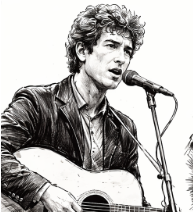
In 1965–1966 Dylan carried out the most famous transition of his career: from a predominantly acoustic folk setup to a language integrating electric instruments and a rock framework—while preserving the literary ambition of his lyrics. Albums such as “Bringing It All Back Home” and “Highway 61 Revisited” (1965) and “Blonde on Blonde” (1966) became historical pivots because they demonstrated how rock could sustain complex lyric structures, visionary imagery, and a new freedom of meter and narrative.
This phase also generated a new performance grammar: intense touring, polarization between “purists” and supporters of electrification, and a media centrality that helped build the myth of an “ungraspable” Dylan.
Withdrawal, reinventions and maturation (late 1960s–1970s)
After the hyper-exposure of the mid-1960s, Dylan entered a period of artistic repositioning. In the 1970s he released pivotal works such as “Blood on the Tracks” (1975), often interpreted as a high point of indirect autobiographical writing: personal material is “transformed” into fiction through characters and scenes that create meaning via imagery and narrative fractures. In parallel, Dylan cultivated extra-musical output (for example “Tarantula,” 1971) and, later, an atypical autobiography (“Chronicles,” 2004), constructed as episodic, selective memory.
From the late 1980s to the “never ending tour”: the artist as continuous performer (1980s–2010s)
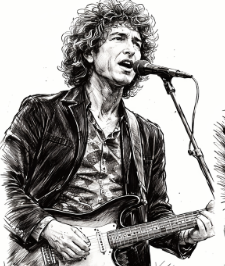
From the late 1980s onward, Dylan consolidated the idea of touring as a near-permanent practice (often discussed publicly under the label “Never Ending Tour”), turning the concert into a site of rewriting: changing arrangements, recontextualized songs, variable vocal registers, and a deliberately non-didactic relationship with the audience. In the studio, a mature peak is often associated with titles viewed as artistic “rebirths”: “Oh Mercy” (1989), “Time Out of Mind” (1997), and “Modern Times” (2006).
Institutionally, Dylan has also been recognized as a foundational figure in rock history: he was inducted into the Rock & Roll Hall of Fame (1988).
The 2000s–2020s: cross-domain recognition and the “literature” question
In 2008 Dylan received a Special Citation from the Pulitzer Prize, citing his profound impact on popular music and American culture and the poetic power of his lyrics.
In 2012 he was awarded the Presidential Medal of Freedom; in the official context, the White House emphasized the reach of his voice and his ability to redefine not only sound, but also what popular music can “say.”
The strongest collision between song and literature arrived with the Nobel Prize in Literature in 2016, awarded “for having created new poetic expressions within the great American song tradition.” The prize formalized, on a global scale, a debate that had accompanied Dylan for decades: to what extent can a text designed to be sung be read as literature.
In the Nobel Lecture (published in 2017), Dylan addressed the theme directly, reflecting on the relationship between songwriting and works such as “Moby-Dick,” “All Quiet on the Western Front,” and “The Odyssey,” and reiterating that the song fully lives as performance rather than as an isolated page.
Cinema and other languages: the oscar and the “american” dimension
Dylan has repeatedly intertwined his music with film and audiovisual media. An emblematic moment is the Academy Award for Best Original Song: “Things Have Changed,” from the film “Wonder Boys,” winner at the 73rd ceremony (2001).
In parallel, the public, institutional valorization of his work has taken on a significant form through the Bob Dylan Center in Tulsa, opened in May 2022, which houses and presents an extensive collection of materials (manuscripts, notebooks, recordings, objects, and documents) connected to his creative activity.
Dylan’s writing: techniques, themes, innovations
Dylan’s specificity cannot be reduced to a single “genre.” Some recurring elements help describe his literary and musical force:
Register montage: alternation of everyday language, biblical imagery, reportage, surrealism, slang, implicit quotation, and traditional formulas.
Scene-based narration: many songs function like short stories or cinematic sequences, with characters entering and leaving without explanation, generating meaning through juxtaposition.
Programmatic ambiguity: Dylan often constructs texts that resist a single interpretation, enabling historical, psychological, and symbolic readings in parallel.
Reworking tradition: melodies, idioms, and themes of American music (folk, blues, country, gospel) are treated as a “lexicon” to reorganize, not as a repertoire to preserve.
Key works and discographic turning points (curated selection)
Without replacing a complete discography, some titles are commonly considered “turning points” for understanding evolutions and ruptures:
1960s: “Bringing It All Back Home” (1965), “Highway 61 Revisited” (1965), “Blonde on Blonde” (1966).
1970s: “Blood on the Tracks” (1975).
Late 1980s–1990s: “Oh Mercy” (1989), “Time Out of Mind” (1997).
2000s: “Modern Times” (2006).
2020s: “Rough and Rowdy Ways” (released June 19, 2020), widely perceived as a return to expansive original songwriting after years that also included projects devoted to the American standards tradition.
Recent live activity: continuity and transformation
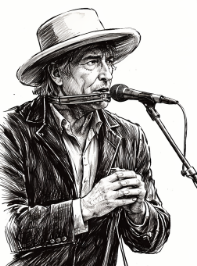
In the period following 2020, Dylan connected his most recent studio phase to a concert cycle that began in November 2021 and continued with extensions and newly announced legs in subsequent years—confirming the centrality of performance as a “second writing” of the songs.
Cultural legacy: what remains of dylan today
Dylan’s legacy can be measured on three levels, which reinforce one another:
Language: he normalized, within pop and rock, the idea that a text can be dense, allusive, and layered without ceasing to be a song.
Album form and concert form: he showed that the album can function as a coherent poetic corpus and that live performance can radically rewrite the repertoire.
Institutionalization without domestication: awards such as the Nobel, Pulitzer, and Medal of Freedom certify his historical weight; yet Dylan maintains an artistic posture that resists definitive “explanation,” sustaining a vast critical field (also supported by archives and dedicated study centers).
Albums

