



U2, complete biography, global Irish rock, monumental tours, cultural engagement, and discography
Profile
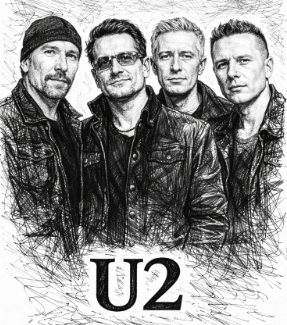
U2 is an Irish rock band formed in Dublin in 1976. The historic lineup consists of Bono (vocals), The Edge (guitar, keyboards), Adam Clayton (bass), and Larry Mullen Jr. (drums). Over more than four decades, the band has built a recognizable identity grounded in three pillars: songwriting shaped around rock anthems, a sonic research path that moves across multiple seasons of contemporary pop-rock, and a live dimension often designed as a cultural event on a global scale.
U2 stand apart from many peers for their ability to combine continuity and transformation: from post-punk roots to an “arena rock” phase, from the electronic and industrial reinventions of the 1990s to the recording maturity of the new millennium, while keeping The Edge’s guitar as a timbral signature and Bono’s voice as the main narrative vehicle.
Historical context and the band’s formation (mid-1970s)
U2’s formation takes place in an Ireland marked by social and political tension, with a generation of young musicians drawn to punk for its urgency and its idea of accessibility: technical “academic” perfection is not required to build a band, but vision, identity, and intensity are.
The group begins as an adolescent project and grows rapidly through rehearsals, small gigs, and strong internal cohesion. From the start, several traits emerge that will become structural:
attention to dynamics (gradual build-up, climax),
the search for a non-traditional guitar sound,
lyrics oriented toward existential, social, and spiritual themes.
Early years: from post-punk to defining a language (1979–1983)
The first recording phase places U2 within the post-punk perimeter, but with an immediate tendency toward an “epic” rock-song form. In these years, the band builds its vocabulary:
drums with recognizable, driving patterns,
bass that is often melodic and structural,
guitar with delay and arpeggios as an identity marker,
vocals shaped around intensity and emotional tension rather than virtuosity.
Albums such as Boy and October define a band in growth, while War consolidates the ability to transform urgency and impact into a larger language suitable for an international audience.
From artistic growth to the global leap (1984–1987)
In the mid-1980s, U2 begin a process of sonic and conceptual expansion: production becomes more atmospheric, songs more layered, and the imagery more cinematic. It is a phase in which the band understands that identity is built not only in the song, but also in the surrounding sonic, visual, and narrative “frame.”
With The Joshua Tree (1987), U2 reach a global and symbolic scale: the album consolidates the idea of a band able to combine stadium rock, authorial sensibility, and a strong cultural tension. International success translates into high-impact tours and unprecedented media centrality for a European band.
Late 1980s: the relationship with America and staging the myth (1988–1990)
After the late-1980s peak, U2 enter a phase of reflection on their relationship with American imagery and with their own monumentality. The point is not “change for the sake of change,” but avoiding self-parody: when a band becomes an institution, the risk is repeating a winning formula until it is exhausted.
This tension sets up one of the most important transformations in their history.
Radical reinvention: the 1990s between rock, electronics, and irony (1991–1999)
With Achtung Baby (1991), U2 radically change skin: guitars become more physical and distorted, structures more sensual and fragmented, and production absorbs electronic and industrial influences. This shift also completes itself on the performance side: live is not only a concert, but multimedia theater, satire of the rock icon, and critique of mass communication.
The phase continues with albums such as Zooropa and Pop, pushing experimentation further: electronics, groove, loops, fragmentation, and a different way of conceiving the rock anthem. It is a period that divides part of the audience, but confirms U2 as a band willing to take risks even when it is not “necessary” to do so.
Return to essentials and new stability (2000–2009)
At the start of the new millennium, the band returns to more direct songwriting and a tighter rock sound. The choice is not a simple “return to the past,” but a reconfiguration: U2 seek a form of contemporary immediacy, with more linear songs and a different balance between experimentation and accessibility.
In this phase, the band consolidates a top-tier live reputation, with global tours featuring very high production values, alongside increasingly professional management of the sonic and visual architecture of the shows.
The 2010s: albums, pop-rock identity, and the digital-era relationship (2010–2019)
In the 2010s, U2 continue with less frequent but still central studio output. It is a phase in which:
the band engages with a transformed market (streaming, social media, fragmented consumption),
songwriting leans toward a more refined pop-rock,
the live dimension remains the core of public perception.
Songs of Innocence and Songs of Experience function as a diptych focused on memory, identity, and maturity, in a language designed to remain communicable to very different audiences.
The 2020s: a re-reading project and future prospects (2020–today)
In 2023 the band released Songs of Surrender, a project based on new versions of historic tracks, functioning as a more essential and reflective re-reading of their catalog. It is a choice that highlights a theme typical of artistic maturity: when a discography becomes vast and symbolic, reinterpretation itself can become a creative act.
In parallel, public discussion around U2 includes news and statements about new studio sessions and a possible next album, framed by various press and industry sources as a medium-term objective.
Concerts and the live dimension: the concert as cultural architecture
U2 are among the bands most closely associated with the idea of touring as a total event. In their case, live is not only reproduction of the album, but construction of an experience:
staging as a narrative element,
setlists structured around emotional and political “blocks,”
centrality of collective participation (chorus, call-and-response, anthem),
the ability to adapt historic repertoire to different contexts and phases.
From the 1980s onward, many U2 tours are remembered not only for numbers, but for their aesthetic imprint: the idea that a rock concert can also be a visual, technological, and cultural language.
Musical style (discursive analysis)
U2’s language is built on elements that, combined, produce an immediately recognizable identity:
The Edge’s guitar as a timbral “signature” (delay, arpeggios, textural layering),
bass that is often melodic and structural rather than purely supportive,
drums centered on solid patterns and build-up dynamics,
Bono’s voice as an interpretive axis, oriented toward intensity and stage presence,
songwriting constructed around progressions and climaxes, with strong “anthem” vocation.
Across their trajectory, these elements are repeatedly repositioned in different contexts—post-punk, epic rock, electronic experimentation, contemporary pop-rock—without dissolving the overall identity.
U2 sold about 170 million records.
Official studio albums
Post-punk and new wave period (1980–1983)
| Year | Album | Main tracks |
|---|---|---|
| 1980 | Boy | I Will Follow · Out of Control |
| 1981 | October | Gloria · Fire |
| 1983 | War | Sunday Bloody Sunday · New Year’s Day |
International breakthrough period (1984–1989)
| Year | Album | Main tracks |
|---|---|---|
| 1984 | The Unforgettable Fire | Pride (In the Name of Love) · Bad |
| 1987 | The Joshua Tree | With or Without You · Where the Streets Have No Name |
| 1988 | Rattle and Hum | Desire · Angel of Harlem |
Experimental period and reinvention (1991–1997)
| Year | Album | Main tracks |
|---|---|---|
| 1991 | Achtung Baby | One · Mysterious Ways |
| 1993 | Zooropa | Stay (Faraway, So Close!) · Numb |
| 1997 | Pop | Discothèque · Staring at the Sun |
Return to classic rock sound (2000–2009)
| Year | Album | Main tracks |
|---|---|---|
| 2000 | All That You Can’t Leave Behind | Beautiful Day · Elevation |
| 2004 | How to Dismantle an Atomic Bomb | Vertigo · Sometimes You Can’t Make It on Your Own |
| 2009 | No Line on the Horizon | Get On Your Boots · Magnificent |
Recent and reflective period (2014–2023)
| Year | Album | Main tracks |
|---|---|---|
| 2014 | Songs of Innocence | Every Breaking Wave · Iris (Hold Me Close) |
| 2017 | Songs of Experience | You’re the Best Thing About Me · Get Out of Your Own Way |
| 2023 | Songs of Surrender (re-recordings) | With or Without You (2023) · One (2023) |
Important singles NOT included on studio albums
| Year | Song |
|---|---|
| 1983 | 11 O’Clock Tick Tock |
| 1984 | A Celebration |
| 1985 | The Unforgettable Fire (single edit) |
| 1989 | Sweetest Thing (1998 version later included on a compilation) |
| 1990 | Night and Day |
| 1995 | Hold Me, Thrill Me, Kiss Me, Kill Me |
| 2002 | Electrical Storm |
| 2010 | Ordinary Love |
Major live albums
| Year | Album | Note |
|---|---|---|
| 1983 | Under a Blood Red Sky | Historic live album from the War era |
| 1988 | Rattle and Hum | Live + studio |
| 2000 | U2 Go Home: Live from Slane Castle | Elevation Tour |
| 2017 | Songs of Experience Live | World tour |
Key official compilations
| Year | Album | Content |
|---|---|---|
| 1998 | The Best of 1980–1990 | Includes Sweetest Thing |
| 2002 | The Best of 1990–2000 | Includes Electrical Storm |
| 2006 | U218 Singles | Singles anthology |
| 2010 | Duals | B-sides and collaborations |

