



The Beatles, complete biography, British rock, musical revolution, concerts, and discography
Profile
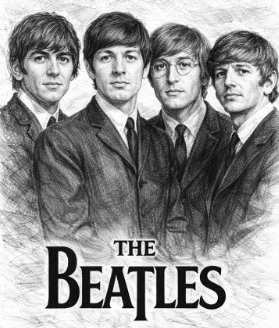
The Beatles are a British rock band founded in Liverpool in the early 1960s, universally regarded as the most influential band in the history of pop and rock music. The classic lineup consists of John Lennon, Paul McCartney, George Harrison, and Ringo Starr.
The Beatles represent an absolute turning point: not only for unprecedented commercial success, but for transforming the very concept of the band, the album, and popular music, profoundly shaping culture, society, and the music industry of the twentieth century.
Historical context and the formation of the band (From the 1950s to 1960)
The Beatles’ emergence took place in a United Kingdom still marked by the post-war period, yet driven by a strong desire for cultural renewal. Liverpool, a port city open to American influences, became a crossroads for:
American rock’n’roll,
rhythm and blues,
British skiffle.
John Lennon founded an early amateur group, joined progressively by Paul McCartney and George Harrison. After various lineup changes and a long apprenticeship, the project took the definitive name The Beatles.
Hamburg and musical development (1960–1962)
A crucial step was the band’s stays in Hamburg, where they played for hours every night in crowded, competitive clubs.
This experience produced decisive effects:
consolidation of the bond among the members,
expansion of the repertoire,
development of strong physical and musical endurance,
definition of a direct, energetic style.
With Ringo Starr joining in 1962, the lineup stabilized definitively.
Beatlemania and global success (1963–1964)
Success exploded rapidly in the United Kingdom and then worldwide. The so-called Beatlemania emerged, an unprecedented phenomenon characterized by:
collective public hysteria,
enormous media exposure,
massive international touring.
The Beatles became the first pop group to exert planetary influence, redefining the relationship between music, media, and youth audiences.
From pop to an authorial language (1965–1966)
In just a few years, the band underwent extraordinarily rapid evolution. Starting from immediate pop forms, the Beatles began to:
write more personal and complex lyrics,
experiment with new harmonic solutions,
expand the use of instruments and studio techniques.
The group also began to perceive the limits of traditional touring, increasingly difficult to manage because of audience noise and the era’s technical infrastructure.
The studio turn and the end of touring (1966)
In 1966 the Beatles definitively stopped live performance. This decision—radical for its time—marked a historic shift: the recording studio became their primary creative instrument.
From that point onward:
the album acquired conceptual value,
music was no longer designed only for the stage,
sonic experimentation became central.
Experimentation and artistic revolution (1967–1968)
In this period the Beatles redefined the boundaries of pop and rock music. The use of:
innovative recording techniques,
psychedelic influences,
non-Western instruments,
unconventional structures,
turned the album into a complex artistic work. The band demonstrated that pop music could be ambitious, conceptual, and culturally significant.
Return to essentials and internal tensions (1968–1969)
After the most experimental phase, the Beatles sought a return to more direct songwriting. However, growing tensions emerged:
artistic divergences,
different personal visions,
difficulties in internal relationships.
Despite this, the group continued to produce material of the highest level, marking a phase of extraordinary creative intensity.
Breakup of the band (1970)
In 1970 the Beatles officially announced the end of the group. The breakup occurred without a farewell tour, but with a clear awareness: the Beatles project had exhausted its function as a collective entity.
Each member pursued a solo career, carrying forward elements of the shared experience.
Musical style (discursive analysis)
The Beatles’ language is characterized by constant evolution:
beginning from rock’n’roll and melodic pop,
progressively increasing harmonic complexity,
growing attention to lyrics,
creative use of the studio as a compositional tool.
Their style cannot be reduced to a single genre: it is a path that moves through pop, rock, folk, psychedelia, and avant-garde, while always maintaining strong melodic identity.
It is the group that has sold the most records ever. The sales statistics say around 800 million albums worldwide.
Discography
Official studio albums (UK canon)
1963–1964 · Beat period
| Year | Album |
|---|---|
| 1963 | Please Please Me |
| 1963 | With the Beatles |
| 1964 | A Hard Day’s Night |
| 1964 | Beatles for Sale |
1965 · Transition period
| Year | Album |
|---|---|
| 1965 | Help! |
| 1965 | Rubber Soul |
1966–1967 · Experimentation
| Year | Album |
|---|---|
| 1966 | Revolver |
| 1967 | Sgt. Pepper’s Lonely Hearts Club Band |
| 1967 | Magical Mystery Tour |
1968–1970 · Final phase
| Year | Album |
|---|---|
| 1968 | The Beatles (White Album) |
| 1969 | Yellow Submarine |
| 1969 | Abbey Road |
| 1970 | Let It Be |
Singles NOT included on the studio albums
(This section includes Hey Jude, Penny Lane, and all other standalone singles.)
1962–1964
| Year | Single |
|---|---|
| 1962 | Love Me Do |
| 1962 | Please Please Me |
| 1963 | From Me to You |
| 1963 | She Loves You |
| 1964 | I Want to Hold Your Hand |
| 1964 | Can’t Buy Me Love |
| 1964 | I Feel Fine |
1965–1966
| Year | Single |
|---|---|
| 1965 | We Can Work It Out / Day Tripper |
| 1966 | Paperback Writer |
| 1966 | Rain |
1967 (psychedelic era)
| Year | Single |
|---|---|
| 1967 | Strawberry Fields Forever |
| 1967 | Penny Lane |
| 1967 | All You Need Is Love |
| 1967 | Hello, Goodbye |
1968–1969
| Year | Single |
|---|---|
| 1968 | Lady Madonna |
| 1968 | Hey Jude |
| 1969 | Revolution |
| 1969 | Get Back |
| 1969 | Don’t Let Me Down |
| 1969 | The Ballad of John and Yoko |
| 1969 | Old Brown Shoe |
1970
| Year | Single |
|---|---|
| 1970 | Let It Be |
| 1970 | You Know My Name (Look Up the Number) |
Official EPs (UK)
| Year | EP |
|---|---|
| 1963 | Twist and Shout |
| 1964 | Long Tall Sally |
| 1965 | Yesterday |
| 1967 | Magical Mystery Tour (UK double EP) |

