



Chris Cornell, complete biography, grunge, soundgarden, audioslave and artistic legacy
Profile
Christopher John Boyle (Seattle, Washington, July 20, 1964 – Detroit, Michigan, May 18, 2017), known professionally as Chris Cornell, was an American singer, guitarist, and songwriter, widely regarded as one of the most recognizable and powerful voices in modern rock history. A central figure in grunge and, more broadly, 1990s alternative rock, Cornell combined vocal intensity, introspective writing, and an ongoing ability to reinvent himself across different musical contexts.
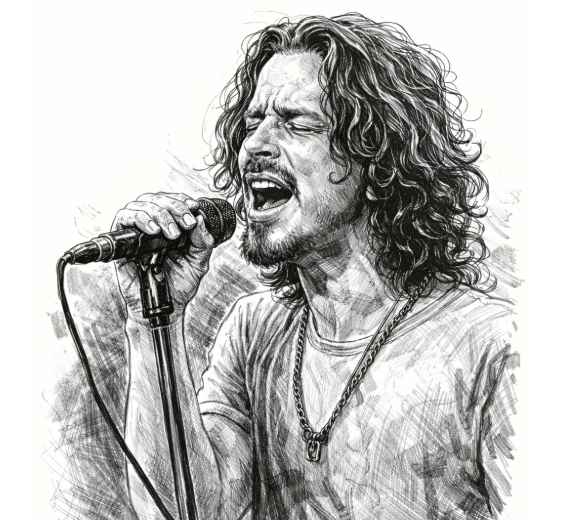
Origins and formation (Seattle, early years)
Raised in Seattle in a complex family environment, Cornell developed a strong interest in music from adolescence, initially as a drummer. His encounter with the city’s underground scene—then in full ferment—proved decisive: punk, heavy metal, and psychedelic rock coexisted and cross-pollinated, creating the ground on which grunge would emerge.
Music also became for Cornell a tool of personal expression and a way to manage inner fragility, a theme that would remain central throughout his artistic output.
Soundgarden and the rise of grunge (1980s–1990s)
Cornell was among the founders of Soundgarden, a band that played a crucial role in the development and spread of grunge. Within the group he soon moved from drums to lead vocals, standing out for range, power, and technical control.
With albums such as “Badmotorfinger” (1991) and especially “Superunknown” (1994), Soundgarden achieved international prominence. The songs combine heavy riffs, unconventional structures, and lyrics charged with existential ambiguity, establishing Cornell as a major songwriter.
The band’s breakup in 1997 closed the first fundamental phase of his career.
Solo path and experimentation (late 1990s)
After Soundgarden, Cornell launched a solo career that highlighted a greater attention to melodic and intimate dimensions. Albums such as “Euphoria Morning” (1999) reveal a more reflective, singer-songwriter side while retaining a strong rock identity.
This phase marked the beginning of a career characterized by continuous changes of perspective, far from a mechanical repetition of past success.
Audioslave: a meeting point between grunge and alternative metal (2000s)
In the early 2000s Cornell became the lead singer of Audioslave, a project formed with three former members of Rage Against the Machine. The result is a sound that blends vocal intensity, groove, and more direct songwriting.
Audioslave achieved strong commercial and radio visibility, demonstrating Cornell’s ability to thrive in a different context without losing recognizability. The project ended in 2007, leaving a compact but widely exposed discography.
Return to soundgarden and final years
In 2010 Soundgarden reunited, releasing the album “King Animal” in 2012. In parallel, Cornell continued his solo activity, also exploring acoustic formats and reinterpretations of his catalog, highlighting interpretive maturity and songwriting quality.
In his final years, he increasingly pursued a direct relationship with audiences, favoring concerts where songs were stripped down and recontextualized.
Vocal style and songwriting
Chris Cornell is often cited for several distinctive characteristics:
Vocal range and power: one of rock’s widest-ranging voices, capable of moving from whisper to controlled scream.
Emotional intensity: performances charged with tension, never purely decorative.
Introspective lyrics: themes related to identity, alienation, pain, and the search for meaning.
Stylistic versatility: the ability to move across grunge, hard rock, alternative, acoustic formats, and more pop-oriented forms without losing coherence.
Essential discography (curated selection)
Soundgarden – “Badmotorfinger” (1991)
Soundgarden – “Superunknown” (1994)
Chris Cornell – “Euphoria Morning” (1999)
Audioslave – “Audioslave” (2002)
Chris Cornell – “Higher Truth” (2015)
Soundgarden – “King Animal” (2012)
Death and posthumous reception
Chris Cornell died in 2017 at the age of 52. His death prompted a widespread reaction within the music world and among listeners, renewing attention to mental health and the emotional pressure associated with an artistic career.
In the following years, his work has been reassessed also in light of the coherence and expressive honesty that ran through his entire career.
Chris Cornell represents a rare balance of technique, expressiveness, and authenticity. He was a signature voice of a generational movement, but also an artist capable of moving beyond the boundaries of grunge, leaving a legacy that continues to influence musicians and audiences well beyond the historical context in which he emerged.

