



Buddy Guy, complete biography, Chicago blues, international concerts, and complete discography
Profile
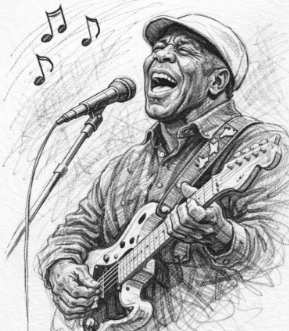
George “Buddy” Guy (Lettsworth, Louisiana, July 30, 1936) is an American guitarist, singer, and bandleader, recognized as one of the leading interpreters of Chicago blues and as a direct link between classic electric blues and modern blues rock.
Buddy Guy has had a documented and sustained influence on generations of blues and rock guitarists, contributing decisively to the evolution of electric-guitar language in the second half of the twentieth century.
Origins and formation (From the 1930s to the 1950s)
Raised in rural Louisiana, Buddy Guy came into contact with:
Delta blues,
gospel music,
Southern African American guitar traditions.
In the 1950s he played in local contexts, developing a style already marked by strong dynamics, expressive use of distortion, and aggressive phrasing, elements that anticipated later blues rock.
From the 1950s: Move to Chicago and entry into the urban scene (1957–1959)
In 1957 Buddy Guy moved to Chicago, where he:
entered the South Side club circuit,
worked as a supporting guitarist for established artists,
was noticed for his stage presence and unconventional approach to the instrument.
In this period he began working with Chess Records, often as a session musician more than as a featured artist.
From the 1960s: Chess Records, experimentation, and underground influence (1960–1969)
The 1960s represent a crucial but complex phase.
Studio activity
Buddy Guy recorded several singles and albums for Chess, but his style was often restrained by more conservative production choices.
Significant tracks
First Time I Met the Blues
Stone Crazy
Ten Years Ago (with Junior Wells)
Live activity
regular concerts in Chicago clubs,
high-intensity performances,
development of a radical guitar style.
In this decade his influence was greater among musicians than in the record market, especially among young British guitarists.
From the 1970s: International recognition and rock audience (1970–1979)
Albums
1968 – A Man and the Blues
1972 – Buddy Guy & Junior Wells Play the Blues
Concerts and countries
In the 1970s Buddy Guy:
performed regularly in Europe,
gained a strong following in the United Kingdom and France,
became a reference point for rock audiences interested in electric blues.
His style, based on feedback, high volume, and physical interaction with the instrument, was recognized as a precursor of modern guitar rock.
From the 1980s: Artistic continuity and role as a blues custodian (1980–1989)
In this period Buddy Guy:
maintained an intense live schedule,
became a central figure in transmitting traditional blues,
supported younger artists as an informal mentor.
Recording success remained limited, but his live reputation grew steadily.
From the 1990s: Critical rediscovery and recording relaunch (1990–1999)
Albums
1991 – Damn Right, I’ve Got the Blues
1993 – Feels Like Rain
1994 – Slippin’ In
These releases marked a turning point:
broad critical acclaim,
renewed international visibility,
institutional recognition and awards.
From the 2000s: Maturity and global consolidation (2000–2009)
Albums
2001 – Sweet Tea
2005 – Bring ’Em In
2008 – Skin Deep
Buddy Guy continued to:
release significant albums,
play at major blues and rock festivals,
collaborate with high-profile artists.
From the 2010s: Latest albums and selective activity (2010–2019)
Albums
2010 – Living Proof
2013 – Rhythm & Blues
2018 – The Blues Is Alive and Well
In later years he gradually reduced touring, while remaining active on stage and in the studio.
Musical style (Practical elements)
Buddy Guy is recognized for:
extreme use of dynamics,
control of feedback and distortion,
unpredictable, vocal-like phrasing,
strong physical interaction with the guitar,
direct influence on blues rock and psychedelic rock.
His approach redefined the expressive possibilities of electric blues guitar.
Discography
Early period / Chess Records (1958–1967)
(A phase dominated by singles and session work; few official LPs at the time.)
Key singles
| Year | Track |
|---|---|
| 1958 | Sit and Cry (The Blues) |
| 1960 | First Time I Met the Blues |
| 1961 | Stone Crazy |
| 1962 | Leave My Little Girl Alone |
| 1965 | My Time After a While |
Transition period and later-issued Chess recordings (1968–1980)
Studio albums
| Year | Album | Main tracks |
|---|---|---|
| 1968 | A Man and the Blues | Mary Had a Little Lamb · Just Playing My Axe |
| 1981 | Stone Crazy! (Chess recordings 1961–1965) | Stone Crazy · I Got a Strange Feeling |
Vanguard Records period / electric blues revival (1991–1998)
Studio albums
| Year | Album | Main tracks |
|---|---|---|
| 1991 | Damn Right, I’ve Got the Blues | Damn Right, I’ve Got the Blues · Five Long Years |
| 1993 | Feels Like Rain | Feels Like Rain · She’s a Superstar |
| 1994 | Slippin’ In | I Smell a Rat · Trouble Man |
| 1996 | Blues Singer | When My Left Eye Jumps · Good Morning Blues |
| 1998 | Heavy Love | Heavy Love · Midnight Train |
Mature period and international recognition (2001–2010)
Studio albums
| Year | Album | Main tracks |
|---|---|---|
| 2001 | Sweet Tea | Baby Please Don’t Leave Me · Done Got Old |
| 2003 | Blues Singer | When My Left Eye Jumps · Hard Time Killing Floor |
| 2005 | Bring ’Em In | Too Soon · Black Night |
| 2008 | Skin Deep | Skin Deep · Hammerhead |
| 2010 | Living Proof | 74 Years Young · Stay Around a Little Longer |
Recent period and career celebration (2013–2022)
Studio albums
| Year | Album | Main tracks |
|---|---|---|
| 2013 | Rhythm & Blues | Best in Town · Messin’ with the Kid |
| 2015 | Born to Play Guitar | Born to Play Guitar · Wear You Out |
| 2018 | The Blues Is Alive and Well | The Blues Is Alive and Well · Bad Day Blues |
| 2022 | The Blues Don’t Lie | I Let My Guitar Do the Talking · We Go Back |
Documentable career facts
Over 60 years of musical activity.
Thousands of concerts in the United States and Europe.
Direct influence on British and American blues rock.
Recognized as a historical bridge between traditional blues and modern rock.

