



John Coltrane, complete biography, modern jazz, spiritual quest and full discography
Profile
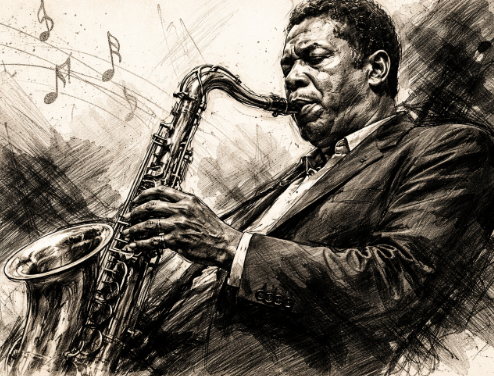
John William Coltrane (Hamlet, North Carolina, September 23, 1926 – Huntington, New York, July 17, 1967) was an American saxophonist, composer, and bandleader, widely regarded as one of the most influential and radical figures in the history of modern jazz. His work moved through hard bop, modal jazz, and the avant-garde, transforming improvisation into a path of formal and spiritual research that redefined the boundaries of the jazz language.
Origins and formation (North Carolina, Philadelphia)
Raised in a family environment shaped by sacred music and African American tradition, Coltrane first gravitated toward the clarinet and then the saxophone. After moving to Philadelphia, he connected with the urban jazz environment, developing a rigorous and systematic study discipline.
Early professional work, including rhythm & blues contexts, helped build a strong technical foundation and a deep sense of time—elements that remained central even in the most experimental phases of his career.
Early recognition and the meeting with Miles Davis (1950s)
In the 1950s Coltrane progressively emerged as a tenor saxophonist with a distinctive voice. Joining Miles Davis’s quintet marked a decisive turning point: there he developed the well-known approach often described as sheets of sound, characterized by harmonic density, rapid phrasing, and continuous forward tension.
At the same time, he went through a personal crisis linked to addiction, overcome toward the end of the decade through a profound ethical and spiritual renewal that would shape his entire subsequent output.
Hard bop and stylistic maturation (1957–1959)
After his work with Davis, Coltrane consolidated his identity through albums that explored hard bop in an increasingly personal manner. This phase defined a balance between harmonic rigor and expressive drive, with growing attention to the internal architecture of improvisation.
His style became progressively more expansive, both in the duration of solos and in formal complexity.
The classic quartet and modal jazz (1960–1964)
With the formation of the classic quartet (McCoy Tyner, Jimmy Garrison, Elvin Jones), Coltrane reached one of the highest peaks in jazz history. The adoption of modal jazz enabled greater improvisational freedom and deep exploration of timbre, rhythm, and intensity.
Albums such as “My Favorite Things,” “Crescent,” and especially “A Love Supreme” offer a unique synthesis of formal discipline and spiritual tension, turning jazz into a medium of transcendent expression.
A Love Supreme: music and spirituality
“A Love Supreme” represents the symbolic core of Coltrane’s poetics. Structured as a four-movement suite, it unites improvisation, composition, and spiritual declaration into a single coherent form.
This work marks a point of no return: music is no longer only an artistic language, but an act of faith, meditation, and inner testimony.
Final phase: free jazz and the avant-garde (1965–1967)
In his final years Coltrane pushed his research into increasingly radical territories, embracing elements of free jazz and breaking traditional structures of harmony and form. The arrival of new musicians and the use of additional instruments further expanded the sonic spectrum.
Often controversial at the time of release, this period was later reassessed as one of the boldest and most visionary phases of twentieth-century jazz.
Musical style and expressive language
Some defining traits of John Coltrane’s style include:
Relentless research: continuous study of scales, harmony, and timbral possibilities.
Improvisational intensity: extended solos as narrative and meditative journeys.
Sound at the center: exploration of multiphonics, altissimo, and extreme dynamics.
Spiritual dimension: music conceived as an ethical and transcendent practice.
Cross-genre influence: lasting impact on jazz, experimental rock, and contemporary art music.
Full discography
Studio albums as leader
1957 – Coltrane
1957 – Blue Train
1958 – Soultrane
1958 – Lush Life
1959 – Giant Steps
1960 – Coltrane Jazz
1960 – My Favorite Things
1961 – Africa/Brass
1961 – Olé Coltrane
1962 – Coltrane
1963 – Ballads
1963 – Impressions
1964 – Crescent
1964 – A Love Supreme
1965 – The John Coltrane Quartet Plays
1965 – Ascension
1966 – Meditations
1966 – Kulu Sé Mama
1967 – Expression
Live albums
1962 – Live at the Village Vanguard
1963 – Impressions (Live)
1965 – Live at Birdland
1971 – Live in Japan (recordings from 1966)
Posthumous and archival releases
1974 – Interstellar Space
1978 – Stellar Regions
1995 – The Classic Quartet: Complete Impulse! Studio Recordings
2005 – One Down, One Up: Live at the Half Note
2018 – Both Directions at Once: The Lost Album
Historical and cultural impact
John Coltrane transformed jazz into a laboratory of continuous research, influencing generations of musicians and reshaping the relationship between technique, expression, and spirituality. His work opened jazz to new formal and philosophical dimensions, making it one of the most advanced musical languages of the twentieth century.
Critical reading: John Coltrane’s contribution to modern music
Coltrane’s contribution can be understood as a radical expansion of musical language, in which improvisation becomes an act of knowledge and spiritual inquiry. His legacy lies not only in technical innovations, but in demonstrating that music can be a path of personal and collective transformation.
Coltrane remains a defining reference for anyone who understands music as research, ethics, and vision.

