



Miles Davis, complete biography, revolutions in modern jazz and complete discography
Profile
Miles Dewey Davis III (Alton, Illinois, May 26, 1926 – Santa Monica, California, September 28, 1991) was an American trumpeter, composer, and bandleader, and an indispensable central figure in the history of modern jazz.
Unlike many of his contemporaries, Miles Davis’s contribution does not rest only on his instrumental style, but above all on his ability to anticipate, catalyze, and lead the major transformations of jazz from the postwar period through the 1980s. Each phase of his career corresponds to a decisive turning point in jazz language.
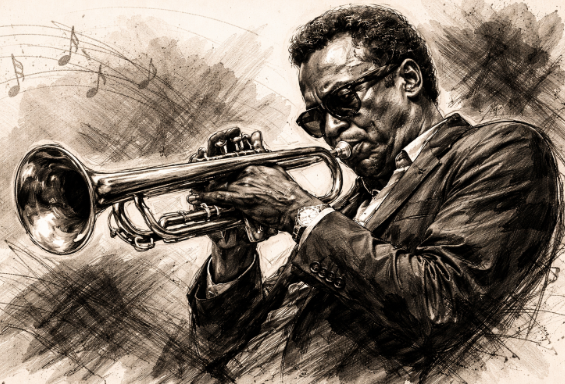
Origins and training (Illinois, New York)
Raised in an affluent family, Davis received formal musical training from adolescence. After early trumpet studies in St. Louis, he moved to New York, where he attended the Juilliard School, while finding the academic environment limiting compared with the vitality of the Harlem scene and 52nd Street.
Direct contact with emerging bebop—especially through Charlie Parker—shaped his artistic direction. Davis soon left academic study to immerse himself fully in professional performance.
Bebop and the encounter with Charlie Parker (1940s)
In the late 1940s, Miles Davis joined Charlie Parker’s group, participating actively in the definition of bebop. In this context he developed an anti-virtuosic trumpet style based on:
controlled, dry tone,
expressive use of space,
essential melodic phrasing.
Already at this stage, a distinctive signature appears: Davis does not compete on speed, but builds a lyrical, introspective, and highly recognizable language.
Birth of the cool and cool jazz (1949–1955)
With the Birth of the Cool project, Miles Davis inaugurated one of the first major stylistic breaks in modern jazz history. The unconventional instrumentation and focus on arrangement marked the rise of cool jazz, characterized by:
softer timbres,
controlled dynamics,
a stronger balance between written material and improvisation.
This phase established a decisive departure from the more aggressive bebop approach and laid the groundwork for a more reflective, structured jazz.
Hard bop and the first great quintet (1950s)
In the mid-1950s, Davis returned to a more energetic language, contributing to the development of hard bop. He formed his first great quintet, featuring young musicians destined to become central figures in jazz.
In this period, Miles Davis refined his role as a leader-curator: he selected strong personalities, left broad creative space, and guided the ensemble through minimal but decisive direction.
Modal jazz and Kind of Blue (1958–1960)
The modal shift represents one of the most important moments in 20th-century music history. With Kind of Blue, Davis introduced an approach based on scales and modes rather than complex harmonic progressions.
This method enables:
greater improvisational freedom,
a focus on tonal color,
more open melodic development.
Kind of Blue became the most influential and best-selling jazz album ever, a cross-genre reference point well beyond jazz.
The second great quintet and post-bop abstraction (1960s)
In the 1960s, Davis led the second great quintet, with very young, highly experimental musicians. Here jazz entered a phase of structural abstraction, in which:
time and harmony become flexible,
form is constructed in real time,
interaction surpasses traditional composition.
This period stands as one of the highest expressions of post-bop jazz.
The electric turn and fusion (1969–1975)
With albums such as In a Silent Way and Bitches Brew, Miles Davis decisively broke with acoustic jazz and opened the door to fusion, integrating:
electric instruments,
rock and funk influences,
open, iterative structures.
Initially contested, this choice redefined jazz’s audience and profoundly influenced contemporary music, from progressive rock to electronic music.
Later years, returns, and final synthesis (1980s–1991)
After a forced hiatus in the 1970s, Davis returned with a hybrid language incorporating funk, pop, hip hop, and urban sonorities. Though divisive, this period confirmed his tendency to engage with the present, rejecting nostalgia.
Musical style and historical role
Key characteristics of Miles Davis:
Primacy of tone over virtuosic technique.
Visionary leadership, grounded in the selection of collaborators.
Capacity to anticipate transformations in jazz language.
Systemic influence: nearly every current of modern jazz passes through his work.
Essential and expanded discography
Studio albums as leader
1951 – The New Sounds
1954 – Walkin’
1957 – ’Round About Midnight
1957 – Miles Ahead
1958 – Milestones
1959 – Kind of Blue
1960 – Sketches of Spain
1963 – Seven Steps to Heaven
1965 – E.S.P.
1967 – Miles Smiles
1968 – Nefertiti
1969 – In a Silent Way
1970 – Bitches Brew
1972 – On the Corner
1981 – The Man with the Horn
1986 – Tutu
1989 – Amandla
Major live albums
1964 – My Funny Valentine
1965 – Live at the Plugged Nickel
1970 – Live-Evil
1975 – Agharta
1991 – Live Around the World
Historical and cultural impact
Miles Davis was the primary evolutionary engine of modern jazz. More than a style, he embodied a method of continuous transformation, demonstrating that jazz is not a static language but an open system capable of absorbing its historical present.
Critical reading: Miles Davis as an architect of modern jazz
Miles Davis’s contribution should be measured not only in discographic or instrumental terms, but as cultural architecture. He created contexts, launched careers, and opened possibilities. His legacy is jazz conceived as process, risk, and vision, not as crystallized tradition.
Miles Davis remains an indispensable figure for understanding not only jazz, but the evolution of modern music itself.

