



Pearl Jam, complete biography, grunge and alternative rock, international concerts, and discography
Profile
Pearl Jam is an American rock band formed in Seattle in 1990, among the historic leading acts of grunge and alternative rock. The core lineup centers on Eddie Vedder (vocals), Jeff Ament (bass), Stone Gossard (rhythm guitar), Mike McCready (lead guitar) and, for a long period, Matt Cameron (drums), with a history marked by drummer changes especially in the first half of the 1990s.
Within the landscape of bands that emerged from the Seattle scene, Pearl Jam stand out for a long, continuous trajectory and for a consistent artistic choice: combining a recognizable sonic identity with a relatively autonomous management of the relationship with industry, media, and the live circuit, while keeping the concert as the main place where the band’s experience is defined.
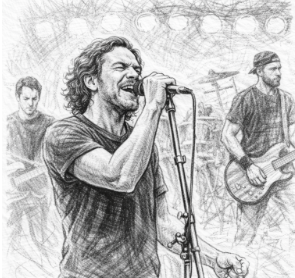
Cultural context and the Seattle scene
Pearl Jam’s rise takes place in the Pacific Northwest, within a musical ecosystem distant from the traditional centers of the industry. The Seattle scene develops in opposition to several dominant traits of 1980s rock:
polished, over-produced aesthetics,
the primacy of image over content,
virtuosity often pursued for its own sake.
In this context, the idea of “authenticity” becomes a cultural axis. In Pearl Jam, that axis takes a specific form: on one side, physical and intensely emotional rock; on the other, a compositional discipline rooted in classic American rock, punk, and hard rock, without collapsing into a single stylistic label.
Origins and formation (1984–1990)
The band’s roots run through the connective tissue of the Seattle scene. Ament and Gossard come from earlier experiences (particularly the orbit of Green River and Mother Love Bone), and the death of Andrew Wood marks a rupture that leads to a recombination of musicians, intentions, and repertoire. McCready joins the developing core and, shortly afterward, the meeting with Eddie Vedder completes the band’s profile.
In the early phase the project also used the name Mookie Blaylock, before settling as Pearl Jam and launching an international-scale recording career.
Early years and definition of the sound (1990–1991)
The first crucial passage is the ability to translate a local scene into a language legible at a large scale. This does not happen through “softening,” but through a precise balance:
energetic riffs and dynamics,
vocal lines capable of sustaining high emotional tension,
writing centered on verse–chorus structures but with an almost “live” intensity.
Ten (1991) is the foundational statement: a debut that consolidates the idea of an “open” alternative rock—melodic yet not domesticated—driven by a vocal identity that is immediately recognizable.
The 1990s: success, creative control, and conflict with the system (1992–1999)
After the initial impact, Pearl Jam confront a theme that becomes central to their story: what to do when a group is born as a cultural response to the mainstream and then, very quickly, finds itself inside the mainstream.
That tension produces a trajectory moving in two complementary directions:
a discography that often seeks solutions less obvious than market expectations;
a management of live activity and public communication aimed at limiting overexposure, avoiding the logic of the band as a “media product.”
Musically, the first half of the decade is marked by albums that expand vocabulary and aggression, alternating immediacy with sharper, more angular choices. In the second half of the 1990s, the group enters a more experimental and, in part, more “album-oriented” phase, where the unity of the record matters as much as (or more than) individual tracks.
In parallel, Pearl Jam become an emblematic case for their willingness to defend conditions of access to concerts and margins of control over the live circuit, in a period when ticketing and promotion dynamics were highly centralized.
Concerts and live culture: identity and continuity
For Pearl Jam, the concert is not an extension of the album but, often, the reverse: it is the primary dimension. The band builds a reputation based on concrete, observable factors:
variable, non-repetitive setlists,
shows often of substantial duration,
centrality of interaction with the audience,
performance quality aimed at making each night distinct.
This approach supports the band’s longevity: it does not depend only on radio rotation or promotional cycles, but on a stable relationship with an audience that follows the group as a live experience.
From 2000 onward: maturity, stability, and recording continuity (2000–2019)
With the arrival and stabilization of Matt Cameron on drums, the band consolidates a long-lasting setup. In these years Pearl Jam:
maintain a regular output of albums,
keep live performance at the center of their identity,
alternate more direct records with others that are more layered.
This is a mature phase in which the band no longer aims for the “revolution” of the early 1990s, but targets qualitative continuity and a coherent, recognizable, still energetic language.
The 2020s: a new recording phase and Dark Matter (2020–today)
In recent years the band releases Gigaton (2020) and then Dark Matter (2024), entering a phase in which writing tends to combine:
more “front-facing” rock energy,
modern production,
attention to the immediate impact of songs in a live context.
Dark Matter is presented as a record designed to feel physical and compact, with a clear emphasis on the band’s collective performance.
Musical style
Pearl Jam’s sound is defined less by a single technical trait and more by a set of coherent structural choices:
strong dynamics, alternating compression and release,
guitars that merge “classic” rock riffing with alternative sensibilities,
voice as a narrative axis, often more interpretive than virtuosic,
lyrics with an intense emotional register, often elliptical, rarely linear in a descriptive sense.
Culturally, the band represents a form of rock that, while becoming popular, retains a “band posture”: primacy of the ensemble, a stage ethic, and attention to coherence and long-term credibility.
Legacy and influence
Pearl Jam’s legacy is measurable on multiple levels:
consolidation of alternative rock as a mass language in the early 1990s,
a model of a long-running band with a strong focus on touring and performance,
influence on American rock, post-grunge, and rock singer-songwriter traditions,
construction of an audience–band relationship based on continuity rather than fashion cycles.
Historically, they are among the few bands of the grunge generation to maintain an active, global profile for over three decades, without relying exclusively on nostalgia for the debut era.
The band has sold about 60 million records.
Debut and global breakthrough period (1991–1993)
Studio albums
| Year | Album | Main tracks |
|---|---|---|
| 1991 | Ten | Alive · Even Flow · Jeremy |
| 1993 | Vs. | Go · Daughter · Animal |
Experimentation and rejection of the mainstream (1994–1998)
Studio albums
| Year | Album | Main tracks |
|---|---|---|
| 1994 | Vitalogy | Better Man · Corduroy · Not for You |
| 1996 | No Code | Who You Are · Hail, Hail · Present Tense |
| 1998 | Yield | Given to Fly · Wishlist · Do the Evolution |
Consolidation and artistic maturity (2000–2006)
Studio albums
| Year | Album | Main tracks |
|---|---|---|
| 2000 | Binaural | Nothing as It Seems · Light Years |
| 2002 | Riot Act | I Am Mine · Save You |
| 2006 | Pearl Jam | World Wide Suicide · Life Wasted |
Artistic continuity and reflection (2009–2013)
Studio albums
| Year | Album | Main tracks |
|---|---|---|
| 2009 | Backspacer | The Fixer · Just Breathe |
| 2013 | Lightning Bolt | Mind Your Manners · Sirens |
Recent period and sonic renewal (2020–present)
Studio albums
| Year | Album | Main tracks |
|---|---|---|
| 2020 | Gigaton | Dance of the Clairvoyants · Superblood Wolfmoon |
| 2024 | Dark Matter | Dark Matter · Wreckage |
Live albums and special projects (selection)
| Year | Album | Note |
|---|---|---|
| 1998 | Live on Two Legs | Highlights from the 1995–1998 tours |
| 2003 | Live at Benaroya Hall | Acoustic performance |
| 2007 | Live at the Gorge 05/06 | Documentation of marathon live shows |
| 2017 | Let’s Play Two | Live in Chicago (Wrigley Field) |
Career note
Pearl Jam are one of the cornerstone bands of the Seattle grunge movement, renowned for their artistic integrity, focus on social themes, and an exceptionally strong live dimension. Their discography shows a steady evolution, from direct, hard-edged rock to more reflective and experimental forms, maintaining lasting relevance in the international rock landscape.

