



Luciano Pavarotti, complete biography, vocal technique and the centrality of bel canto in modern opera
Profile
Luciano Pavarotti (Modena, Italy, October 12, 1935 – Modena, Italy, September 6, 2007) was an Italian lyric tenor, universally recognized as one of the most celebrated and influential voices in the history of opera.
He embodied a rare synthesis of technical perfection, vocal naturalness, and immediate communication, playing a decisive role in bringing opera to a global audience well beyond the traditional boundaries of the opera house.
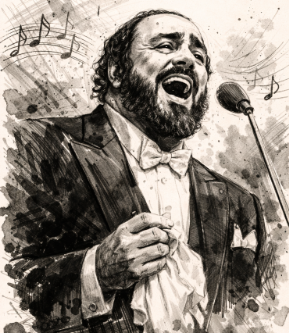
Training and early years (Modena)
Pavarotti grew up in Modena in a family environment strongly connected to singing: his father, an amateur tenor, passed on a deep passion for Italian opera. After initial studies to become a teacher, Luciano devoted himself entirely to singing, refining his craft under Arrigo Pola and later Ettore Campogalliani.
From the outset, his voice revealed a naturally projected profile, with high placement, even registration, and ease in the upper range, qualities that would form the foundation of his future greatness.
Debut and international breakthrough
His operatic debut took place in the early 1960s, but his true international breakthrough came in the following decade, with appearances at the major European and American opera houses.
A key moment in his career was success in bel canto roles, which highlighted:
purity of emission,
precision of intonation,
brilliance of timbre.
From that point on, Pavarotti became a constant presence in the seasons of the most important theaters and festivals.
Bel canto as the center of artistic identity
The core of Pavarotti’s art is Italian bel canto, understood as an ideal balance of technique, expressivity, and vocal naturalness. His preferred repertoire includes works by:
Donizetti,
Bellini,
Rossini,
early Verdi.
His bel canto interpretations stand out for combining technical virtuosity with immediate communicative impact, without expressive forcing or declamatory artifice.
Verdi repertoire and Italian lyric tradition
Alongside bel canto, Pavarotti successfully performed the lyric Verdi repertoire, choosing roles compatible with his vocal profile and consciously avoiding those of excessive dramatic weight.
His approach to Verdi is characterized by:
luminous, sustained legato,
simple and direct phrasing,
consistent attention to the melodic line.
This strategy helped preserve vocal integrity over an exceptionally long career.
Vocal technique and interpretive style
Pavarotti’s technique is often cited as a reference model. His distinctive traits include:
Natural emission free of tension.
High notes that are free, ringing, and perfectly centered.
Timbral homogeneity across the full vocal range.
Clear, intelligible diction, without excessive expressivity.
His interpretive style privileges pure cantabilità, placing the voice at the center of the musical experience.
Recording activity and media reach
Pavarotti built one of the most extensive and widely distributed discographies in opera history, including:
complete opera recordings,
solo recitals,
collections of famous arias.
At the same time, his participation in media events and crossover projects—especially in the later decades of his career—contributed to an unprecedented dissemination of opera, bringing operatic singing to a truly global audience.
Vocal style and distinctive characteristics
Core elements of Luciano Pavarotti’s style:
Sunny, immediately recognizable timbre.
Natural ease in the upper register.
Clarity of emission and phrasing.
Centrality of melody as a primary expressive value.
Direct communicative power, across diverse audiences.
Repertoire and selected discography
Opera
Donizetti – L’elisir d’amore, La fille du régiment
Bellini – I puritani
Verdi – Rigoletto, La traviata, Un ballo in maschera
Puccini – La bohème, Tosca, Turandot
Rossini – Il barbiere di Siviglia
Recitals and solo recordings
The Essential Pavarotti
O Holy Night
Pavarotti & Friends
Ti adoro
Artistic and cultural impact
Luciano Pavarotti played a decisive role in making opera accessible and globally recognizable, without compromising its technical and stylistic foundations. He helped build a lasting bridge between operatic tradition and popular culture, with unprecedented impact.
Critical reading: Luciano Pavarotti as a paradigm of the modern tenor
Pavarotti’s contribution lies in demonstrating that technical perfection can coexist with mass popularity, and that operatic singing can preserve its integrity while engaging with the contemporary world.
Luciano Pavarotti remains a paradigm of the modern tenor, an essential reference for understanding bel canto and the evolution of vocal interpretation in the 20th century.

