



Live lactic cultures are a group of Gram-positive bacteria that turn carbohydrates into lactic acid without using oxygen.
Description of raw materials used in production.
- The primary raw materials are the microorganisms themselves, often stored in lab cultures. These can include Lactobacillus, Bifidobacterium, Saccharomyces, and others.
Step-by-step summary of the industrial production process.
- Begin with the selection and growth of the appropriate microorganisms in a lab setting.
- Once cultivated in adequate quantities, they are inoculated into a suitable substrate (like milk for yogurt).
- The microorganisms are allowed to ferment the substrate for a set period.
- Once fermentation is complete, the product may be further treated or packaged as a finished product.
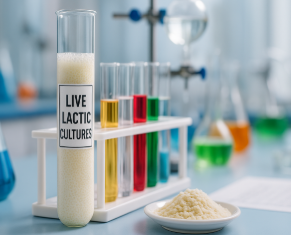
Live cultures are microscopic and thus not visible to the naked eye. When present in products like yogurt, they contribute to the texture and flavor but don't alter the color.
Commercial applications.
They are essential in the production of many fermented foods such as yogurt, kefir, sauerkraut, kimchi, miso, and many fermented drinks.
Food Products. Milk solids are crucial in the production of many dairy products like cheeses, yogurts, and ice creams. They are also used as ingredients in baked goods, chocolates, and candies.
Sports Nutrition. They're utilized in protein powders and dietary supplements due to the high-quality milk proteins.
Medical Applications
Clinical Nutrition. Milk solids can be used in medicinal foods and beverages intended for patients requiring specific or enhanced nutritional intake.
Animal Feed. Often used as ingredients in animal feeds because of their nutritional content.
Some of this group produces only lactic acid, while others produce :
- acetic acid
- ethanol
- carbon dioxide
They are abundant in nature and are essential for human and animal survival.
They are normally present in the skin, digestive system and some mucous where they perform multiple functions, including ensuring tissue protection against the action of harmful microbes.
These functions are so important that many live lactive ferments are called "probiotics" or life-protecting agents.
They are used in a variety of foods and raw materials where they contribute to the flavor of fermented products.
Live lactic cultures – technical food ingredient sheet
Description
Live lactic cultures are viable microorganisms (mainly lactic acid bacteria) able to ferment lactose and other sugars, producing lactic acid.
They mostly belong to the genera Lactobacillus, Lactococcus, Streptococcus thermophilus and Bifidobacterium.
They are used to:
ferment foods (yoghurt, kefir, cheeses)
provide probiotic functions
improve shelf-life, digestibility and safety of foods
A key requirement is that they remain alive and viable in the final product, at the intended dose.
Indicative nutritional values per 100 g
(Since they are microorganisms, live lactic cultures themselves have no meaningful caloric value; data refer to a dried or carrier-based culture blend.)
Energy: 0–10 kcal
Protein: traces (from growth medium residues)
Carbohydrates: traces
Lipids: traces
Minerals: variable (depends on carrier and medium)
Viable cell count: typically 1×10⁹ – 1×10¹¹ CFU/g
Key constituents
Viable bacterial cells of selected strains.
Cell components: peptidoglycan, lipoteichoic acids, phospholipid membranes.
Functional metabolites: lactate, bioactive peptides, exopolysaccharides (EPS).
Technological carriers: maltodextrin, inulin or other supports in freeze-dried powders.
Production process
Strain selection and identification based on safety, technological and probiotic properties.
Controlled fermentation in bioreactors using milk, whey or nutrient broths.
Biomass harvesting by centrifugation.
Concentration and washing to remove residual growth medium.
Stabilisation:
freeze-drying (lyophilisation) or
spray drying (for some applications).
Blending with protective carriers (e.g., inulin, maltodextrin).
Packaging under controlled conditions, often in protective atmosphere and/or under refrigeration.
Production under GMP/HACCP, with controls on:
microbial purity
viability (CFU/g)
genetic identity of the strain
absence of pathogens and undesirable antibiotic resistance.
Physical properties
Appearance: white to off-white powder, fine or granular.
Odour: neutral to slightly lactic/fermented.
Dispersibility: good dispersion in liquids at moderate temperatures.
Viability: highly dependent on water activity, temperature and oxygen exposure.
Sensory and technological properties
Impart acidity, fermented flavour and lactic notes.
Contribute to texture in yoghurts through exopolysaccharide production.
Enable lactic coagulation in fresh cheeses and fermented milks.
Improve shelf-life by lowering pH and inhibiting undesirable microflora.
Some strains help reduce lactose content during fermentation.
Food applications
Yoghurts and fermented milks.
Kefir, buttermilk, skyr and similar products.
Fresh cheeses (e.g., cream cheese, soft cheeses, mozzarella-like products).
Ripened cheeses: contribute to flavour and aroma development.
Probiotic supplements (capsules, sachets, tablets).
Functional foods: probiotic drinks, fermented desserts, ice creams with added cultures.
Reduced-lactose or lactose-free products (through enzymatic degradation by the cultures).
Nutrition & health
Live lactic cultures may support:
gut microbiota balance
lactose digestion (via β-galactosidase activity)
immune modulation
intestinal regularity
reduced incidence or duration of certain mild gastrointestinal discomforts
Effects are strain-specific, dose-dependent and require adequate viability throughout shelf-life.
Generally recognised as safe for the healthy population, with caution only in severely immunocompromised subjects.
Portion note
In fermented foods: typically 10⁷–10⁹ CFU/g in the finished product.
In dietary supplements: 1×10⁹ – 1×10¹¹ CFU per daily dose (or as declared by the manufacturer).
Allergens and intolerances
The cultures themselves are not intrinsic allergens.
Possible presence of MILK traces if grown on dairy-based media.
Gluten-free by nature; any gluten content would derive from carriers or processing aids.
In supplements, additional allergens may be present (e.g., soy, milk, egg) and must be checked on the label.
Storage and shelf-life
Preferably stored refrigerated at 2–8 °C, unless specifically formulated for ambient stability.
Some preparations are shelf-stable at room temperature when packed in protective packaging (foil blisters, moisture-barrier containers).
Avoid:
high humidity
direct light
high temperatures
Typical shelf-life for freeze-dried cultures: 12–24 months.
In fresh fermented foods, viability decreases over time; shelf-life is often limited by sensory as well as microbiological criteria.
Safety & regulatory
Must comply with regulations covering food-use microorganisms and probiotics where applicable.
Strains should be:
taxonomically identified (genetic level)
non-pathogenic
lacking undesirable antibiotic resistance traits
Production follows GMP/HACCP with documented strain history, purity, and viability.
For probiotic claims, some jurisdictions require documentation of:
strain name
CFU count at end of shelf-life
evidence of health effects (strain-specific).
Labeling
Generic declaration in foods: “live lactic cultures” or “live yoghurt cultures”, etc.
For specific probiotic products: listing of genus, species, and strain (e.g., Lactobacillus rhamnosus GG).
Required information:
total CFU per serving up to the end of shelf-life
storage conditions (e.g., “keep refrigerated”)
any allergens from carriers or growth media (e.g., MILK).
Troubleshooting
Low viability at end of shelf-life:
storage temperature too high or high humidity → improve cold chain and packaging.
Poor acidification in dairy products:
under-dosing, wrong temperature or pH → adjust inoculation rate and fermentation profile.
Weak flavour development:
strain not suitable for the desired flavour → select more aromatic strains (e.g., Lactococcus lactis).
Excessive whey separation in yoghurt:
incubation too long or at incorrect temperature → optimise time/temperature; adjust culture blend.
Over-acidification:
excessive fermentation → shorten fermentation time or lower incubation temperature.
Sustainability & supply chain
Overall lower environmental impact compared to many macro-ingredients.
Main energy use is associated with:
fermentation
concentration and freeze-drying
cold storage and distribution
Facilities must manage fermentation effluents and biomass discards, with wastewater treatment monitored via BOD/COD.
By improving food preservation and shelf-life, live cultures can help reduce food waste in the dairy and fermented-food sectors.
Main INCI functions (cosmetics)
(as “Lactobacillus Ferment”, “Bifida Ferment Lysate”, “Lactococcus Ferment Lysate”)
Skin-conditioning
Barrier-supporting and microbiome-balancing
Humectant and soothing action in some formulations
Used in “probiotic-inspired” skincare, serums, creams, and microbiome-friendly products.
Conclusion
Live lactic cultures are a key ingredient for fermented foods and probiotic products, combining technological roles (acidification, texture, shelf-life) with potential health benefits related to gut microbiota and digestion. When strains are properly selected, produced and stored under controlled conditions, they ensure consistent quality, safety and functionality across a wide range of dairy and non-dairy applications.
Mini-glossary
SFA – Saturated fatty acids: present in animal-based substrates, not relevant in pure cultures themselves.
MUFA – Monounsaturated fatty acids: minor components in growth media.
PUFA – Polyunsaturated fatty acids: present only in trace amounts in media.
TFA – Trans fatty acids: not produced by lactic cultures; irrelevant in pure culture powders.
GMP/HACCP – Good Manufacturing Practices / Hazard Analysis and Critical Control Points: quality and safety systems in food production.
BOD/COD – Biological oxygen demand / chemical oxygen demand: indicators of the environmental impact of process wastewater.
CFU – Colony-forming units, a measure of viable microorganisms in a product.

