



Evening primrose (Oenothera biennis L.)
The term evening primrose refers to Oenothera biennis L., a biennial herbaceous species native to North America and now naturalised in many temperate regions, where it colonises sandy, well-drained soils, roadsides, fallow fields and disturbed habitats. In its first year, the plant develops a basal rosette of elongated leaves, and in the second year an erect stem bearing inflorescences with characteristic yellow, cup-shaped flowers, which open mainly in the evening hours. As the fruits (elongated capsules) ripen, they produce the seeds, which are the main part of interest.
From a morphological and agronomic standpoint, evening primrose is valued primarily for its seeds, which are harvested when the plant has completed its vegetative cycle. The seeds are separated from the capsules, dried and sent to subsequent processing stages. The extraction process can be carried out by mechanical pressing or by more sophisticated techniques in order to obtain an oil with consistent characteristics. Pedoclimatic conditions, cultivation practices and harvest timing influence both seed yield and the compositional profile of the oil.
The composition of evening primrose relates mainly to the oil contained in the seeds, which is rich in fatty acids, with a significant presence of linoleic acid and γ-linolenic acid (GLA), along with smaller amounts of oleic acid and other lipid fractions. The seeds also provide fibre, proteins, minerals, phenolic compounds and tocopherols with antioxidant function. Levels of essential fatty acids may vary according to growing area, climatic conditions and extraction parameters.
From a technological perspective, evening primrose is used in the food sector (seeds and oil as nutritional ingredients) and for the production of raw materials destined for herbal preparations, dietary supplements and, to a lesser extent, topical formulations. The quality of the raw material depends on correct species identification, harvesting techniques, drying methods and storage conditions, as well as control of extraction parameters and oil standardisation. In all applications, careful management of the seeds and processing steps is essential to preserve fatty acid content and the technological characteristics that distinguish common evening primrose.
 | 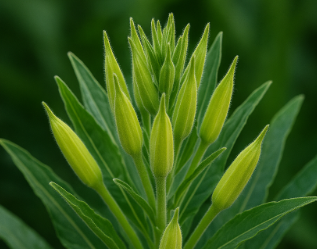 |
Botanical classification (APG IV)
Botanical name: Oenothera biennis L.
Common name: common evening primrose, evening primrose
Family: Onagraceae
Order: Myrtales
Modern clades (phylogenetic):
Angiosperms
Eudicots
Core eudicots
Rosids
Domain: Eukaryota
Kingdom: Plantae
Cultivation and growth conditions
Climate
Common evening primrose is a biennial herb widespread in temperate and cool–temperate regions. It tolerates winter cold and short frost periods, entering vegetative dormancy during the cold season. It prefers summers that are mild to moderately warm and is penalised by very dry conditions with prolonged heat if no water supply is available.
Exposure
The species grows best in full sun, which promotes compact vegetative growth, abundant flowering, and regular seed set. It can adapt to bright partial shade, but excessive shading reduces development of the basal rosette, the emergence of flowering stems, and overall fruit production.
Soil
Evening primrose is quite adaptable, but performs best in soils that are:
Well drained, with no prolonged waterlogging;
Of loam or loam-sandy texture;
Moderately supplied with organic matter;
With a slightly acidic to neutral pH.
Soils that remain waterlogged penalise the deep taproot and increase the risk of root rot. Very poor soils slow growth, while balanced fertility supports vigour, flowering, and seed yield.
Irrigation
The crop benefits from a moderately moist soil:
In the juvenile phase, after germination and during formation of the basal rosette;
In spring, during stem elongation and flower initiation.
Plants tolerate short dry periods, but regular water availability improves flowering and capsule development. Water should be supplied without excess: persistent saturation and high humidity favour root and collar diseases.
Temperature
The favourable temperature range is roughly 10–24 °C.
Cool spring temperatures support the onset of flowering.
Excessively hot, dry conditions may accelerate seed set and shorten the vegetative cycle.
In the rosette (overwintering) stage, plants tolerate temperatures well below 0 °C.
Fertilization
Nutrient demands are not high, but the species responds well to:
Organic amendments (mature compost) to improve soil structure and porosity;
Moderate nitrogen (N) inputs in early stages to support leaf growth;
Adequate phosphorus (P) and potassium (K) to promote root development, balanced growth, and flowering.
Excess nitrogen favours lush vegetative growth at the expense of flowering and capsule formation.
Crop care
Sowing and early management: Evening primrose reproduces readily by seed. Young rosettes must be kept free from competitive weeds that reduce light, water, and nutrients.
Thinning: Useful in seedbeds or dense stands to reduce intraspecific competition and support correct development of the taproot.
Weed control: Preferably by shallow hoeing and organic mulches.
Plant health: The species is generally hardy; problems usually arise only under conditions of high humidity and poor drainage, which can favour fungal diseases.
Harvest
In the typical biennial cycle:
In the first year, the plant forms a basal rosette and develops the root system.
In the second year, it produces flowering stems and inflorescences, followed by capsules containing numerous small seeds.
Capsules are harvested when they are yellow-brown and close to natural dehiscence. For technical uses or seed production, capsules are dried in ventilated, shaded environments and then threshed to extract the seeds.
Propagation
Propagation is almost exclusively by seed:
Autumn or spring sowing, either directly in the field or in seedbeds.
Seeds germinate best in cool, well-worked, light soils.
Timely thinning allows proper rosette development and reduces competition.
Vegetative propagation is not commonly used, as the biennial life cycle makes natural seeding the simplest and most efficient propagation method.
Indicative nutritional values per 100 g (seeds)
Energy: ~550–590 kcal
Protein: ~20–23 g
Total carbohydrates: ~4–6 g
Dietary fibre: ~10–12 g
Total fat: ~52–55 g
SFA: minor fraction of total fat
MUFA
PUFA (predominant fraction, including linoleic acid and gamma-linolenic acid)
Minerals: potassium, calcium, magnesium, phosphorus
Vitamins: vitamin E and small amounts of B-group vitamins
Sodium: very low
Values may vary with variety, growing conditions and seed maturity.
Key constituents
Lipid fraction
high proportion of polyunsaturated fatty acids (PUFA), mainly linoleic acid (omega-6) and gamma-linolenic acid (GLA)
smaller amounts of saturated fats (SFA) and monounsaturated fats (MUFA)
Minor lipid components
tocopherols (vitamin E) contributing to oxidative stability
phytosterols and other unsaponifiable compounds
Non-lipid matrix
dietary fibre and plant cell wall polysaccharides
vegetable proteins with a balanced, though not complete, amino acid profile
Micronutrients
minerals such as potassium, calcium, magnesium and phosphorus
traces of B-group vitamins
Production process
Cultivation and harvesting
field cultivation under temperate conditions
harvesting of mature seed capsules when fully developed and dry enough for threshing
Seed cleaning and drying
separation of seeds from plant material
cleaning, grading and gentle drying to a safe moisture level
Oil extraction
mechanical cold-pressing or controlled industrial pressing to obtain evening primrose oil
in some processes, further extraction and refining may be used to optimise yield
Filtration and quality control
filtration/clarification of crude oil
analytical control of fatty-acid profile, acidity, peroxide value and purity
Packaging
filling into dark or light-protected containers to limit oxidation
storage and distribution under controlled conditions
Physical properties
Seeds are small, brownish and rich in oil.
The oil is fluid, with a yellow to golden colour and relatively low viscosity.
Due to the high PUFA content, it is sensitive to oxidation if not properly protected from light, oxygen and heat.
At room temperature it remains liquid and shows typical behaviour of a light vegetable oil.
Sensory and technological properties
Mild, slightly nutty and herbal aroma
Delicate, neutral-to-slightly nutty flavour
High spreadability and good skin feel (for cosmetic use)
Technologically, the oil is suitable as:
a carrier oil in nutritional formulations and supplements
a functional ingredient in oil blends
a lipid phase in cosmetic emulsions
Because of the high PUFA content, careful control of oxidation (antioxidants, packaging, storage) is important.
Food applications
Use in food supplements, typically in soft-gel capsules containing evening primrose oil
Possible addition in small quantities to salads and cold dishes (where permitted and appropriate)
Inclusion in blends of vegetable oils designed for specific fatty-acid profiles
Ingredient in specialised nutritional products, where controlled doses of GLA are desired
Culinary use as a standard cooking oil is limited, especially for high-temperature applications, because of its high PUFA content and oxidation sensitivity.
Nutrition & health
High energy density, typical of oils and oil-rich seeds
Significant content of polyunsaturated fatty acids, especially omega-6 (linoleic acid and gamma-linolenic acid)
Source of vitamin E and phytosterols
Traditionally positioned as a nutraceutical ingredient in the context of balanced diets and specific formulations
Its use should be framed within the overall dietary fat balance, considering total PUFA and SFA intake from all sources
Portion note
For food use, evening primrose oil is generally taken in small quantities, typically 1–3 g per day in the form of supplements or as part of carefully formulated products.
The effective portion should follow product-specific recommendations and overall dietary guidance.
Allergens & intolerances
Evening primrose is not among the major regulated food allergens.
Rare individual sensitivities to seed oils are possible.
In commercial formulations (capsules, enriched foods), any potential allergens usually derive from excipients, capsule materials (e.g. gelatine) or other added ingredients and must therefore be checked on the label.
Storage & shelf-life
Seeds
store in a cool, dry place, protected from pests
avoid high humidity to prevent mould growth
Oil
store in well-closed, preferably dark containers, away from light, heat and oxygen
refrigeration or cool storage can improve stability
shelf-life is strongly influenced by protection from oxidation; once opened, it is advisable to consume within a limited time frame
Use of antioxidants (e.g. tocopherols) and oxygen-barrier packaging can help maintain quality.
Safety & regulatory
Evening primrose seeds and oil must comply with general food safety and hygiene requirements, including application of HACCP in production and packing.
Controls include checks for contaminants, residues, oxidation markers and compliance with specifications for composition and purity.
Products marketed as food supplements must comply with specific regulations on composition, labelling, recommended daily dose and health/ nutrition claims, depending on the jurisdiction.
Labelling
For evening primrose oil and seed-based products, the label should indicate:
the botanical source and part used (e.g. “evening primrose oil from Oenothera biennis seeds”)
full ingredient list for blends or compound products
net content, batch number, best-before/use-by date
storage conditions
for supplements, the recommended daily dose and any required warnings
clear highlighting of any allergens originating from other ingredients
Troubleshooting
Rancid or off-odour oil
causes: oxidation due to exposure to light, heat or air
actions: improve packaging, use dark bottles, reduce storage temperature, limit storage time after opening
Low extraction yield
causes: immature seeds, poor seed quality or suboptimal pressing conditions
actions: optimise harvest timing, drying, pressing parameters and pre-treatments
Hazy or discoloured oil
causes: incomplete filtration, oxidation, or storage at low temperatures causing temporary cloudiness
actions: refine or filter as appropriate, verify storage conditions, evaluate oxidative stability
Sustainability & supply chain
Evening primrose can be integrated into crop rotations with relatively low input requirements, contributing to soil management and diversification.
Seed production with good agricultural practices supports sustainable use of land and resources.
A traceable supply chain, with clear information on origin, cultivation and processing, is important for quality assurance and market positioning.
Efficient extraction, careful handling and reduced waste along the chain help minimise environmental impact.
Main INCI functions (cosmetics)
In cosmetics, evening primrose is commonly listed as:
Oenothera Biennis Oil
Typical cosmetic functions:
emollient oil in skin-care emulsions and body oils
conditioning and softening effect for skin and hair
functional component in products positioned as containing omega-6 or “nutritive” plant oils
Cosmetic use requires that the oil meets standards for purity, stability (particularly of PUFA) and safety as defined by cosmetic regulations.
Conclusion
Common evening primrose (Oenothera biennis L.) is a seed-oil plant of notable interest due to its content of polyunsaturated fatty acids, especially gamma-linolenic acid, together with tocopherols, phytosterols and a fibrous seed matrix. The oil is used mainly in food supplements and cosmetic products, where it acts as a functional lipid component and carrier.
Appropriate agricultural practices, rigorous quality control and proper storage conditions are essential to preserve the nutritional and technological properties of the oil and to guarantee its safety and reliability in both food and cosmetic applications.
Mini-glossary
SFA – saturated fatty acids; fats with no double bonds. Excessive replacement of other fats by SFA may be less favourable for blood lipid profiles.
MUFA – monounsaturated fatty acids; fats with one double bond, generally preferable to high SFA intake within a balanced diet.
PUFA – polyunsaturated fatty acids; fats with two or more double bonds, including omega-3 and omega-6 families that contribute to many physiological processes.
HACCP – Hazard Analysis and Critical Control Points; systematic approach to identifying and controlling food-safety hazards throughout the production chain.
Studies
Evening primrose produces a seed oil whose active ingredients are triglycerides of fatty acids, mainly linolenic and gamma linolenic. (1).
Evening primrose oil is administered internally in the treatment and mitigation of the symptoms of atopic dermatitis. A clinical study in patients with atopic dermatitis, in which the influence of Evening primrose oil was estimated on inflammation, dryness, exfoliation and itching, revealed an improvement in all parameters compared to the placebo group (2).
Evening primrose oil should be used with caution in patients with epilepsy and schizophrenia or by people taking epilectic drugs. It should not be given during pregnancy or breastfeeding or to children without medical supervision (3).
Essential oil exerts an antioxidant action.
Evening primrose polyphenol extract demonstrated anti-migrant, anti-invasive and antimetastatic potential towards prostate and breast cancer cell lines (4).
In this study, evening primrose was shown to promote the contraction of matrix collagen, actin polymerisation and the production of essential ECM proteins. These results confirm the therapeutic value of this plant in slowing down the progression of skin ageing (5).

