



Ribwort plantain (Plantago lanceolata L.)
Ribwort plantain (Plantago lanceolata L.) is a perennial herbaceous species of the family Plantaginaceae. It has a root system formed by a taproot with numerous lateral rootlets, which allows good anchorage even in compacted soils. The leaves are arranged in a basal rosette, with a lanceolate or narrowly elliptic blade, acute apex and entire or slightly toothed margin. They are easily recognised by the prominent parallel veins (usually 3–5 main bundles) running longitudinally from base to tip. The petiole may be more or less developed, and the leaf blade has a medium-firm consistency, with tissues rich in mechanically robust veins.
The flowering stalks (scapes) are erect, leafless, often with an angular or slightly furrowed cross-section, and terminate in a dense, cylindrical spike inflorescence. The flowers are small, brownish-green, with reduced sepals and petals, and exserted stamens bearing pale anthers. Flowering generally takes place from spring to summer, with possible extension depending on climatic conditions. After (mainly anemophilous) pollination, small capsules are formed, each containing two seeds. The seeds are small, brown, and have a seed coat that can release a modest amount of mucilage on contact with water.
From an ecological standpoint, Plantago lanceolata is a highly adaptable species, frequent in grasslands, roadside verges, ruderal areas and trampled surfaces, where it tolerates soil compaction and moderately dry conditions. It is widely distributed in Europe and many other temperate regions, both in natural and semi-natural habitats. Leaf tissues contain polysaccharides (mucilages in lower amounts than in some other Plantago species), iridoid glycosides (e.g. aucubin), a fraction of tannins and flavonoids, as well as mineral salts and small quantities of other secondary metabolites.
Due to the leaf structure rich in longitudinal veins and the presence of polysaccharidic and phenolic components, the leaves show marked mechanical resistance and a characteristic behaviour during drying, with preservation of the venation pattern and reduction of water content to levels compatible with the stability of the dried plant material. The combination of ecological adaptability, leaf morphology and chemical composition makes ribwort plantain a species of interest in various agronomic contexts and in grass sward management.
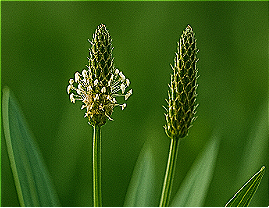 | 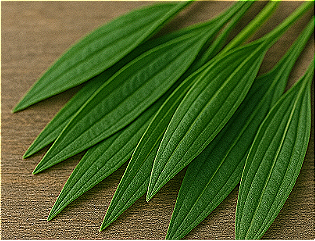 |
Botanical classification
Common name: ribwort plantain (narrowleaf plantain)
Clade: Angiosperms
Order: Lamiales
Family: Plantaginaceae
Genus: Plantago
Species: Plantago lanceolata L.
Cultivation and growth conditions
Climate
Ribwort plantain is a very hardy perennial herb, well adapted to temperate climates, including cold winters and moderate summer drought. It tolerates frost and light freezing, provided there is no prolonged waterlogging. Optimal vegetative growth occurs at temperatures between 12 and 22 °C; above 30 °C growth slows, flower stalks are produced earlier and leaf development is reduced.
Exposure
The crop prefers full sun, which favours production of large leaves and regular inflorescences. It tolerates partial shade, but under reduced light the canopy is more open and yield potential is lower.
Soil
Ribwort plantain grows well in light or sandy–loam soils, well drained, with pH from slightly acidic to neutral. It is a relatively undemanding species and can establish even on moderately poor soils, provided they are not waterlogged. Very clayey, compact soils are less suitable, as they hinder root development and increase water stress. A moderate level of organic matter improves structure and water-holding capacity.
Irrigation
This is a rather drought-tolerant species, able to withstand dry periods, but it benefits from regular soil moisture during germination, early vegetative growth and before the first flowering. Irrigation should be moderate, avoiding waterlogging and excessive inputs that would favour leaf diseases and root rots. In mid-summer, supplementary irrigations can support regrowth after cutting and maintain leaf quality.
Temperature
Germination is regular above 8–10 °C; optimal development is between 15 and 22 °C. Established plants generally tolerate even severe frosts, whereas very young seedlings can be damaged by extreme cold. Very high temperatures combined with drought and dry winds reduce leaf size and overall forage quality.
Fertilization
Ribwort plantain has moderate nutrient requirements and needs a balanced supply of nitrogen (N), phosphorus (P) and potassium (K):
Nitrogen supports leaf growth, but should be kept at moderate levels to avoid very soft tissues, more susceptible to leaf pathogens.
Phosphorus promotes root system development and overall plant robustness.
Potassium improves stress tolerance and leaf firmness.
Applications of well–matured organic amendments are usually sufficient; excessive nitrogen increases disease susceptibility and reduces leaf structure.
Crop care
Main crop operations include:
Weed control by hoeing or mechanical cultivation, especially in the early stages, as plantain has slow initial growth.
Periodic cutting to stimulate new leaf formation and limit tissue lignification.
Appropriate crop rotation on fields used for cutting or biomass production, limiting crops from the same botanical family.
Monitoring of possible pests (e.g. aphids, defoliating larvae) and fungal diseases, and intervention using integrated pest management criteria.
Good soil aeration and a balanced water regime help maintain crop health.
Harvesting
Leaf harvesting is done repeatedly during the growing season, when leaves are well developed and still tender. For medicinal or culinary uses, it is preferable to harvest in early stages, when leaves are more aromatic and less fibrous. Inflorescences can be harvested for seed production when ripe and when the seeds have a uniformly brown colour.
Propagation
Propagation is generally by seed, via direct sowing in the field or sowing in a nursery bed followed by transplanting:
sowing is shallow or with very light covering on a fine seedbed, to favour germination;
an adequate seeding rate ensures uniform ground cover and helps limit weed competition.
In some cases, division of clumps can be used to propagate vigorous individuals and maintain desired traits of a given population or selection.
Indicative nutritional values per 100 g (fresh edible leaves)
(values adapted from published compositions of Plantago lanceolata leaves; ranges depend on growth stage and environment)
Energy: ~20–30 kcal
Water: 80–90 g
Protein: ~2–3 g
Total fat: <1 g
SFA: very low fraction
Available carbohydrates: ~2–4 g
Total dietary fibre: ~2–4 g
Minerals: potassium, calcium, magnesium, iron, zinc in amounts comparable to leafy vegetables
Vitamins: carotenoids (provitamin A), vitamin C, B-group vitamins in small amounts
Overall, ribwort plantain behaves nutritionally like a low-energy leafy vegetable with modest contributions of fibre and micronutrients.
Key constituents
Structural fibre: cellulose, hemicelluloses, pectins
Mucilaginous polysaccharides with moderate water-binding capacity
Tannins and other phenolic compounds
Iridoid glycosides (e.g. aucubin, catalpol)
Flavonoids (e.g. luteolin and apigenin derivatives)
Minerals and vitamins in variable trace amounts
Modest levels of plant proteins and lipids
Production process
Harvesting
Manual collection of leaves or whole aerial parts during full vegetative growth, avoiding heavily polluted areas (roadsides, industrial zones).
Cleaning
Removal of soil, foreign plant material and damaged or diseased leaves.
Drying
Low-temperature drying in ventilated conditions or controlled dryers to stabilise the plant material while limiting degradation of actives and colour.
Cutting and grading
Size reduction (cut, sifted leaves) for herbal teas and extracts.
Packaging
Packed in moisture-protective containers or bags, labelled by batch and origin.
Physical properties
Morphology: narrow lanceolate leaves forming a rosette, with marked parallel venation; cylindrical seed spikes on slender scapes.
Colour: green in fresh material, dark green to brownish after drying.
Odour: mild, herbaceous.
Fresh product: high water activity and rapid perishability; dried drug: low moisture, more stable but sensitive to light and oxygen.
Sensory and technological properties
Flavour: mild herbaceous taste with a slight bitterness and astringent note.
Mouthfeel: in aqueous preparations (infusions, decoctions) the mucilage fraction can give a slightly viscous, soft texture.
Technological behaviour:
can be incorporated in herbal tea blends;
dried leaves powder can be used at low inclusion levels in herbal preparations, extracts or functional products where a modest mucilaginous effect is acceptable.
Food uses
Fresh young leaves, occasionally used in salads or mixed vegetable dishes in traditional/local contexts.
Ingredient in herbal infusions and tisanes (dried leaves) either on its own or in blends.
Minor component in some functional or botanical preparations, syrups and extracts, usually more for traditional/herbal positioning than for macronutrient contribution.
In modern diets, its role is mainly herbal rather than as a staple food.
Nutrition and health
Ribwort plantain has a low caloric value and only modest amounts of proteins, fats and digestible carbohydrates. Nutritional and functional interest lies mainly in:
its dietary fibre and mucilage content;
the presence of carotenoids, vitamin C and minerals;
a rich profile of phenolic compounds and iridoid glycosides that show antioxidant and other biological activities in experimental models.
Traditional uses include herbal preparations for respiratory and oral–pharyngeal comfort and for minor skin applications; however, when used simply as a food or herbal tea, it should be considered as part of a varied, balanced diet, without attributing medicinal claims to ordinary culinary use.
Portion note
In practical use:
as fresh greens: typically 5–20 g fresh leaves per serving, often mixed with other leafy vegetables;
as dried herb in infusions: about 1–2 g dried leaves per cup, according to standard herbal practice.
Allergens and intolerances
Ribwort plantain is not among the mandatory major allergens, but individual hypersensitivity cannot be excluded.
As with other herbs, local reactions or mild intolerance are possible in sensitive persons.
In processed foods and herbal products, Plantago lanceolata must be listed in the ingredient list, and any additional regulated allergens present in the formulation must be highlighted according to legislation.
Storage and shelf-life
Fresh leaves:
store refrigerated;
short shelf-life (a few days) due to wilting and enzymatic browning.
Dried herb:
store in a cool, dry place, protected from light and strong odours;
keep in well-closed containers to prevent moisture uptake and oxidation;
typical shelf-life: about 6–18 months, depending on drying quality, packaging and storage conditions.
Loss of colour, aroma and a “stale” odour are indicators of quality decline.
Safety and regulatory aspects
Subject to general requirements for botanical food ingredients: limits on contaminants (pesticides, heavy metals, microbial contamination, foreign bodies).
Operators must apply GMP/HACCP principles in harvesting, drying, processing and packaging.
Full traceability of batches (origin, harvest period, processing steps) is required in the food and herbal sectors.
Use in herbal medicinal products, where applicable, is regulated separately and must follow the specific national and EU rules for such categories.
Labelling
For food and herbal use, labels should indicate at minimum:
ingredient name (e.g. “Ribwort plantain – Plantago lanceolata L.”);
plant part used (typically “leaf” or “aerial parts”);
physical form (whole, cut, powdered, extract);
instructions for use (e.g. infusion dose and steeping time), where relevant;
batch identification, net content, durability date and storage conditions;
business operator name and address.
In multi-ingredient products, Plantago lanceolata must appear in the ingredients list in descending order of weight.
Troubleshooting
Typical defects
Wilting and yellowing of fresh leaves due to inadequate refrigeration or prolonged storage.
Colour loss and loss of aroma in dried leaves from prolonged exposure to light and oxygen.
Mould growth if dried material is stored at excessive humidity or with insufficient drying.
Preventive measures
For fresh leaves: rapid cooling after harvest and limited storage time.
For dried herb: proper drying (low final moisture), use of moisture- and light-protective packaging, and storage in cool, dry rooms.
Regular quality checks (visual inspection, odour, absence of visible mould).
Main INCI functions (cosmetics)
Extracts from Plantago lanceolata leaves may appear in cosmetic ingredient lists as Plantago Lanceolata Leaf Extract or similar names. Based on cosmetic ingredient databases and supplier data, key functions include:
Skin conditioning (helps keep skin in good condition, improving comfort and feel);
Antimicrobial activity (helps control growth of microorganisms in the product or on the skin surface);
Antioxidant / protective support, helping to counteract free radicals and environmental stress in combination with other actives.
Use levels, purity and extraction solvents must comply with cosmetic regulations, and the finished product requires safety assessment.
Conclusion
Ribwort plantain (Plantago lanceolata L.) is a widespread wild herb whose leaves and aerial parts are used primarily for herbal and traditional applications, with limited but interesting use as a minor leafy ingredient. Nutritionally it behaves like a light leafy vegetable, while its main interest lies in its phytochemical profile (fibre, mucilages, iridoids, flavonoids and tannins).
When used within a diverse and balanced diet, ribwort plantain can modestly contribute to fibre and micronutrient intake and broaden the spectrum of plant bioactives. In cosmetics, well-characterised leaf extracts are valued for skin-conditioning, antimicrobial and antioxidant roles, provided they are used within safe and regulated limits.
Mini-glossary
SFA: Saturated Fatty Acids. Fats that, in excess, are associated with increased cardiovascular risk; they are present only in very small amounts in leafy herbs such as ribwort plantain.
MUFA: MonoUnsaturated Fatty Acids. A class of unsaturated fats considered favourable when included as part of a balanced diet.
PUFA: PolyUnsaturated Fatty Acids. Include essential fatty acids; adequate intake supports normal physiological and metabolic functions.
GMP/HACCP: Good Manufacturing Practices / Hazard Analysis and Critical Control Points. Organisational systems used to ensure hygiene, safety and quality along food and cosmetic supply chains.
BOD/COD: Biochemical Oxygen Demand / Chemical Oxygen Demand. Parameters used to assess the organic load of process wastewater and its environmental impact.
Studies
Albendazole, a component present in plantain, is an anthelmintic, a vermifuge that is used against tapeworm and intestinal worms especially in veterinary medicine (1).
Plantain leaves have traditionally been used to treat inflammatory disorders, such as skin inflammation, oral mucosa, mouth and throat. It has astringent properties linked to the presence of tannins, emollient and soothing properties due to the content of mucus and anti-inflammatory properties (conditioned, among other things, by phenylethanoids). The macerated leaves/herbs of ribeyer is used for poultices and rinsing in wound support therapy for skin diseases and inflammation (2).
References____________________________________
(1) Stuchlíková Raisová L, Podlipná R, Szotáková B, Syslová E, Skálová L. Evaluation of drug uptake and deactivation in plant: Fate of albendazole in ribwort plantain (Plantago laceolata) cells and regenerants. Ecotoxicol Environ Saf. 2017 Jul;141:37-42. doi: 10.1016/j.ecoenv.2017.03.014.
(2) Blumenthal M, Goldberg A, Brinckann J. Expanded Commission E Monographs. Plantain. Newton: American Botanical Council; 2000. Herbal medicine; pp. 307–10.
(3) Laanet PR, Bragina O, Jõul P, Vaher M. Plantago major and Plantago lanceolata Exhibit Antioxidant and Borrelia burgdorferi Inhibiting Activities. Int J Mol Sci. 2024 Jun 28;25(13):7112. doi: 10.3390/ijms25137112.
Abstract. Lyme disease, caused by Borrelia burgdorferi sensu lato infection, is the most widespread vector-borne illness in the Northern Hemisphere. Unfortunately, using targeted antibiotic therapy is often an ineffective cure. The antibiotic resistance and recurring symptoms of Lyme disease are associated with the formation of biofilm-like aggregates of B. burgdorferi. Plant extracts could provide an effective alternative solution as many of them exhibit antibacterial or biofilm inhibiting activities. This study demonstrates the therapeutic potential of Plantago major and Plantago lanceolata as B. burgdorferi inhibitors. Hydroalcoholic extracts from three different samples of each plant were first characterised based on their total concentrations of polyphenolics, flavonoids, iridoids, and antioxidant capacity. Both plants contained substantial amounts of named phytochemicals and showed considerable antioxidant properties. The major non-volatile constituents were then quantified using HPLC-DAD-MS analyses, and volatile constituents were quantified using HS-SPME-GC-MS. The most prevalent non-volatiles were found to be plantamajoside and acteoside, and the most prevalent volatiles were β-caryophyllene, D-limonene, and α-caryophyllene. The B. burgdorferi inhibiting activity of the extracts was tested on stationary-phase B. burgdorferi culture and its biofilm fraction. All extracts showed antibacterial activity, with the most effective lowering the residual bacterial viability down to 15%. Moreover, the extracts prepared from the leaves of each plant additionally demonstrated biofilm inhibiting properties, reducing its formation by 30%.

