



Mustard (Sinapsis species, Brassica alba, Brassica nigra and others) belongs to the Brassicaceae family and is an oily vegetable crop from which oil and seeds are mainly obtained.
Yellow mustard is obtaided by Brassica alba plant.
Parts & commercial forms: whole seeds, meal/flour, prepared mustard (paste or liquid condiment), mustard oil (edible only from low-erucic cultivars), press cakes (defatted meal).
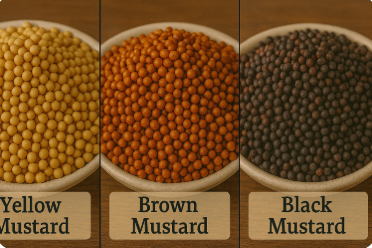
Common name: Mustard
Cultivated species:
Sinapis alba L. — White or yellow mustard
Brassica juncea (L.) Czern. — Brown or Indian mustard
Brassica nigra (L.) W.D.J. Koch — Black mustard
Kingdom: Plantae
Clade: Angiosperms
Clade: Eudicots
Order: Brassicales
Family: Brassicaceae
Genera: Sinapis, Brassica
Species:
Sinapis alba L.
Brassica juncea (L.) Czern.
Brassica nigra (L.) W.D.J. Koch
Cultivation and growth conditions
Climate:
Mustard prefers temperate to cool climates. It is a relatively hardy crop with good tolerance to low temperatures in the early stages. Moderate temperatures promote rapid germination and uniform growth, while excessively hot summers may induce early flowering and reduce seed yield.
Sun exposure:
Mustard requires full sun, which ensures proper vegetative development and optimal production of flowers and seed pods (siliques).
Soil:
The crop adapts to a wide range of soils but performs best in fertile, well-drained, medium-textured soils with a pH between 6.0 and 7.5. Waterlogging should be avoided to prevent root problems. Soils rich in organic matter support more vigorous plant growth.
Irrigation:
Mustard has moderate water requirements. Soil moisture should be kept reasonably constant during germination and flowering. Excess water in the later stages may favor diseases or cause lodging of the plants.
Temperature:
Germination: optimal between 10 and 20 °C
Vegetative growth: 15–25 °C
Temperatures above 30 °C can hasten maturation and reduce seed production
Fertilization:
Mustard responds well to balanced fertilization:
Nitrogen: promotes initial vegetative growth, but should be applied in moderate amounts to avoid excessive foliage at the expense of seeds.
Phosphorus: supports root development and flowering.
Potassium: important for seed formation and stress resistance.
Sulfur availability in the soil is particularly important, as it is involved in the synthesis of glucosinolates, the characteristic sulfur compounds of the Brassicaceae family.
Crop care:
Hoeing and shallow cultivation to control weeds and improve soil aeration.
Mulching may be used to limit weed growth and conserve moisture.
Preventive control of flea beetles and lepidopteran larvae, which frequently attack crucifer crops.
Monitoring for common fungal diseases such as molds and leaf spots.
Harvest:
Harvest takes place when plants turn yellow and the pods begin to dry. Cutting and threshing must be carried out carefully, since mature siliques can open easily and shed the seeds. Seeds should be dried to around 10% moisture to ensure safe storage.
Propagation:
Mustard is propagated by seed. Sowing is carried out in spring or late summer, depending on the species and local climate conditions. Rotating mustard with cereals or legumes is recommended to reduce the build-up of pests and diseases typical of Brassicaceae.
Caloric value (indicative)
Seeds: ~500–520 kcal per 100 g.
Prepared mustard (condiment): ~60–120 kcal per 100 g (depends on water, salt, sugar/acid).
Mustard oil: ~884 kcal per 100 g.
Seed composition (typical, per 100 g)
Fat: ~36–40 g (see lipid profile)
Protein: ~24–26 g (albumins/globulins; good EAA profile)
Carbohydrate: ~28 g (with fiber ~12 g)
Ash/Micronutrients: Ca, Mg, K, P, Fe, Zn; sulfur-containing metabolites characteristic of Brassicaceae
Mustard oil profile (low-erucic, edible types)
MUFA (MonoUnsaturated Fatty Acids—generally heart-friendly): oleic C18:1 and eicosenoic C20:1 together ~55–65% (erucic C22:1 is low in edible cultivars).
PUFA (PolyUnsaturated Fatty Acids—beneficial, balance with Ω-3): linoleic C18:2 (Ω-6) ~15–25%, ALA C18:3 (Ω-3) ~6–12%.
SFA (Saturated Fatty Acids—best in moderation): palmitic + stearic ~5–8%.
Key phytochemistry & aroma precursors
Glucosinolates: sinigrin (brown/black → allyl isothiocyanate, AITC, hot/pungent), sinalbin (yellow → p-hydroxybenzyl isothiocyanate, milder).
Myrosinase: endogenous enzyme that hydrolyzes glucosinolates upon water activation, releasing isothiocyanates (pungency), thiocyanates, traces of nitrite.
Mucilage: hydrophilic polysaccharides that provide thickening/emulsifying in pastes.
Sensory & techno-functional properties
Sharp heat/pungency from AITC (more intense in brown/black; yellow is milder/sweeter).
Emulsification: mustard flour improves stability of mayonnaise/dressings and wetting of powders.
Antimicrobial: isothiocyanates inhibit yeasts/bacteria → useful in pickles/brines.
Antioxidant: phenolics/peptides can delay lipid oxidation in meats and sauces.
Manufacture & processing
Meal/flour: milling of seeds (with or without defatting); particle size controls enzyme–substrate contact and heat release.
Prepared mustard: seed/meal + water (activates myrosinase) + acid (vinegar/wine) + salt, optional sugar/spices. pH and maturation time tune aroma and heat.
Oil: cold-pressed or solvent-extracted; for edible use, select low-erucic cultivars meeting regulatory limits (similar to canola standards).
Applications
Culinary: table mustards, rubs for meats, emulsions (mayonnaise, vinaigrettes), pickles; whole seeds in curries and pickling mixes.
Bakery: mustard flour for flavor, mild antimicrobial effect (rope/spoilage control).
Industrial: ready sauces, seasoned snacks, preservation “hurdle” with salt/acid.
Nutrition & health
Seeds supply protein, fiber, and minerals; energy dense due to oil content.
Isothiocyanates drive sensory and some preservative effects; as with other Brassicaceae, chronic excess of glucosinolates can be goitrogenic (thyroid iodine interplay)—unlikely at typical culinary intakes.
Oil (low-erucic) offers a favorable MUFA/PUFA balance; suitable for dressings and moderate-heat cooking.
Safety, allergens & regulatory
In the EU, mustard is a major allergen: mandatory declaration for seeds, flours, extracts, and oils with residual proteins.
Irritation: AITC can induce lacrimation, rhinitis, and contact dermatitis; avoid aerosols/concentrated vapors.
Erucic acid (C22:1): traditional high-erucic oils are restricted due to myocardial lipidosis risk; use low-erucic edible grades compliant with EU/FAO/WHO limits.
Cross-reactivity: possible in those allergic to other Brassicaceae or certain pollens.
Quality & storage
Seeds/flour: airtight, cool/dry/dark; mill close to use for maximum pungency.
Prepared mustard: keep sealed and dark; AITC volatilizes over time, reducing heat.
Oil: protect from light/oxygen (PUFA) and odors; shelf life similar to other high-oleic oils.
Troubleshooting
Weak heat in condiment: increase activation water, adjust pH (too low pH quickly inactivates myrosinase), extend cold maturation.
Sauce separation: raise mustard flour to 0.2–0.6%, add lecithin, or adjust viscosity.
Excess bitterness: favor yellow mustard (sinalbin), temper reaction time/temperature, balance with sugar/honey.
Sustainability & supply
Grown in temperate/continental climates (Canada, EU, India). Consider crop rotations, prudent nitrogen inputs, disease control; organic and residue-controlled chains are available.
Studies
Oily crops contain high levels of tocopherols, which prevent the oxidation of lipids and thus contribute to improving the longevity of the seeds (1).
Because of their non-polar nature, tocopherols become part of seed oil after oil extraction, where they play a key role as antioxidants in vitro and in vivo. In vitro, tocopherols are the main compounds that protect the oil from lipid peroxidation, which causes the absence of flavors and the reduction of shelf life (2).
In vivo activity of tocopherols is exercised in the human or animal body after they are consumed in the diet or in vitamin supplements, where they protect cells from oxidative stress (3).
Mustard contains substances of interest for human health such as (4) :
- Erucic acid
- Vitamin E
- Alpha tocopherol
- Gamma tocopherol
The fatty acid profile in yellow mustard (Brassica alba) is dominated by erucic acid with 6.87%, followed by oleic acid with 5.08% and linoleic acid with 1.87%, while in black mustard (Brassica nigra) the predominant fatty acid is oleic with 22.96%, followed by linoleic with 6.63% and linolenic with 3.22% (5).
Safety
Mustard has been commonly used in homeopathic and traditional medicines, where it is believed to have anti-microbial and anti-inflammatory properties and in the treatment of ailments ranging from arthritis to respiratory congestion. This case highlights the potential danger of misuse of homeopathic homeopathic DIY remedies such as mustard powder (6).
Mustard studies

