



Bluefin tuna
(Thunnus thynnus – Atlantic bluefin tuna; loins, fillets, belly cuts; fresh, frozen, smoked or canned)
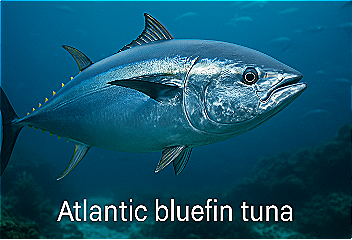
Description
Bluefin tuna (Thunnus thynnus) is a large, high-value pelagic species, prized for its strong, rich flavour and, in some cuts (belly/“toro”), high intramuscular fat with pronounced marbling, often compared to high-grade beef.
Widely used raw (sushi, sashimi, tartare, tataki) in premium gastronomy, as well as grilled, seared or braised, and in high-end canned products in oil (fillets and belly).
Flesh colour ranges from deep red in lean dorsal muscle to paler pink–red in heavily marbled areas; after cooking or canning, it becomes beige–pink and opaque.
Indicative nutritional values (per 100 g raw, lean dorsal muscle)
(Average values; very variable with cut, season, fat content and whether wild or ranched.)
Energy: 140–190 kcal
Water: ≈ 70–75 g
Protein: 23–30 g
Total fat: 4–7 g
First occurrence: SFA/MUFA/PUFA = saturated/monounsaturated/polyunsaturated fatty acids. In lean dorsal bluefin, total fat is moderate, with around 1–2 g/100 g saturated fat and a substantial share of MUFA and PUFA (including marine omega-3). Within a diet that keeps overall saturated fat moderate, this profile is generally more favourable than many red meats.
Carbohydrates: 0 g
Cholesterol: 35–45 mg
Sodium (intrinsic): 35–50 mg
Selected micronutrients (per 100 g, typical ranges):
Selenium: ≈ 50–80 µg (sometimes higher)
Niacin (vitamin B3): 8–15 mg
Vitamin B6: ≈ 0.8–1.0 mg
Vitamin B12: ≈ 2–9 µg
Phosphorus: ≈ 200–250 mg
Potassium: ≈ 300–450 mg
Heme iron: ≈ 1–2 mg
Long-chain omega-3 (EPA + DHA): typically 0.4–1.5 g/100 g, with a wide range depending on cut and fatness.
Very fatty cuts and products in oil (belly, canned fillets)
Fatty belly cuts (“toro”, “ventresca”) or canned fillets in oil may reach or exceed:
Energy: 300–350 kcal/100 g drained
Total fat: 20–30 g/100 g
Protein: ≈ 20–25 g/100 g
Salt: commonly ≈ 1 g/100 g in oil- or brine-packed preserves.
Key constituents
Proteins
High biological value (BV) proteins with a full essential amino acid profile.
Rich in BCAA (branched-chain amino acids: leucine, isoleucine, valine), important for muscle metabolism and repair.
Lipids
Moderately fatty in dorsal cuts; very fatty in belly cuts and in oil-packed products.
Contains saturated, monounsaturated and polyunsaturated fatty acids, with notable levels of marine omega-3 EPA (eicosapentaenoic acid) and DHA (docosahexaenoic acid).
No industrial trans fats; only minor natural marine trans isomers.
Minerals and vitamins
Good source of selenium, phosphorus, potassium, vitamin D, vitamin B12, niacin, and heme iron.
Other components
High histidine content, which can be converted to histamine if time–temperature control fails (scombroid risk).
Non-protein nitrogenous compounds and nucleotides that contribute to strong umami taste, plus myoglobin that drives the dark red colour.
Production process
(Overview for wild catch, ranching, fresh/frozen market and canned products.)
Capture and landing
Caught using longlines, purse seines, fixed traps (tuna traps) and other gears under tight international management (e.g. ICCAT in the Atlantic/Mediterranean).
Rapid onboard chilling (ice, slurry, refrigerated seawater) is critical to limit spoilage and histamine formation and to preserve colour and texture.
Ranching/fattening in cages
In the Mediterranean, bluefin is often captured alive (juveniles/adults) and transferred to offshore cages, where fish are fattened on forage fish until they reach desired size and fat content for sashimi markets.
Primary processing
In plants or on board: evisceration, heading, washing.
Sectioning into large carcases, then loins, fillets, belly, tail, etc.
For high-end sashimi markets, very precise cutting and handling (including methods such as ikejime and spinal cord destruction) are used to optimise pH, colour and texture.
Fresh/chilled and frozen products
Fresh: vacuum-packed or MAP-packaged loins and portions, distributed under strict cold chain.
Frozen: rapid freezing (blast, plate or ultra-low “tuna freezing” at e.g. −35 to −60 °C) to preserve colour and texture; glazing and packing; export and distribution.
Canned and oil-packed products
Cooking or pre-cooking (steam or water) of selected cuts.
Removal of skin, bones and dark muscle as required.
Cutting into fillets, chunks or belly pieces, packing into cans/jars.
Addition of covering medium (olive or extra virgin olive oil, brine, other oils) and salt;
Seaming/closing and retorting (sterilisation);
Cooling, labelling and ambient storage.
Physical properties
Highly pigmented muscle: deep red to bright crimson in lean parts; more marbled and paler red in fatty belly areas.
Firm, dense structure with relatively thick muscle fibres; fatty areas feel softer and more unctuous.
Typical post-mortem pH around 5.6–6.2; high water activity.
In oil-packed products, added fat substantially increases energy and perceived oiliness and, when oils are good quality, can moderate oxidation.
Sensory and technological properties
Flavour
Very intense, rich, “meaty” tuna flavour with pronounced umami; belly cuts are extremely succulent and complex, highly prized in gourmet cuisine.
Texture
Dorsal loins: firm and dense, suited to raw/rare preparations and short cooking.
Belly: soft, buttery, almost melt-in-mouth when raw or lightly cooked; can become fragile with prolonged heat.
Technological behaviour
Handles high-heat, short-time cooking (grill, pan) well when not overcooked; overcooking drives moisture loss and a dry, fibrous texture.
Excellent for tataki or seared outer surface with a rare centre.
In preserves, maintains defined fillets/chunks and a rich, oily mouthfeel.
Food applications
Home cooking and foodservice
Raw or lightly processed: sushi, sashimi, tartare, carpaccio, tataki (where legally allowed and microbiologically safe).
Cooked: grilled, seared, baked steaks, stews and braises with tomato, legumes or vegetables; belly roasted or grilled, sometimes gently smoked.
Artisanal and industrial
Fillets and belly in olive oil, often associated with Mediterranean specialties (Italy, Spain, etc.).
Smoked products, bluefin bottarga, specialty pâtés and spreads.
Fish meal and fish oil from heads, bones and trimmings for feed and ingredient uses.
Nutrition & health
Bluefin tuna provides:
High-quality protein with high BV, contributing to maintenance and development of muscle mass.
Significant amounts of marine omega-3 EPA and DHA, which, in the context of a varied diet, contribute to:
normal heart function and more favourable blood-lipid profile;
support of certain brain and vision functions.
Substantial selenium, which participates in antioxidant systems and interacts with mercury, though the degree of protection in humans is still being studied.
Lean dorsal cuts provide moderate fat; fatty belly and oil-packed products deliver much higher energy and total fat per portion and should be factored into daily energy and fat balance.
Mercury – high-concentration species
Bluefin is a large, long-lived, apex predator and tends to accumulate high levels of methylmercury, often above 0.5 mg/kg and sometimes at or above 1.0 mg/kg in individual fish.
As a result, it is usually classified among species to limit strongly or avoid for:
pregnant or breastfeeding individuals,
young children,
people with very high intakes of large predatory fish.
Many national/international guidelines place bluefin and other large tunas in the category of fish that should be eaten only occasionally, favouring low-mercury species (small pelagics, cod, salmon, herring, sardines) for frequent consumption.
Histamine (scombroid) risk
Like other tunas, bluefin is prone to histamine formation if time–temperature control is inadequate.
High histamine can cause scombroid poisoning (flushing, headache, itching, gastrointestinal symptoms) typically within hours after the meal.
Strict cold chain from catch to consumer, rapid chilling and proper handling are essential to minimise this risk.
Portion note
As a main protein dish, a typical adult portion is 120–150 g cooked or drained.
In raw preparations (sashimi, tartare), 80–100 g per portion is common.
For vulnerable groups, any bluefin consumption should be occasional and limited, always balanced with low-mercury fish choices and in line with national advisories.
Allergens and intolerances
Bluefin tuna is a fish allergen and must be labelled as such; it can trigger reactions in individuals with fish allergy.
Prepared dishes (salads, pâtés, ready meals) may contain additional allergens such as soy, milk, egg, gluten, mustard, etc., which must be clearly indicated on labels.
Histamine-related reactions are toxic pseudo-allergic events, not IgE-mediated, but can resemble allergic reactions clinically; they must be distinguished from true fish allergy.
Quality and specifications (typical themes)
Composition
Protein, total fat (including detailed fatty acid profile), moisture and salt within specification.
For oil-packed products: defined fish-to-oil ratio and tight control of lipid oxidation.
Physical/sensory
Uniform red colour (for fresh cuts) without excessive browning or dark oxidation patches.
Clean marine odour, free from rancid, ammoniacal or “stale” notes.
Minimal bones and unwanted tissues;
Appropriate texture (not mushy, not excessively dry).
Chemical
Histamine below legal limits for scombroid fish.
Mercury and other heavy metals below regulatory maximum levels.
Peroxide value, anisidine value and other oxidation indicators controlled, especially in fatty and oil-packed products.
Microbiological
Fresh/chilled: low total counts and absence of pathogens when held at 0–2 °C.
Sterilised preserves: commercial sterility throughout shelf-life.
Storage and shelf-life
Fresh/chilled
Store at 0–2 °C (ice, refrigerated, often under vacuum or MAP).
Shelf-life is typically only a few days, strongly dependent on initial freshness, capture and bleeding method, handling and packaging.
Frozen
Store at ≤ −18 °C; for sashimi-grade products, even lower temperatures (e.g. −35 to −60 °C) are often used to better preserve colour and texture.
Typical quality shelf-life: 6–12 months, with gradual sensory decline.
Canned and oil-packed
Store unopened at ambient temperature in a cool, dry, dark place.
Typical shelf-life: 2–5 years depending on process and packaging.
Once opened: keep refrigerated (≈ 4 °C) and consume within about 3 days.
Safety and regulatory
Bluefin tuna is subject to:
legal limits on histamine for scombroid fish;
maximum levels for mercury (often around 1.0 mg/kg for large predatory fish in many jurisdictions);
microbiological and hygiene criteria for fresh, frozen and canned products;
species, catch area and production method labelling requirements (“wild-caught”, “ranched/farmed”).
Management of Atlantic and Mediterranean bluefin stocks is coordinated by ICCAT.
After severe overfishing and near-collapse in the past, stringent recovery plans and quotas have led to clear stock improvements, with many recent assessments considering the main Atlantic stock in good status, although sub-population uncertainties remain.
Processing facilities must operate under GMP/HACCP, with CCPs for:
time–temperature control,
thermal process validation for canned products,
cleaning, sanitation and prevention of cross-contamination.
Labelling
Common designations:
“bluefin tuna”, “Atlantic bluefin tuna”, “tonno rosso” (in Italian markets).
Best practice includes the scientific name Thunnus thynnus and FAO catch area.
For processed products, labels should include:
full ingredient list with clear emphasis of the allergen fish and any other allergens;
type of covering medium (olive/extra virgin olive oil, brine, water);
net and drained weight;
nutrition declaration;
origin and, for premium products, possibly local/geographical indications and traditional techniques.
Troubleshooting
Dry, fibrous steaks
Cause: overcooking of relatively lean cuts or excessively aggressive heat.
Actions: reduce time/temperature, use marinades, prefer quick searing and leave the centre pink/rare where safe.
Excessive oiliness (belly and oil-packed products)
Cause: combination of high intrinsic fat and added oil.
Actions: moderate portion size; pair with acidic, bitter or high-vegetable side dishes; drain more thoroughly before use.
Surface browning and oxidised smell
Cause: pigment and lipid oxidation due to oxygen, light and inadequate temperature.
Actions: improve packaging (vacuum/MAP), cold chain and time in display.
Clusters of flushing/headache/itching after eating
Likely cause: histamine incident (scombroid).
Actions: test histamine on suspect batches, investigate time–temperature management, reinforce HACCP measures.
Sustainability and supply chain
Bluefin tuna has a history of heavy overexploitation and high market value (especially for sashimi), with some stocks driven close to collapse in the past.
In recent years, thanks to strict quotas, recovery plans and increased control, assessments indicate:
rising spawning biomass,
Atlantic stocks currently in much improved condition, with no overfishing detected in many recent evaluations, though uncertainties and regional differences persist.
Ongoing concerns include:
impacts of ranching/fattening (removing wild juveniles for cage fattening rather than full aquaculture),
high carbon footprint associated with long-distance transport and deep-cold storage,
potential risk of renewed overfishing if controls are relaxed.
Good practice along the chain:
preferential sourcing from well-managed, traceable fisheries and, where available, certified operations;
full utilisation of the fish (minimising waste, using trimmings for fishmeal/oil);
proper effluent management with attention to BOD/COD and recyclable packaging;
stock rotation using FIFO to limit oxidation, quality loss and waste.
Conclusion
Bluefin tuna (Thunnus thynnus) is an outstandingly flavourful, high-protein marine ingredient with a rich content of omega-3 fatty acids, selenium and key vitamins, especially in premium fatty cuts. Nutritionally, it can contribute positively to cardiometabolic and protein intake within a varied diet, but its high mercury burden makes it a food that should be consumed sparingly and thoughtfully, particularly by pregnant/breastfeeding women and children. Environmentally, despite notable progress in stock management, bluefin remains a high-profile species requiring careful attention to origin, quotas, traceability and sustainability credentials. Responsible use—moderate frequency, appropriate portion sizes, preference for well-managed sources and full utilisation of the animal—allows appreciation of its gastronomic qualities while minimising health and ecological risks.
Mini-glossary
SFA/MUFA/PUFA – Saturated/monounsaturated/polyunsaturated fatty acids; in lean bluefin cuts, total fat is moderate with a substantial unsaturated fraction, while fatty belly and oil-packed products are very energy-dense; overall health impact depends on the total dietary pattern.
EPA/DHA/ALA – Eicosapentaenoic acid / docosahexaenoic acid / alpha-linolenic acid; EPA and DHA are long-chain marine omega-3s linked to heart, brain and vision benefits; ALA is a plant omega-3 that the body can convert only partially into EPA/DHA.
BV (biological value) – Measure of how efficiently dietary protein can be used for body protein synthesis; bluefin tuna has high BV.
BCAA – Branched-chain amino acids (leucine, isoleucine, valine), important for muscle metabolism and recovery, abundant in fish and meat proteins.
GMP/HACCP – Good Manufacturing Practices / Hazard Analysis and Critical Control Points; fundamental systems to ensure hygienic, safe and traceable processing of fish products.
BOD/COD – Biochemical/Chemical Oxygen Demand; indicators of the organic and oxidisable load of wastewater, used for sizing and monitoring treatment plants in seafood and other food industries.
FIFO – First In, First Out; stock-rotation principle whereby older lots are used before newer ones, reducing oxidation, expiry issues and waste.

