Chia (Salvia hispanica)
Descrizione
La chia è il seme della pianta Salvia hispanica (famiglia Lamiaceae), originaria del Centro e Sud America. I semi sono piccoli (1–2 mm), di colore nero, grigio o screziato, con superficie lucida e consistenza croccante. A contatto con acqua formano un gel mucillaginoso ricco di fibre solubili. La chia è apprezzata per il profilo nutrizionale molto ricco, in particolare per il contenuto elevato di acidi grassi omega-3 (ALA), proteine, calcio, fibre e antiossidanti.
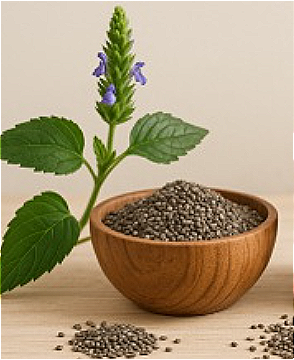
Nome comune: Chia
Pianta di origine: Salvia hispanica L.
Regno: Plantae
Clado: Angiosperme
Clado: Eudicotiledoni
Ordine: Lamiales
Famiglia: Lamiaceae
Genere: Salvia
Specie: Salvia hispanica L.
Nota: La chia è una specie erbacea annuale appartenente alla stessa famiglia della salvia comune. I semi sono la parte di maggior interesse alimentare e sono utilizzati interi, macinati o sotto forma di gel idratato.
Coltivazione e condizioni di crescita della pianta di chia
Clima:
Predilige climi temperato–caldi o subtropicali.
Sensibile al gelo: le basse temperature possono danneggiare seriamente le piante, soprattutto nelle prime fasi.
Si coltiva in genere come coltura primaverile–estiva nelle zone a clima temperato.
Esposizione:
Terreno:
Preferisce suoli ben drenati, da leggeri a di medio impasto.
Tollerante a terreni relativamente poveri, purché non compatti e senza ristagni idrici.
Gradisce pH da leggermente acido a neutro.
Irrigazione:
Necessita di umidità regolare nelle prime fasi di sviluppo per una buona emergenza delle plantule.
Una volta affrancata, è relativamente tollerante a brevi periodi di siccità.
È importante evitare ristagni e eccessi d’acqua, che favoriscono malattie radicali.
Temperatura:
Concimazione:
Coltura mediamente poco esigente, soprattutto in sistemi estensivi.
Può beneficiare di un moderato apporto di sostanza organica (compost, letame maturo) prima della semina.
In terreni molto poveri è utile una concimazione di fondo equilibrata, senza eccessi di azoto.
Cure colturali:
Controllo delle infestanti particolarmente importante nelle fasi iniziali, finché le piante non ombreggiano il terreno.
È opportuno evitare compattamento del suolo, che riduce lo sviluppo dell’apparato radicale.
Raccolta:
Moltiplicazione:
Valori nutrizionali indicativi per 100 g
Energia: ≈ 480–490 kcal
Acqua: ≈ 5–7%
Carboidrati: ≈ 42–44 g
Proteine: ≈ 16–17 g
Grassi totali: ≈ 30–32 g
SFA (grassi saturi): ≈ 3–4 g
MUFA (grassi monoinsaturi): ≈ 2–3 g
PUFA (grassi polinsaturi, inclusi n-3 ALA e n-6): ≈ 23–25 g
Fibre: ≈ 34–36 g (molto elevate, soprattutto solubili)
Minerali: calcio (≈ 600–650 mg), magnesio, fosforo, potassio, zinco
Vitamine: piccole quantità di B1, B3 e antiossidanti (composti fenolici)
Principali sostanze contenute
Acidi grassi polinsaturi (ALA prevalente)
Fibre solubili (mucillagini) e insolubili
Proteine con buon profilo aminoacidico
Polifenoli: acidi clorogenico, caffeico, quercetina
Minerali: calcio, magnesio, fosforo
Tracce di fitosteroli e tocoferoli (attività antiossidante)
Processo di produzione
Coltivazione
Predilige climi caldi e secchi, terreni ben drenati.
Necessita di irrigazione moderata e buona esposizione solare.
Principali produttori: Messico, Paraguay, Bolivia, Argentina.
Raccolta
Post-raccolta
Pulizia e selezione dei semi.
Essiccazione fino a umidità idonea per lo stoccaggio.
Confezionamento in sacchi o contenitori sigillati.
Trasformazioni ulteriori
Proprietà fisiche
Semi piccoli, ovali, lucidi.
Colori variabili nero-grigio-bianco.
Assorbimento d’acqua: fino a 10–12 volte il proprio peso.
Formazione di gel grazie alle mucillagini.
Proprietà sensoriali e tecnologiche
Sapore: delicato, leggermente nocciolato.
Aroma: neutro → facilmente integrabile in molte ricette.
Il gel di chia conferisce viscosità e può sostituire parzialmente uova e addensanti.
Ottima stabilità all’ossidazione grazie alla presenza di antiossidanti naturali.
Ideale per prodotti da forno, cereali, yogurt, bevande funzionali.
Impieghi alimentari
Aggiunta a yogurt, smoothie, frutta, insalate.
Preparazione di pudding di chia.
Panificazione, crackers, barrette, granola.
Addensante naturale per salse e creme.
Olio di chia come ingrediente funzionale nei prodotti salutistici.
Nutrizione e salute
Ricchissima di fibra solubile, utile per il senso di sazietà e la regolarità intestinale.
Fonte vegetale importante di omega-3 (ALA), con potenziale contributo alla salute cardiovascolare.
Elevato contenuto di calcio, particolarmente utile nelle diete a ridotto consumo di latticini.
La fibra mucillaginosa può modulare l’assorbimento dei carboidrati.
Consumo da aumentare gradualmente per evitare gonfiore.
Nessun beneficio sostituisce indicazioni mediche.
Nota porzione
Allergeni e intolleranze
Non contiene allergeni principali UE.
Possibili intolleranze individuali o sensibilità gastrointestinale a dosi elevate.
Da evitare in soggetti con difficoltà di deglutizione senza adeguata idratazione.
Conservazione e shelf-life
Semi interi: 12–24 mesi in contenitori ermetici, al riparo da luce e calore.
Semi macinati: 6–12 mesi (più sensibili all’ossidazione).
Olio di chia: 6–9 mesi in vetro scuro, refrigerato.
Sicurezza e regolatorio
La chia è un novel food autorizzato nell’UE con limiti di utilizzo specifici per alcune categorie alimentari.
Deve rispettare norme su:
Impianti produttivi soggetti a GMP e HACCP.
Etichettatura
Nome prodotto: “semi di chia” / Salvia hispanica.
Origine.
Lotto, TMC, condizioni di conservazione.
Eventuali avvertenze nutrizionali (es. consumo graduale, uso in prodotti specifici).
Troubleshooting
Sapore rancido → ossidazione dei grassi, conservazione scorretta.
Gel troppo denso → eccesso di semi o lunga idratazione.
Presenza di insetti o corpi estranei → stoccaggio non idoneo.
Semi che non gelificano → scarsa qualità o prodotto troppo vecchio.
Sostenibilità e filiera
Coltivazione con ridotto impatto idrico rispetto ad altre colture tropicali.
Buona resa agricola in sistemi a basso input.
Possibilità di produzione biologica estensiva.
Imballaggi riciclabili consigliati (vetro, carta multistrato, plastica riciclabile).
Principali funzioni INCI (cosmesi)
Derivati cosmetici dalla chia includono:
Salvia Hispanica Seed Oil → emolliente, nutriente, ricco di ALA.
Salvia Hispanica Extract → antiossidante, idratante.
Chia seed mucilage → filmogeno, leggero addensante naturale.
Conclusione
La chia è una materia prima nutrizionalmente ricca e tecnologicamente versatile. Grazie all’elevato contenuto di fibre, omega-3 ALA e minerali, è ampiamente utilizzata in alimenti funzionali, panificazione e prodotti salutistici. La sua capacità di formare gel offre applicazioni innovative sia nell’industria alimentare sia nella cosmesi naturale. Una corretta conservazione garantisce stabilità e qualità del prodotto.
Mini-glossario
SFA: grassi saturi
MUFA: grassi monoinsaturi
PUFA: grassi polinsaturi
ALA: acido alfa-linolenico (omega-3 vegetale)
MRL: Maximum Residue Level
GMP: Good Manufacturing Practices
HACCP: Hazard Analysis and Critical Control Points
I semi di Chia contengono componenti bioattivi (tocoferoli, polifenoli, miricetina, quercetina, kaempferol, acido clorogenico e dialdeide 3,4-dihydroxyphenylethanol-elenolicacid e carotenoidi) che possono essere indicati come responsabili per il mantenimento di bassi valori di perossido e di conseguenza una buona stabilità ossidativa (1).
Chia studi
Bibliografia_____________________________________
(1) Ixtaina VY, Martinez ML, Spotorno V, Mateo CM, Maestri DM, Diehl BWK, Nolasco SM, Tomas MC. Characterization of chia seed oils obtained by pressing and solvent extraction. J Food Compos Anal. 2011;24:166–74. doi: 10.1016/j.jfca.2010.08.006
Abstract. The oil yield, fatty acid composition and the physicochemical and quality characteristics of chia crude seed oils obtained by pressing and solvent extraction were determined. The extraction methods assayed influenced significantly the oil yield, obtaining about 30% more oil by solvent than by pressing. The main fatty acids ranked in the following order of abundance: α-linolenic acid (α Ln) > linoleic acid (L) > oleic acid (O) ≈ palmitic acid (P) > stearic acid (S) for both extraction systems. The n-3/n-6 FA ratio of chia oils ranged from 3.18 to 4.18, being markedly higher than that reported for other vegetable oils. The main triacylglycerols were: αLnαLnαLn > αLnαLnL > αLnLL > αLnαLnP > αLnLO ∼ αLnLP, which represent about 87–95% of the total content of these compounds. The quality and composition of some minor constituents of chia seed oils were influenced by the extraction process. Oils presented a moderate content of bioactive components, such as tocopherols, polyphenols, carotenoids and phospholipids; the high unsaturation level determined their low oxidative stability.
Adel A, Ikram R, Wasi N. Salvia hispanica (White chia): A new window for its antidepressant and memory boosting activity.
Pak J Pharm Sci. 2019 May;32(3):1005-1009.
Abstract. To determine the effects of Salvia hispanica on activities related to memory, anxiety and depression. Albino rats as well as albino mice were utilized in the current study. Two groups of animals were made including 10 animals in each group. One was a control group and another was treated group. Neuropharmacological parameters were assessed using Light and Dark box test, Stationary rod activity, Water maze test, Open field activity and Home cage activity. The control group was maintained on water and treated group was fed with approximately 106 mg/kg extract of Salvia hispanica for 30 days. The observations were recorded on 1st day, 15th day and 30th day. The results of current study showed an increased time spent in the light box of Light and Dark box model, reduction in elapsed time utilized by animal to reach platform in Stationary rod and water maze model, reduced number of peripheral square and central square crosses in the open field and decreased number of cage crosses in the home cage activity. Salvia hispanica shows memory enhancement and also shows an antidepressant activity on chronic administration.
Coelho O, Rocha D, da Silva BP, Silva A, Caldas AP, Almeida A, Ribeiro P, Alfenas R. Effect of Chia (Salvia hispanica L.) Flour on Glycemic Response and Energy Intake in Healthy Adults
Curr Dev Nutr. 2019 Jun 13;3(Suppl 1). pii: nzz031.P06-099-19. doi: 10.1093/cdn/nzz031.P06-099-19.
Abstract. Objectives. Postprandial glycemic control is essential in both healthy and diabetic people, as hyperglycemia predisposes to complications associated with diabetes. The consumption of fiber-rich meals help to prevent and control undesirable glycemic changes. This study aimed to evaluate the effect of one-day consumption of chia on glycemic response and energy intake in healthy adults. Methods. Single-blind, randomized, crossover design study involving healthy adults, normal weight (BMI 18.5–24.9 kg/m2), euglycemic (100 mg/dL), with no diabetes family history. They attended to the laboratory after 10–12 h fasting and received either 350 ml of a shake containing 10 g of chia flour (4.44 g of fiber) or 350 ml of a control shake (1.1 g of fiber)- similar in calories and macronutrients, containing 51 g of available carbohydrate - on two non-consecutive days (washout period). At each testing day, 60 minutes after shake intake a glucose solution (25 g) was provided. Capillary blood glucose was measured in fasting state (–60 min), immediately before (0 min), and 15, 30, 45, 60, 90, 120 minutes after glucose load. In addition, food intake was assessed 24-hour dietary recall was performed after each testing day. Habitual dietary intake was estimated using the semi-quantitative QFCA. The study was approved by the Local Ethics Committee. Repeated-measures ANOVA test was used to compare habitual dietary intake and consumption after shake. Two-way repeated measures ANOVA test followed by Bonferroni’s post-hoc was used to assess the differences in postprandial blood glucose. Incremental area under the curve (AUC) of postprandial glycemia was calculated using the trapezoidal rule and paired sample t-test was used to compare them. All analyses were conducted using SPSS software. Statistical significance was set as p < 0.05. Results. Fifteen subjects completed the study (14 female and 1 male). Consumption of chia (10 g of chia flour) did not change the blood glucose (p > 0.05) nor food intake (p > 0.05) among adults (25 ± 1 years), euglycemic (87.88 ± 1.21 mg/dL), normal weight (21.06 ± 0.28 kg/m2 and 23.23 ± 1.19% body fat percentual). Conclusions. The one-day consumption of chia flour did not affect the glycemic response and did not interfere in energy intake in healthy individuals. The long-term effect of chia should be assessed.
Fernández-López J, Lucas-González R, Viuda-Martos M, Sayas-Barberá E, Navarro C, Haros CM, Pérez-Álvarez JA. Chia (Salvia hispanica L.) products as ingredients for reformulating frankfurters: Effects on quality properties and shelf-life.
Meat Sci. 2019 Oct;156:139-145. doi: 10.1016/j.meatsci.2019.05.028
Teoh SL, Lai NM, Vanichkulpitak P, Vuksan V, Ho H, Chaiyakunapruk N. Clinical evidence on dietary supplementation with chia seed (Salvia hispanica L.): a systematic review and meta-analysis.
Nutr Rev. 2018 Apr 1;76(4):219-242. doi: 10.1093/nutrit/nux071.
Abstract. Context: Chia seed is a popular dietary supplement, taken mainly for its high content of alpha-linolenic acid, vegetable protein, and dietary fiber, yet information about its clinical effects is lacking. Objective: This review aims to summarize the clinical evidence regarding the use of chia seed for a wide variety of health conditions. Data sources: A number of databases, including PubMed and Embase, were searched systematically. Study selection: Randomized controlled trials that assessed the clinical effects of chia seed consumption in human participants were included. The quality of trials was assessed using the Cochrane Risk of Bias Tool. Data extraction: Data on study design, blinding status, characteristics of participants, chia seed intervention, comparator, clinical assessment, duration of intake, interval of assessment, and study funding status were extracted. Meta-analysis was performed. Results: Twelve trials were included. Participants included healthy persons, athletes, diabetic patients, and individuals with metabolic syndrome. Pooling of results showed no significant differences except for the following findings of subgroup analysis at higher doses of chia seed: (1) lower postprandial blood glucose level (mean difference [MD] of -33.95 incremental area under the curve [iAUC] [mmol/L × 2 h] [95%CI, -61.85, -6.05] and -51.60 iAUC [mmol/L × 2 h] [95%CI, -79.64, -23.56] at medium doses and high doses, respectively); (2) lower high-density lipoprotein in serum (MD of -0.10 mmol/L [95%CI, -0.20, -0.01]); and (3) lower diastolic blood pressure (MD of -7.14 mmHg [95%CI, -11.08, -3.19]). The quality of all evidence assessed using the Grading of Recommendations Assessment, Development, and Evaluation (GRADE) approach was low or very low. All trials employed only surrogate markers as outcomes. Conclusions: Future trials with improved methodological quality, well-described clinical events, and validated surrogate markers as outcomes are needed to support the potential health benefits of chia seed consumption.
Pellegrini M, Lucas-Gonzalez R, Sayas-Barberá E, Fernández-López J, Pérez-Álvarez JA, Viuda-Martos M. Bioaccessibility of Phenolic Compounds and Antioxidant Capacity of Chia (Salvia hispanica L.) Seeds.
Plant Foods Hum Nutr. 2018 Mar;73(1):47-53. doi: 10.1007/s11130-017-0649-7.
Abstract. The aim of this work was to evaluate (i) the phenol and flavonoid recovery and bioaccessibility indexes and (ii) the antioxidant activity of both types of non-defatted and defatted chia seeds during the in vitro gastrointestinal digestion. The ground samples were subjected to in vitro simulated gastrointestinal digestion, and the resultant fractions were extracted and subjected to spectrophotometric assays. The results pointed to increasing concentrations of polyphenolic compounds during digestion, although only a low-medium percentage of phenols and a low percentage of flavonoids were available for absorption in the intestinal tract. In addition, the high level of fats seemed to have a negative effect on the bioaccessibility of flavonoids. Further studies should be undertaken to better understand the stabilization of the bioactive compounds of chia and to improve their bioaccessibility. Meanwhile, the present study represents a solid base for studying the bioavailability of bioactive compounds of chia seeds.
Sicurezza
Bilgic Y, Demir EA, Bilgic N, Dogan H, Tutuk O, Tumer C. Detrimental effects of chia (Salvia hispanica L.) seeds on learning and memory in aluminum chloride‑induced experimental Alzheimer's disease.
Acta Neurobiol Exp (Wars). 2018;78(4):322-331.
Abstract. Polyphenols and omega‑3 fatty acids are thought to have beneficial effects in Alzheimer's disease, the most common cause of dementia. Seeds of chia (Salvia hispanica L.) are highly rich in these nutrients, and thus, the present study investigated the effects of chia seeds on behavior and cognition in an aluminum‑induced Alzheimer's disease model in rats. Experimental animals received chia supplementation either during the generation of the model (i.e., pretreatment) or after the model was established (i.e., treatment). A battery of behavioral and cognitive tests were performed, including open‑field, elevated plus maze, Porsolt's forced swim, and Morris' water maze, to evaluate anxiety‑ and depression‑like behaviors, and learning and memory. Results showed that chia supplementation was ineffective against Alzheimer's‑related anxiety, whereas depression‑like behaviors were attenuated with both pretreatment and treatment. There was no improvement in learning and memory with chia treatment. Rather, cognitive performance in chia‑pretreated animals was remarkably worse as compared to their non‑treated disease‑induced counterparts. Hippocampal concentrations of amyloid-β42, amyloid precursor protein, and total tau protein were similarly increased in all disease‑induced animals (despite chia supplementation), as compared to the controls. Based on these findings, chia supplementation during the progression of Alzheimer's disease may exacerbate the disease. Although the results presented here emerge from an experimental/preclinical study, we suggest cautious and careful use of chia, especially in early‑stage Alzheimer's patients, until future research in different experimental settings is conducted.
Tomas-Pérez M, Entrala A, Bartolomé B, Caballero ML, Quirce S. Dermatitis Caused by Ingestion of Chia Seeds.
J Investig Allergol Clin Immunol. 2018;28(1):46-47. doi: 10.18176/jiaci.0203.




