



Loto rice, long grain A, (Oryza sativa)
Loto rice is a commercial variety belonging to the long A grain category and is classified under the Ribe designation. The grain has an oval-elongated shape, with a length-to-width ratio typical of long-grain rices and a slightly tapered profile. After milling, the surface appears smooth, light-coloured and regular; the internal structure is predominantly starchy, with an amylose content generally sufficient to ensure good cooking stability.
From a technological standpoint, Loto rice behaves consistently with the characteristics of the long A group: it absorbs water in a balanced way, the grains remain relatively separate, and there is limited tendency to stickiness, while still developing a thin surface starch layer that is useful for binding. The oval shape, combined with the amylose fraction, provides a compact texture that is not excessively sticky, with a structure that remains stable even after moderate cooling.
The sensory profile is essentially neutral, with mild aroma and a uniform white colour. This neutrality, together with the good structural integrity of the grain, makes Loto rice suitable for general use: soups, dry preparations, rice salads, side dishes and one-dish meals. In formulations where a versatile starchy base is required, capable of carrying seasonings while maintaining a regular texture, the Loto variety is among the commonly used options for everyday production.
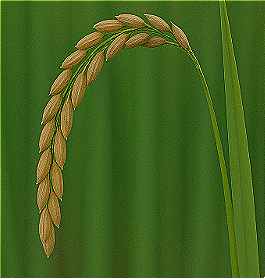 | 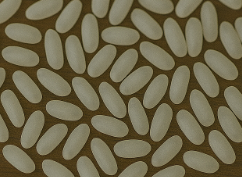 |
Botanical classification
Common name: Loto rice (Long A oval, Ribe denomination)
Clade: Angiosperms
Order: Poales
Family: Poaceae
Genus: Oryza
Species: Oryza sativa L.
Cultivation and growth conditions
Climate
Loto rice is an Italian Long A cultivar belonging to the Ribe market group, with an oval grain and good suitability for industrial processing. It is adapted to warm–temperate climates, with hot summers and constant water availability in rice-growing areas. It requires a growing season free from frost, with high temperatures during tillering, stem elongation and flowering. The crop is sensitive to low temperatures at germination and anthesis, which can reduce grain set and yield.
Exposure
Like most flooded rice types, it requires full sun to ensure adequate photosynthetic activity and good panicle development. Prolonged shading (e.g. from tall hedgerows or buildings) reduces plant vigour and grain production.
Soil
Loto rice is grown on flat soils suitable for flooding, preferably clay or clay–loam soils with good water-holding capacity and adequate organic matter content. Very sandy, highly permeable soils are unfavourable, as they do not allow a stable water layer to be maintained. Optimal pH ranges from slightly acidic to neutral or mildly alkaline.
Irrigation
The crop is usually managed under controlled flooding, maintaining a uniform water layer over the soil for most of the growing cycle. Careful regulation of water levels in the various stages (pre-emergence, tillering, stem elongation, ripening) is essential to:
control typical paddy weeds;
reduce water stress;
promote uniform crop growth.
Sudden changes in water depth or unplanned dry periods can negatively affect yield and technological quality of the grain.
Temperature
Optimal temperatures for germination are above 12–13 °C, while for vegetative growth and flowering ideal values are between 20 and 30 °C. Cold episodes at anthesis reduce fertilization and grain set; conversely, periods of intense heat combined with strong radiation and dry winds can cause grain scorching and defects such as breakage and chalkiness.
Fertilization
Loto rice requires balanced fertilization with nitrogen (N), phosphorus (P) and potassium (K):
Nitrogen, applied in split doses (pre-flooding and topdressings), should support tillering without excessively increasing lodging risk;
Phosphorus favours early crop establishment and root system development;
Potassium contributes to lodging resistance and grain quality (cooking behaviour, firmness, industrial yield).
Excess nitrogen increases susceptibility to fungal diseases (e.g. blast) and may reduce yield stability.
Crop care
Main agronomic practices include:
weed control through crop rotation, possible false sowing, mechanical operations and/or selective chemical treatments;
accurate land levelling to ensure uniform flooding;
careful management of water levels to limit unwanted aquatic species and reduce crop stress;
monitoring of diseases (especially blast) and pests, with application of integrated pest management strategies;
selection of an appropriate sowing density, according to soil fertility and input level, to limit internal competition and lodging.
Good air circulation in the canopy helps to limit diseases and favours proper panicle ripening.
Harvesting
Harvest takes place when grain ripening is uniform and grain moisture is suitable for mechanized combining. Excessive delay increases the risk of lodging, shattering and quality loss. After harvest, grain is dried to a moisture content suitable for proper storage and subsequent processing.
Propagation
The Loto cultivar is propagated using certified seed, produced in varietal seed multiplication lots to ensure genetic purity, uniform Long A oval grain and consistent commercial and technological–culinary characteristics typical of rice marketed under the Ribe denomination. On farm, paddy sowing (broadcast or in rows, on dry soil or under water) is carried out by adjusting the seed rate to the target plant density, soil fertility and the agronomic technique adopted.
Indicative nutritional values per 100 g (raw product)
Energy: 335–355 kcal
Protein: 6.5–8.0 g
Total fat: 0.8–1.2 g
SFA (Saturated Fatty Acids): very low amount
MUFA and PUFA: minor fractions
Available carbohydrates: 76–79 g
Starch: main component
Dietary fibre: 0.8–1.2 g
Minerals: phosphorus, potassium, magnesium, manganese
Vitamins: B1, B3, B6 in trace amounts
Residual moisture: 11–14 %
Key constituents
Starch (amylose and amylopectin, with a relatively relevant amylose share for this type)
Proteins (mainly prolamins and glutelins)
Residual fibre (cellulose, hemicelluloses)
Minerals: P, K, Mg, Mn
B-group vitamins
Lipids in traces (triglycerides and phospholipid fractions)
Production process
Cultivation in paddy fields with appropriate water and nutrient management.
Mechanical harvesting of mature paddy rice.
Drying to moisture levels suitable for storage.
Dehusking (removal of the hull).
Polishing (degree depending on commercial standard).
Optical and mechanical sorting of kernels.
Packaging in a dry atmosphere in sealed containers.
Physical properties
Grain type: long grain A, regular oval shape
Colour: white (more or less bright depending on polishing)
High kernel density
Medium to high water absorption
Progressive starch gelatinisation during cooking
Sensory and technological properties
Good cooking stability
Grains tend to remain separate when properly cooked
Limited surface starch release
Adequate volume yield
Typical cooking time: 15–18 minutes (depending on system and method)
Neutral taste with a simple, delicate sensory profile
These attributes make Loto rice suitable for applications where defined, separate grains are required.
Food uses
Dishes with dry or semi-separated grains
Rice salads
Baked dishes and timbales
Stuffed preparations
International recipes where well-shaped, separate grains are desired
Nutrition and health
Loto Ribe rice shows a nutritional profile typical of starch-based rices, with a moderate protein content and a low total fat level. The amount of SFA is very small and consistent with dietary models where limiting saturated fat is recommended.
Due to polishing, fibre and micronutrient levels are lower than in wholegrain rice. The amylose content can contribute to a relatively more gradual glycaemic response than in varieties dominated by amylopectin, although rice remains a carbohydrate-rich food and total glycaemic impact depends on portion size, cooking method and overall meal composition.
Portion note
For adults, a standard portion is generally 70–80 g of raw product, depending on the overall meal and individual energy needs.
Allergens and intolerances
Naturally gluten-free.
Possible cross-contamination with gluten-containing cereals in multi-grain facilities.
No major rice-specific allergens are typically reported, aside from rare individual sensitisation or rice allergy.
Storage and shelf-life
Store in a cool, dry place, away from humidity and direct light.
Typical shelf-life: 18–24 months from packaging, under correct storage conditions.
Barrier packaging with sealed closures is recommended to limit moisture uptake and contamination.
Safety and regulatory aspects
Must comply with EU and national legislation on:
contaminants, pesticide residues and mycotoxins
food hygiene requirements
traceability throughout the supply chain
food information and labelling rules
Application of food safety and hygiene management systems such as GMP/HACCP is required along the chain.
Labelling
Typical mandatory and standard information includes:
sales name (e.g. “Loto rice, long grain A, oval, Ribe denomination”)
country of origin or place of provenance
lot number and minimum durability date (“best before …”)
nutrition declaration per 100 g (and, where applicable, per portion)
storage conditions and basic cooking/use instructions
any “gluten-free” claim only if supported by appropriate process controls and analytical verification
any nutrition or health claims only if permitted and compliant with applicable legislation
Troubleshooting
Possible defects
Slightly sticky grains due to overcooking.
Reduced grain separation if the water-to-rice ratio is not appropriate.
Higher proportion of broken grains due to insufficient sorting or mechanical stress.
Preventive measures
Strict control of cooking time and water ratio.
Gentle rinsing, if desired, to reduce surface starch without damaging the grains.
Use of homogeneous lots in industrial or large-scale applications to ensure process consistency.
Sustainability and supply chain
The production chain is predominantly Italian, with cultivation mainly in the Po Valley area. Environmental impact depends on water management, fertiliser and plant protection product use, and agronomic practices.
Improvement elements may include:
optimisation of irrigation practices and water-saving technologies
crop rotation to support soil fertility and reduce disease pressure
reduction and careful control of chemical inputs
monitoring of environmental indicators, including BOD/COD in process wastewater where applicable
Main INCI functions (cosmetics)
Rice derivatives (starch, powders, extracts) obtained from Loto or similar varieties can be used in cosmetic formulations as:
Absorbent
Opacifying agent
Skin conditioning agent
Viscosity controlling agent in certain water-based or emulsion systems
Conclusion
Loto rice, long grain A, oval, Ribe denomination exhibits typical characteristics of long-grain rice with good cooking stability, limited stickiness and a stable structure. It is suitable for dry dishes, salads and preparations where distinct, well-formed grains are required. The nutritional profile is consistent with a cereal dominated by starch, offering moderate protein, low fat and very low SFA. Its technological behaviour and versatility support its use both in domestic cooking and in standardised food processing.
Mini-glossary
SFA: Saturated Fatty Acids. Class of fats which, when consumed in excess, is associated with an increased cardiovascular risk; in rice the amount is naturally very low.
MUFA: MonoUnsaturated Fatty Acids. Fats generally regarded as favourable for cardiovascular health when consumed as part of a balanced diet.
PUFA: PolyUnsaturated Fatty Acids. Fats that can contribute positively to lipid profile and inflammatory status when consumed in adequate amounts.
GMP/HACCP: Good Manufacturing Practices / Hazard Analysis and Critical Control Points. Systems and standards used to manage hygiene, safety and quality in food production and processing.
BOD/COD: Biochemical Oxygen Demand / Chemical Oxygen Demand. Wastewater quality parameters indicating, respectively, the biodegradable and chemically oxidisable fraction of organic matter, used to assess the environmental impact of industrial effluents.
Studies
In general, rice contains more than 100 bioactive substances mainly in its bran layer including phytic acid, isovitexin, gamma-oryzanol, phytosterols, octacosanol, squalene, gamma-aminobutyric acid, tocopherol and derived from tocotrienol (1), antioxidants.
It does not contain beta carotene (provitamin A) and has a very low iron and zinc content (2).
In rice bran there are bioactive phytochemicals that exert protective actions against cancer that involve the metabolism of the host and the intestinal microbiome. A diet based on rice bran has shown positive effects in reducing the risk of colon cancer (3).
Allergies: Be careful, rice contains a certain amount of lactose.
The most common types of rice used are :
- Arborio : large grains, the most common in Italy
- Ribe : elongated grains.
- Thaibonnet : medium, elongated and fine grains
- Rome : large grains
- Basmati : thin and elongated grains. Grown in Pakistan and India
- Carnaroli : large grains
- Vialone nano : large, round grains
- Original or Balilla : small round grains
- Jasmine : fine grains of Asian origin
- Red : red, small and narrow grains
- Wild : Zizania palustris
- Baldo : large, shiny grains
- Ganges : from India
- Footboard : releases a lot of starch
- Venus : from China and the Po Valley
- Patna : from Thailand. Long and narrow grains
- Sant'Andrea : Thick and long grains. Releases a lot of starch
Rice viruses and pests: Pseudomonas aeruginosa, Rice yellow mottle virus, Magnaporthe oryzae , Rice Tungro Bacilliform Virus , Lissorhoptrus oryzophilus Kuschel, Oebalus pugnax, Xanthomonas oryzae

