



Green tea is a beverage made by infusing the leaves of the plant Camellia sinensis, which belongs to the botanical family Theaceae. Unlike black tea, green tea leaves do not undergo oxidation: after harvesting they are quickly heat-treated (by steaming or pan-firing), then rolled and dried. This process helps preserve the green color of the leaves and their fresh, vegetal aroma.
As a food ingredient and beverage, green tea is appreciated for its delicate, grassy or slightly toasted flavor, depending on the variety (such as sencha, matcha, longjing, gunpowder, etc.). It contains polyphenols, catechins, caffeine (in lower amounts than black tea), and small quantities of vitamins and minerals. It is consumed hot or cold, on its own or as a base for flavored drinks. In cooking and pastry-making it can be used as an ingredient in desserts, ice creams, cookies and smoothies, and in the case of matcha, as a fine powder that adds a bright green color and characteristic taste to various preparations.
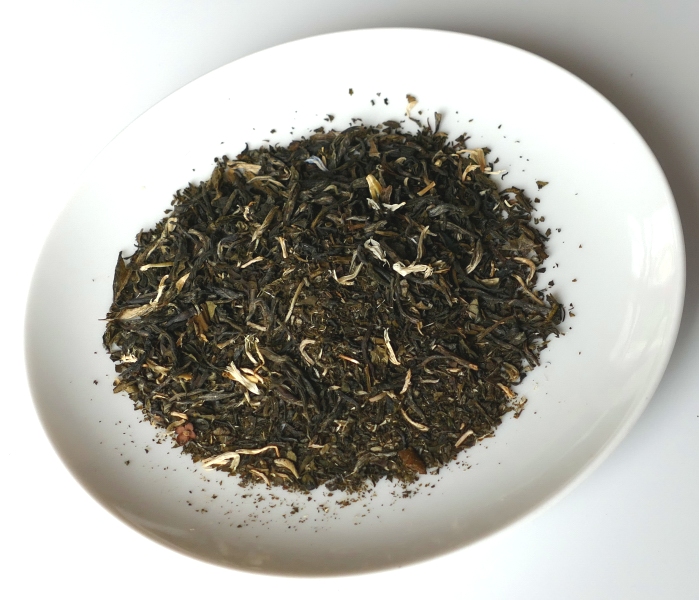
Common name: Green tea
Parent plant: Camellia sinensis (L.) Kuntze
Kingdom: Plantae
Clade: Angiosperms
Clade: Eudicots
Order: Ericales
Family: Theaceae
Genus: Camellia
Species: Camellia sinensis (L.) Kuntze
Note: Green, black, white, and oolong tea all come from the same species. The difference is processing: green tea is obtained by rapidly inactivating leaf enzymes (with heat or steam) to prevent oxidation.
Cultivation and growth conditions
Climate
Tea plants thrive in humid subtropical and temperate climates.
Optimal temperatures: 18–30 °C.
They tolerate short drops below 10 °C, but not prolonged frost.
Vigor is highest in areas with high, well-distributed rainfall throughout the year.
High-quality green tea is often produced in cool, misty mountain regions (e.g. parts of China and Japan).
Sun exposure
Tea generally prefers full sun.
More light → leaves richer in catechins and with a fresh, brisk aroma.
In some systems (e.g. gyokuro in Japan) leaves are partially shaded before harvest to increase chlorophyll and amino acids (especially L-theanine).
Soil
Tea plants require soils that are:
acidic (pH 4.5–6.0),
deep,
rich in organic matter,
moisture-retentive yet well drained.
Calcareous or very compact soils reduce both yield and quality.
Irrigation
Water requirements are high, particularly for green-tea plantations:
Regular soil moisture favors tender leaves rich in aromatic and phenolic compounds.
Waterlogging must be avoided to prevent root and collar rots.
In intensive plantations, supplemental irrigation is often used during dry periods.
Temperature
Germination: 20–25 °C
Optimal vegetative growth: 18–30 °C
Young leaves are damaged even by light frosts
Excessive heat (>35 °C) slows growth and can degrade aroma compounds
Fertilization
Tea is a nutrient-demanding crop, especially for green tea production.
Nitrogen: crucial for tender leaves and high L-theanine content; often applied in relatively high amounts.
Phosphorus: supports root development and general plant health.
Potassium: improves leaf quality, stress tolerance, and overall yield.
In traditional systems, well-rotted manure and compost are used to sustain soil fertility over time.
Crop care
Regular pruning to maintain a low, bushy shape (“tea bush”) and to facilitate hand or mechanical plucking.
Removal of flower buds, as flowering diverts energy away from leaf production.
Weed control in young plantations.
Monitoring for pests (tea leafhoppers, leaf rollers, caterpillars, sucking insects) and diseases (anthracnose, blister blight, powdery mildew).
Good air circulation reduces fungal pressure and excessive humidity around the canopy.
Harvest
Harvesting for green tea is highly selective.
The best quality comes from the terminal bud (“pekoe”) plus 1–2 young leaves.
For high-grade teas, harvesting is done by hand; large plantations may use mechanical harvesters.
Harvest season: spring to summer, often in multiple “flushes” (spring flush, summer flush, etc.).
Immediately after picking, leaves are heat-treated (steamed or pan-fired) to deactivate polyphenol oxidase and prevent oxidation, preserving the “green” character.
Propagation
Tea plants are propagated by:
Seed: traditional method, but results in high genetic variability.
Cuttings: preferred in modern plantations to maintain uniform, selected clones.
Layering (marcotting): used locally in some systems.
New plants generally need 3–5 years before entering full production.
Caloric Value (Per 100 g Of Product)
Ready-to-drink infusion (unsweetened): ~0–3 kcal/100 g (negligible energy at use levels).
Dried leaf/powder (matcha): ~250–350 kcal/100 g.
Hydroalcoholic extract: ~50–150 kcal/100 g (depends on solids and EtOH residue).
Glyceric/glycolic extract: ~150–300 kcal/100 g.
Standardized dry extract (powder): ~200–350 kcal/100 g.
Key Constituents
Polyphenols: catechins (notably EGCG – epigallocatechin gallate; EGC – epigallocatechin; ECG – epicatechin gallate; EC – epicatechin) with marked in-vitro antioxidant activity; potential contribution to oxidative protection, with caution at high EGCG intakes due to possible hepatic effects. Flavonols (quercetin, kaempferol) and phenolic acids (gallic).
Methylxanthines: caffeine (theine), theobromine, theophylline; may support alertness and, in sensitive individuals, cause insomnia/jitteriness.
Amino acids: L-theanine (adds umami and may have a calming effect).
Minerals and micronutrients: potassium, manganese; traces of others.
Volatile components: terpenic alcohols (e.g., linalool), aldehydes, and esters contributing to the green–floral profile.
Analytical markers: total catechins and EGCG by HPLC; caffeine; TPC (Folin–Ciocalteu) as a global phenolic indicator.
Production Process
Raw materials: tender buds and first leaves selected by cultivar and terroir; removal of foreign matter.
Enzyme inactivation: rapid thermal treatment (steam or pan-firing) to block polyphenol oxidase and prevent oxidation.
Rolling/shaping: mechanical rolling to rupture cells and define form and extraction behavior.
Drying: to low moisture for stability; for fine powders (matcha), stone-milling of leaves stripped of main veins.
Extraction (for functional extracts): water/EtOH at controlled temperature, optionally with adsorption resins to enrich catechins; optional decaffeination (e.g., CO₂ supercritical).
Concentration and standardization: filtration, gentle concentration, setting the assay in catechins/EGCG and caffeine; spray-dry encapsulation with suitable carriers when required.
Quality controls: HPLC profile (catechins/caffeine), TPC, pesticides and metals, moisture/aw, microbiology; packaging per GMP/HACCP.
Sensory And Technological Properties
Aroma/color: green, herbaceous, sometimes floral notes; yellow-green hue in infusion.
Astringency and body: driven by catechins and methylxanthines; L-theanine adds umami that can round the profile.
Compatibility: risk of haze from polyphenol–protein or metal-ion complexes; water hardness and pH influence clarity and taste.
Food Applications
Infusions and RTD beverages; syrups and flavor bases; confectionery and chocolate; dairy/ice-cream; baked goods; dressings and snacks; fine powder (matcha) for delicate color and signature taste. Indicative dosages: 0.05–0.50% dry extract in liquids (per sensory target); 0.3–2.0% powder in doughs/desserts; for functional beverages, 50–200 mg total catechins per serving as a typical technological range.
Nutrition And Health
Leaves supply polyphenols with in-vitro antioxidant activity. In foods, no health claims should be assigned without specific authorization. Caffeine provides a stimulant effect; L-theanine can modulate taste perception and, per literature, may have relaxing effects. High-EGCG supplements require caution and appropriate labeling (possible risks at elevated doses in susceptible individuals).
Quality And Specifications (Typical Topics)
Assay in total catechins and EGCG (via HPLC); caffeine; TPC.
Physicochemical parameters: moisture/aw, particle size (powders), pH of test solution, color index.
Contaminants: pesticides within legal limits; heavy metals; residual solvents where applicable; compliant microbiology.
Sensory: absence of off-flavors (old-hay notes, excessive roast).
Traceability and hygiene: conformity to GMP/HACCP along the chain.
Storage And Shelf Life
Store protected from light, humidity, and oxygen, in low-permeability barrier packs; inert headspace and reduced DO are preferable.
For powders: control RH and aw to avoid caking and aroma fade; reseal tightly after use.
Avoid temperature swings that accelerate residual-lipid rancidity and aroma decay. Apply FIFO rotation.
Allergens And Safety
Tea is not among major allergens; mind caffeine for children, pregnant individuals, and sensitive subjects. Check any EtOH limits in hydroalcoholic extracts and labeling requirements related to caffeine and decaffeinating agents.
INCI Functions In Cosmetics
Typical entries: Camellia Sinensis Leaf Extract; Camellia Sinensis Leaf Powder; Camellia Sinensis Leaf Water.
Roles: antioxidant, skin conditioning, mild astringent, soothing, and masking; in some formulas, polyphenols contribute secondary preservation.
Troubleshooting
Excess bitterness/astringency: high dose or “hard” catechin-rich extract → reduce dose, use softer fractions, balance with sweetness/umami, optimize application pH.
Haze: polyphenol–protein or Ca/Mg complexes → clarification, fine filtration, mild chelants; assess water hardness.
Sedimentation in beverages: fine particles or polyphenolic complexes → increase colloidal stability (hydrocolloids), microfiltration.
Caffeine above target: variable raw materials → HPLC checks, optional CO₂ supercritical decaffeination.
Sustainability And Supply Chain
Adoption of responsible agronomic practices (e.g., integrated pest management), voluntary certifications, and traceability; valorization of spent leaves via secondary extraction or composting. Effluent management with BOD/COD targets and reduced water consumption; recyclable packaging and temperature-controlled logistics support stability and lower impact.
Conclusion
Green tea leaves offer a distinctive sensory profile and a polyphenolic toolkit suitable for multiple applications. Performance depends on raw-material quality, initial thermal handling, catechin standardization, and protection from light/oxygen/humidity; with these controls, stable, consistent, and pleasant products are achievable.
The characteristic scent of tea seems to be influenced by the jasmonic acid present in the leaves (1).
When tea is taken to prevent or combat disease, attention should be paid to doses and, as with almost all herbs, ingestion of large amounts may be toxic. When the tea is taken for therapeutic purposes for cardiovascular diseases, diabetes and more, the best results are obtained in people who consume 3-4 cups of tea (600-900 mg of catechins) per day (2).
This study believes that green tea plays a neuroprotective role in neurodegenerative diseases and memory decline with old age, such as Alzheimer's disease (3).
A polysaccharide composed only of glucose has been isolated from the green lemon and the authors of the discovery explain how this polysaccharide can be a potential therapeutic agent on prostate cancer (4).
Oral administration of green tea extract exercised cardioprotective activity and prevented doxorubicin induced cardiotoxicity by accelerating heart antioxidant defense mechanisms and down regulating the lipid peroxidation levels to the normal levels (5).
The protective effect against hematologic neoplasms, especially acute myeloid leukemias has been suggested (6).
EtOH — Ethanol: hydroalcoholic co-solvent; relevant for labeling if residual.
EGCG — Epigallocatechin gallate: predominant green-tea catechin; positive for antioxidant activity; caution at high doses due to potential hepatotoxicity.
EGC — Epigallocatechin: non-esterified catechin; antioxidant, moderate astringency.
ECG — Epicatechin gallate: esterified catechin; antioxidant, contributes to astringency.
EC — Epicatechin: non-esterified catechin; antioxidant, contributes to body.
HPLC — High-performance liquid chromatography: quantitative analysis of catechins/caffeine and other markers.
TPC — Total phenolic content: Folin–Ciocalteu method; global, non-specific phenolic indicator.
RTD — Ready to drink: beverage ready for consumption.
CO₂ (supercritical) — Carbon dioxide in the supercritical phase: extraction/decaffeination with low solvent residue.
GMP — Good manufacturing practice: production practices for quality and hygiene.
HACCP — Hazard analysis and critical control points: preventive system with defined CCP.
BOD/COD — Biochemical/chemical oxygen demand: effluent organic-load indicators.
DO — Dissolved oxygen: should be minimized to limit oxidation.
RH — Relative humidity: control for powder stability.
aw — Water activity: fraction of “free” water related to stability and microbiology.
FIFO — First in, first out: stock rotation prioritizing older lots.
CCP — Critical control point: step where a control prevents/eliminates/reduces a hazard.

