



Cucumber
(Cucumis sativus – family Cucurbitaceae, fresh whole fruit, slices, sticks, juice and purées)
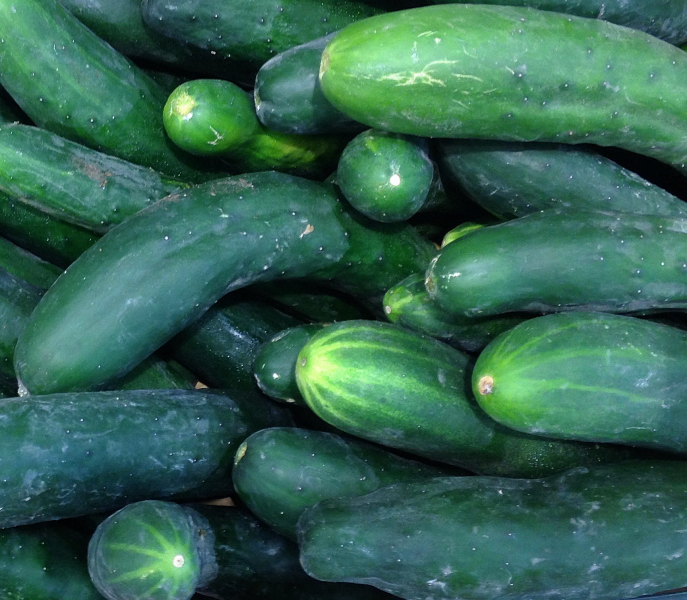
Cucumber (Cucumis sativus) is an annual herbaceous plant of the family Cucurbitaceae, grown for its elongated green fruits with very high water content. The plant has creeping or climbing stems, large heart-shaped leaves and small yellow flowers. The fruits, commonly called cucumbers, vary in shape, size and surface (smooth or slightly rough) depending on the variety, and are made up mostly of water, with a thin outer skin and a tender, juicy interior.
As a food ingredient, cucumber is appreciated for its fresh, mild taste. It is mainly eaten raw in salads, crudités and sandwiches, or processed into pickles. It is also used as a base for sauces and dips, such as tzatziki, and pairs well with yogurt, fresh herbs, lemon and extra-virgin olive oil. From a nutritional point of view, cucumber is rich in water, provides some dietary fiber and small amounts of vitamins (particularly vitamin K and vitamin C) and minerals such as potassium and magnesium. Thanks to its low calorie content and refreshing sensation, it is often included in light dishes and summer salads.
Botanical classification
Common name: cucumber
Botanical name: Cucumis sativus L.
Botanical family: Cucurbitaceae
Probable origin: South Asia, now cultivated worldwide
Habit: annual herb with creeping or climbing stems and tendrils
Vine length: shoots can reach 1–3 m when trained on supports
Lifespan: annual
Cultivation and growth conditions
Climate
Prefers warm temperate to warm climates.
Sensitive to cold and frost; does not tolerate temperatures near 0 °C.
Grows best with mild springs and warm summers with good water availability.
Exposure
Requires full sun, with many hours of light per day.
In overly shaded positions it:
flowers less,
produces fewer fruits and more deformities.
Soil
Prefers soils that are:
fertile,
well drained,
of medium texture (loam–sandy or loam–silty),
rich in organic matter.
Ideal pH: 6.0–7.5.
Does not like heavy, cold soils prone to waterlogging.
Irrigation
Needs plenty of water, especially:
during flowering,
during the fruit enlargement phase.
Keep the soil constantly fresh and moist but not waterlogged.
Avoid strong fluctuations between dry and very wet soil, which can lead to bitter or misshapen fruits.
Prefer soil-level irrigation, avoiding excessive wetting of the foliage.
Temperature
Optimal growth range: 18–28 °C.
Below 12–14 °C growth slows markedly.
Above 32–34 °C, with low humidity, plants may suffer stress and drop flowers.
Fertilization
A nutrient-demanding crop.
Before sowing or transplanting:
incorporate well-rotted manure or compost to enrich the soil.
During the crop cycle:
provide a balanced supply of nitrogen (N), phosphorus (P) and potassium (K);
potassium is important for fruit quality and firmness.
Avoid excess nitrogen, which makes plants overly vegetative and more disease-prone.
Crop care
Light hoeing to control weeds and aerate the soil.
Mulching (straw, biodegradable films, etc.) helps to:
reduce weeds,
maintain moisture,
prevent direct contact between fruits and soil.
When grown on trellises, tie the vines to supports to improve aeration and fruit health.
Monitor common diseases such as powdery mildew, downy mildew, root rots, and pests such as aphids and whiteflies.
Harvest
Fruits are harvested continuously, as soon as they reach the desired commercial size and while they are still tender and crisp.
The harvest period usually extends from late spring to late summer, depending on sowing time and region.
Frequent picking (every 2–3 days) stimulates the plant to produce new fruits.
Propagation
Propagated by seed.
Direct sowing in the field:
when the risk of frost has passed and the soil has warmed (typically in spring);
sow in hills or rows, placing 2–3 seeds per hole and thinning to the best seedlings.
It is also possible to sow in trays or pots and transplant when seedlings have 2–3 true leaves and the weather is favorable.
Indicative nutritional values (per 100 g raw cucumber with peel)
(Average values for fresh, unseasoned product.)
Energy: 12–18 kcal
Water: ≈ 95–97 g
Protein: 0.5–0.8 g
Total fat: 0.1–0.3 g
first occurrence: SFA/MUFA/PUFA = saturated/monounsaturated/polyunsaturated fatty acids.
In cucumbers overall fat content is extremely low, and the contribution of SFA is minimal, while the small MUFA/PUFA fraction is nutritionally negligible. Cucumbers do not meaningfully influence dietary fat intake.
Carbohydrates: 2–4 g (simple sugars ≈ 1.5–2.5 g)
Dietary fibre: 0.4–1.0 g
Sodium (natural): very low (≈ 2–10 mg)
Potassium: ≈ 130–170 mg
Vitamin C: ≈ 2–5 mg
Vitamin K: ≈ 10–20 µg
Minor amounts of vitamin A (carotenoids), folates, magnesium and manganese.
(Dressings, salt and added oils considerably change nutrient values.)
Key constituents
Water
predominant component (>95%), responsible for very low energy density and refreshing character.
Carbohydrates
mostly simple sugars and small amounts of polysaccharides;
limited but useful fibre contribution, especially with peel.
Proteins
low total protein amount, with traces of essential amino acids.
Lipids
very small total lipid content;
traces of unsaturated fatty acids, phytosterols and lipophilic compounds in peel and seeds.
Vitamins, minerals and phytochemicals
potassium, magnesium, calcium in small amounts;
vitamin K and vitamin C in moderate levels;
traces of phenolic compounds, flavonoids and cucurbitacins, which can contribute slight bitterness and antioxidant activity.
Production process
Cultivation
grown in open fields or greenhouses, requiring warm conditions, abundant water and well-drained soils;
trained on trellises or supports;
integrated or organic practices often used to reduce pesticide input.
Harvesting
fruits picked manually or mechanically at the right size and physiological immaturity (firm texture, small soft seeds);
careful handling is important to prevent bruising and rapid deterioration.
Post-harvest operations
sorting, grading and removal of damaged fruits;
washing (sometimes brushing);
for industry: slicing, dicing or stick-cutting, rapid cooling and packing.
Packaging
fresh produce packed in crates, trays or flow-packs;
ready-to-eat (fresh-cut) cucumber packed under modified atmosphere (MAP) and kept under cold chain.
Physical properties
Structure: juicy flesh with crisp texture; central cavity containing seeds;
Colour: peel from light to dark green; interior pale green to nearly white;
pH: slightly acidic to neutral (~5.5–6.5);
Water activity (aw): very high → product is highly perishable without refrigeration.
Sensory and technological properties
Flavour and aroma
mild, slightly sweet and watery flavour;
characteristic fresh “green” aroma due to volatile aldehydes, alcohols and esters;
slight bitterness (cucurbitacins) may appear near the peel in some cultivars.
Texture
crisp and refreshing when fresh;
loses firmness over time or with inappropriate storage conditions.
Processing behaviour
prone to dehydration and softening;
becomes soft when cooked;
ideal for salads, cold dishes, marinades and pickling.
Food uses
Home and foodservice
eaten raw in mixed salads, poke bowls, sandwiches and wraps;
used in yogurt-based sauces (tzatziki), gazpacho and cold soups;
consumed as sticks for dips or crudités.
Food industry
component of ready-to-eat salads, fresh-cut vegetables and grain salads;
ingredient in vegetable juices, smoothies and green blends;
raw material for pickles (fermented or acidified);
used in sauces and ready meals.
Nutrition and health
Very low in calories and excellent for increasing meal volume with minimal energy intake.
Supports hydration due to its high water content.
Provides small amounts of vitamin K, vitamin C, potassium and folates.
Low sugar content compared with many vegetables.
Portion note:
as salad/side: 80–150 g per portion;
in sauces (e.g., tzatziki): 20–50 g inside the sauce portion.
Allergens and intolerances
Cucumber itself is not a major allergen.
Possible issues:
oral allergy syndrome in individuals allergic to certain pollens (cross-reactivity),
rare individual intolerances.
In processed products (salads, sauces) allergens such as milk, egg, mustard, gluten, soy may be present depending on the recipe and must be clearly labelled.
Quality and specifications (typical criteria)
Appearance and texture
firm, straight fruits with intact peel and uniform colour;
no yellowing, soft areas or dehydration marks.
Chemical and physical parameters
Brix as an indicator of sugars;
nitrate levels within legal limits;
pesticide residues compliant with regulations.
Microbiology
low surface counts, especially for fresh-cut products;
strict hygiene and temperature control under HACCP.
Storage and shelf-life
Whole fresh cucumbers
optimal storage: 7–10 °C, high humidity (90–95%);
temperatures too low can cause chilling injury (watery or translucent spots);
typical shelf-life: 1–2 weeks.
Fresh-cut cucumbers
storage at 0–4 °C under MAP;
shelf-life: 5–10 days, with progressive loss of crispness.
Avoid prolonged exposure to sunlight, dryness or heat.
Safety and regulatory aspects
Classified as fresh fruit/vegetable; must comply with legal limits for:
pesticide residues,
nitrates,
contaminants (metals, environmental residues).
Fresh-cut and ready-to-eat cucumber products require:
GMP/HACCP controls,
strict hygiene in washing and cutting,
full cold-chain management.
Labelling
For whole fresh product:
name (“cucumber”), origin, class, size, lot.
For processed/fresh-cut products:
full ingredient list,
declaration of any allergens,
nutrition declaration,
storage conditions and use-by date.
Troubleshooting
Loss of firmness / soft cucumbers
causes: dehydration, improper temperature, advanced age;
actions: correct storage temperature and humidity, optimise packaging.
Yellowing of peel
indicates over-maturity;
actions: harvest earlier, avoid heat/light exposure.
Developed seeds or internal cavities
caused by over-maturity or agronomic imbalance;
actions: optimise harvest timing and irrigation.
Microbial spoilage in fresh-cut products
causes: poor hygiene, insufficient cooling;
actions: improve sanitation, cold chain and product scheduling.
Sustainability and supply chain
Cucumbers have a low–moderate carbon footprint, especially when produced locally and seasonally.
Main concerns:
water use and fertilisation in greenhouse systems,
waste along the supply chain (size defects, dehydration).
Best practices:
integrated/organic cultivation,
optimised cold-chain logistics and FIFO rotation,
recovery of off-grade fruit for animal feed, biogas or composting.
Main INCI functions (cosmetics)
Extracts derived from cucumber (Cucumis Sativus Fruit Extract) are used for:
skin conditioning,
perceived soothing and refreshing action,
light “green/vegetal” fragrance notes.
Conclusion
Cucumber is a very low-calorie, high-water vegetable that contributes freshness, hydration and mild flavour to dishes. While not nutrient-dense, it is valuable in low-energy diets, fresh salads, ready meals and sauces. Proper cultivation, handling and cold-chain management help preserve its crispness, colour and quality, with relatively low environmental impact compared to many other food chains.
Mini-glossary
SFA/MUFA/PUFA – saturated/monounsaturated/polyunsaturated fatty acids. Cucumbers contain very little total fat, so their influence on dietary fat intake is negligible.
GMP/HACCP – good manufacturing practices / hazard analysis and critical control points; preventive systems ensuring hygiene, safety and traceability in fresh and fresh-cut produce.
BOD/COD – biochemical/chemical oxygen demand; indicators of organic load in processing wastewater, used in designing and monitoring treatment systems.
FIFO – first in, first out; inventory rotation principle to minimise spoilage and waste.
Studies
Recent studies have attributed cucumber nutraceutical properties to cucumber for its discreet content of minerals, fiber and vitamins.
It consists of:
- water 95%
- carbohydrates 3.6%
- protein 0.65%
nutraceuticals (1):
- Vitamin C 8mg/100g
- Vitamin E 0.16mg/100g
- Retinol 28ug/100g
- Vitamin B9 15ug/100g
- Flavonoids
What it is used for and where
Medical
This study attributes to cucumber the effectiveness of reducing pain in moderate osteoarthritis (2).
Traditional medical medicine used it to treat hyperlipidaemia, constipation and headaches. It has anti-inflammatory and antioxidant properties (3) and the fruit juice of this plant is used as an emollient in anti-acne lotions. It has been studied in some animal models where anti-hyperglycaemic effects were observed (4).
Cosmetics
The aqueous extract of cucumber has demonstrated cooling properties that soothe irritated skin and reduce swelling (5).
For more information:
References_______________________________________________________
(1) Alsadon A., Al-Helal I., Ibrahim A., Abdel-Ghany A., Al-Zaharani S., Ashour The effects of plastic greenhouse covering on cucumber (Cucumis sativus L.) growth. T. Ecol. Eng. 2016;87:305–312. doi: 10.1016/j.ecoleng.2015.12.005.
Abstract. Cucumber (Cucumis sativus L.) is an important vegetable crop belonging to the cucurbit family. Cucumbers are grown under protected cultivation worldwide. The influence of greenhouse covering materials on cucumber physiological processes and yield were evaluated. Three greenhouses, each with 48 m2, North–South direction and with wet-pad and fan cooling system were covered by either one of the 200 μm thickness plastic films; newly developed NIR-reflective film (C1) and two commercial films (C2 and C3). The predicted equations of the photosynthetic rate (μmol CO2 m−2 s−1), transpiration (m mol H2O m−2 s−1), intercellular CO2 concentration (μmol CO2 mol−1), stomatal conductance (mol H2O m−2 s−1) and leaf temperature were obtained by multiple regression analysis of the measured data. The average temperatures were 22.27 ± 2.06 °C, 23.80 ± 2.26 °C, 25.42 ± 2.41 °C and 31.12 ± 4.30 °C for films C1, C2, C3 and outside respectively. The results revealed that vapour pressure deficit (VPD) under (C1) was lower than that under C2 and C3 during the production period. The average of photosynthetic rate values were 16.61 ± 5.49, 15.51 ± 5.18 and 14.91 ± 4.78 μmol CO2 m−2 s−1 for films C1, C2 and C3, respectively. While, the transpiration rate and the intercellular CO2 concentration under (C1) were higher than those under C2 and C3 during the production period. Therefore, fruit and yield traits increased under C1 followed by C2 and then by C3 of greenhouses covers. It can be concluded that the greenhouses plastic covering material has a great influence on the internal environmental conditions, physiological processes and productivity of cucumber plants.
(2) Nash RJ, Azantsa BK, Sharp H, Shanmugham Effectiveness of Cucumis sativus extract versus glucosamine-chondroitin in the management of moderate osteoarthritis: a randomized controlled trial. V. Clin Interv Aging. 2018 Oct 25;13:2119-2126. doi: 10.2147/CIA.S173227.
Abstract. Purpose: Osteoarthritis (OA) is an age-related disease caused by the wear and tear of the joints. Presently, there is no known cure for OA, but its management involves the use of high doses of pain killers and antiinflammatory agents with different side and dependency effects. Alternative management strategies involve the use of high doses of glucosamine-chondroitin (GC). This study was carried out to evaluate the efficacy of Q-Actin™, an aqueous extract of Cucumis sativus (cucumber; CSE) against GC in the management of moderate knee OA.....Conclusion: The use of 10 mg CSE, twice daily, was effective in reducing pain related to moderate knee OA and can be potentially used in the management of knee pain, stiffness, and physical functions related to OA.
(3) Mukherjee PK, Nema NK, Maity N, Sarkar BK. Phytochemical and therapeutic potential of cucumber. Fitoterapia. 2013 Jan;84:227-36. doi: 10.1016/j.fitote.2012.10.003.
(4) Chandrasekar B, Mukherjee B, Mukherjee SK. Blood sugar lowering potentiality of selected Cucurbitaceae plants of Indian origin. Indian J Med Res. 1989 Aug;90:300-5.
Abstract. Using five experimental models, the blood sugar lowering efficacy of eight plants of Cucurbitaceae family has been assessed. The ethanolic extract of Cucumis sativus Linn, Cucumis melo utilissimum Roxb, Cucumis melo Linn, Benincasa hispida Thunb Cogn and Tricosanthes anguina Nees, when administered in 250 mg/kg dose, orally to rats failed to lower blood sugar or to depress the peak value, after glucose load. However, ethanolic extract of Momordica charantia Linn plant and Coccinia indica Whit and Arn root significantly lowered blood sugar in fasted model and depressed the peak value in glucose loaded model. Ethanolic extract of Tricosanthes dioica Roxb plant caused a significant lowering of blood sugar in fasted rats and depressed the peak value in glucose loaded single and longterm fed groups of rats. The ethanolic extract of the aerial part of T. dioica also induced significant depression in the peak values in the glucose loaded models.
(5) Kumar D, Kumar S, Singh J, Narender, Rashmi, Vashistha B, Singh N. Free Radical Scavenging and Analgesic Activities of Cucumis sativus L. Fruit Extract. J Young Pharm. 2010 Oct;2(4):365-8. doi: 10.4103/0975-1483.71627.
Abstract. The aqueous fruit extract of Cucumis sativus L. was screened for free radical scavenging and analgesic activities. The extract was subjected to in vitro antioxidant studies at 250 and 500 μg/ml and analgesic study at the doses 250 and 500 mg/kg, respectively. The free radical scavenging was compared with ascorbic acid, BHA (Butylated hydroxyl anisole), whereas, the analgesic effect was compared with Diclofenac sodium (50 mg/kg). The C. sativus fruit extract showed maximum antioxidant and analgesic effect at 500 μg/ml and 500 mg/kg, respectively. The presence of flavonoids and tannins in the extract as evidenced by preliminary phytochemical screening suggests that these compounds might be responsible for free radical scavenging and analgesic effects.

