



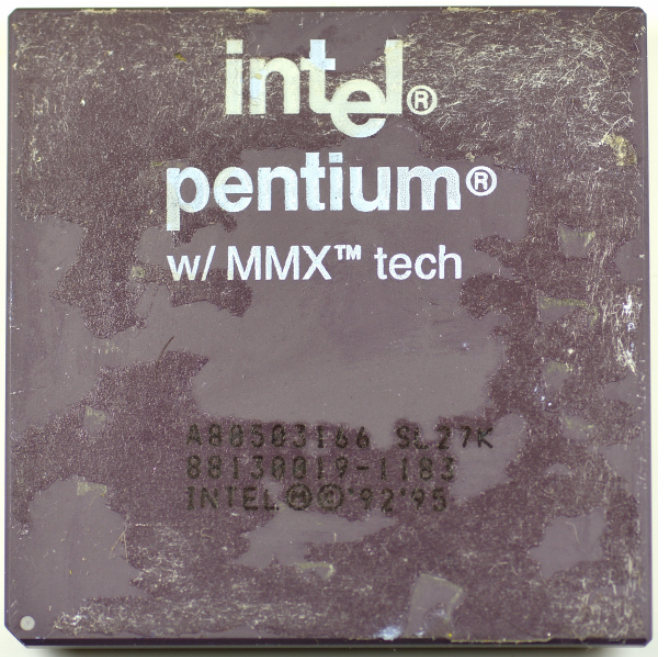
Intel Pentium MMX A80503166 SL27K
Pentium processor with MMX technology at 166 MHZ, 66 MHZ FSB, and 512 K L2 cache
The Intel Pentium MMX A80503166 SL27K is a processor in the Intel Pentium family that integrates MMX technology, introduced to improve efficiency for repetitive “block-style” integer operations (typical of multimedia, audio, 2D graphics, and some compression routines). The “Pentium processor with MMX technology” designation identifies a Pentium variant optimized at the instruction/throughput level for specific workloads while preserving compatibility with the x86 software ecosystem of its era.
The Pentium with MMX series was offered at several clock speeds: 133, 166, 200, 233, 266, 300 MHZ. The model covered in this report is the 166 MHZ version.
MMX technology: practical meaning
MMX introduces dedicated instructions for parallel integer operations (early SIMD-style acceleration), with the goal of improving performance on:
low/medium complexity audio and video processing
filters and transforms on 2D images
codec and compression routines with data-level parallelism
consumer applications that benefit from higher throughput on repetitive operations
In real-world use, the benefit depends strongly on software: gains are visible only when applications and libraries actually use MMX instructions.
Frequency and bus: 166 MHZ with 66 MHZ FSB
Frequency: 166 MHZ
The 166 MHZ clock defines the core performance profile. In practice, on “classic” workloads (office, GUI, DOS/Windows-era applications), responsiveness is driven by clock rate, memory latency, and cache behavior.
FSB speed: 66 MHZ
The 66 MHZ FSB is the link between the CPU and the chipset (memory and I/O). Operationally:
bandwidth to RAM and peripherals depends heavily on the chipset and motherboard quality
a 66 MHZ FSB is a typical constraint of this Pentium generation, so cache plays a key role in reducing main-memory traffic
L2 cache: 512 K and performance impact
L2 cache: 512 K
A 512 K L2 cache reduces how often the CPU must access main memory, improving performance consistency on medium working sets. In practice:
it improves smoothness under light multitasking and library-heavy applications
it reduces penalties when RAM is relatively slow or the chipset is less efficient
in some memory-bound scenarios it can matter more than a small clock increase
Power and thermals: 2.7–2.9 V and 13.1 W TDP
Voltage: 2.7 V – 2.9 V
The 2.7–2.9 V supply range aligns with the transition to lower voltages compared to early 5 V Pentiums, with benefits in power and heat.
TDP: 13.1 W
A 13.1 W TDP places the processor in a relatively manageable cooling class for desktop systems of the era (compact heatsinks with a fan), with a positive effect on stability and noise versus higher-power parts.
Model identification: what the codes indicate
A80503166
The “A80503” prefix identifies the Pentium family/line, while “166” indicates the 166 MHZ speed grade (also useful for quick variant recognition).
SL27K
The SL27K code is an sSpec used to uniquely identify stepping, revision, and production characteristics, useful for motherboard/BIOS compatibility and electrical requirements.
Sketch of the most important connections
                 66 MHZ FSB + chipset (memory and I/O)
        ┌─────────────────────────────────────────────────────┐
        │  chipset / northbridge + RAM + I/O controllers       │
        │  RAM, storage, peripheral buses, BIOS                │
        └───────────────────────────┬─────────────────────────┘
                                    │
                                    ▼
                     ┌─────────────────────────────┐
                     │  Pentium MMX SL27K           │
                     │  166 MHZ                     │
                     │  MMX                         │
                     │  512 K L2                    │
                     │  2.7–2.9 V, 13.1 W TDP       │
                     └─────────────┬───────────────┘
                                   │
                                   ├────────► RAM (via chipset over FSB)
                                   └────────► I/O (storage/network/video via platform)
Table 1 – Identification data and specifications
| Characteristic | Indicative value |
|---|---|
| Model | A80503166 SL27K |
| Family | Pentium with MMX technology |
| Frequency | 166 MHZ |
| FSB speed | 66 MHZ |
| L2 cache | 512 K |
| Voltage | 2.7 V – 2.9 V |
| TDP | 13.1 W |
| Series available speeds | 133, 166, 200, 233, 266, 300 MHZ |
Table 2 – Operational and design considerations
| Aspect | Practical meaning |
|---|---|
| MMX | Improves throughput on optimized routines (multimedia and block operations) |
| 166 MHZ | Mid-range performance profile of the MMX series, platform-dependent |
| 66 MHZ FSB | Generation-typical limit; chipset and RAM strongly affect real performance |
| 512 K L2 | Reduces RAM traffic and improves stability on medium working sets |
| 2.7–2.9 V | Lower voltage than earlier generations, improving power characteristics |
| 13.1 W TDP | Relatively simple cooling and good thermal stability in desktop systems |

