



Intel SK121 (Mobile Pentium 100 MHz, TT80502100, TCP package)
The SK121 code identifies an Intel Mobile Pentium designed for laptop computers, belonging to the “classic” Pentium P5 generation (before the introduction of MMX), featuring a superscalar architecture and full compatibility with the x86 software ecosystem of the time. The mobile variant is mainly distinguished by the adoption of Voltage Reduction Technology (VRT) and SL enhanced power-saving features, intended to reduce power consumption and thermal requirements in notebooks.
Note on codes: the correct part number is TT80502100 (it is sometimes reported with an extra trailing “0” due to a typo).
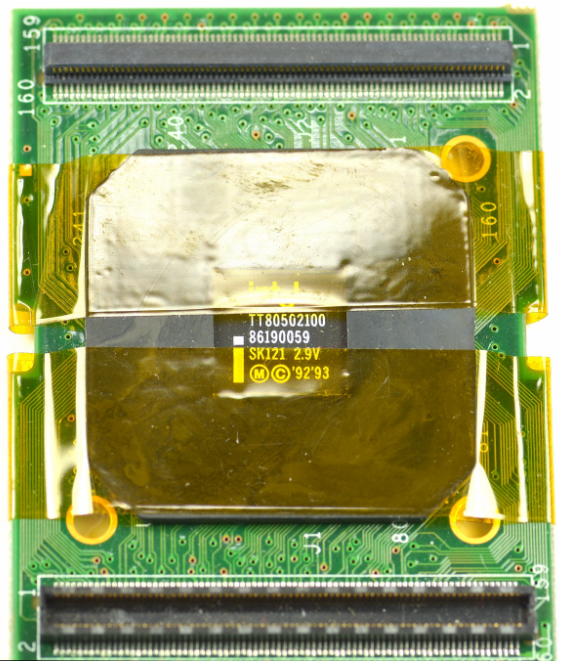
Platform context
This Mobile Pentium 100 MHz operates with a 66 MHz FSB, a typical scheme of the mid-1990s in which real-world performance depends heavily on:
the efficiency of the chipset and the memory controller
RAM latency and bandwidth
mobile power management policies (clock control and energy management)
In this context, the advantage of the mobile version is not “faster”, but better suited to the power/thermal constraints of laptops.
Practical meaning of frequency, bus, and CPUID
Frequency 100 MHz
It defines the core throughput for the typical integer/floating-point workloads of the time (GUI, productivity, legacy applications). In a notebook, the effective frequency can be influenced by clock management and the power profile.
Bus 66 MHz
The front side bus at 66 MHz connects the CPU to the chipset: system memory and much of the I/O “pass through” it. In memory-sensitive applications, the limit is not only the CPU but also the RAM/chipset subsystem.
CPUID 0570h
The 0570h value is a signature identifying the CPU family/model/stepping (Pentium family 5 signature). Operationally, it is mainly useful for BIOS, kernel, and diagnostic compatibility rather than for performance.
Split supplies: core 2.9 V and I/O 3.3 V
The most “mobile-oriented” specification is the dual supply:
Core: 2.9 V → significantly reduces the power dissipated in the core (where much of the consumption is concentrated).
I/O: 3.3 V → preserves electrical compatibility with the external ecosystem (chipset and 3.3 V logic of the time).
This separation is the core of VRT: lower dissipation and easier integration in compact designs.
TCP package: what it implies and why it is “for laptops”
The specified package is TCP (Tape Carrier Package), a “flat” solution aimed at reduced footprint and integration in thin systems. From a design perspective, TCP is typically associated with:
better suitability for small form factor designs
optimized thermal handling compared to more traditional packages, under comparable design conditions
integration consistent with notebooks and embedded/mobile solutions of the same era
In practice: it is not an aesthetic detail, but a strong indicator that the component was designed for compact systems (unlike many desktop variants in PGA/SPGA).
Simplified functional diagram
FSB 66 MHz (CPU ↔ chipset link)
┌──────────────────────────────┐
│ Chipset / northbridge         │
│ RAM + I/O controller          │
└───────────────┬──────────────┘
                │
                ▼
       ┌──────────────────────┐
       │ Intel Mobile Pentium  │
       │ SK121 – 100 MHz       │
       │ CPUID 0570h           │
       │ Core 2.9 V / I/O 3.3 V│
       │ TCP package           │
       └──────────────────────┘
Table 1 – Identification data and specifications
| Characteristic | Indicative value |
|---|---|
| Model / sSpec | SK121 |
| Family | Intel Mobile Pentium |
| Part number | TT80502100 |
| Frequency | 100 MHz |
| Bus speed (FSB) | 66 MHz |
| CPUID | 0570h |
| Core supply | 2.9 V |
| I/O supply | 3.3 V |
| Package type | TCP (Tape Carrier Package) |
Table 2 – Operational and design aspects
| Aspect | Practical meaning |
|---|---|
| 100 MHz | Performance consistent with mid-1990s notebooks; strongly platform-dependent (RAM/chipset) |
| FSB 66 MHz | Typical generation bottleneck: memory and I/O affect responsiveness |
| CPUID 0570h | Identifier useful for BIOS/OS compatibility and hardware diagnostics |
| Core 2.9 V + I/O 3.3 V | VRT: lower power and heat in the core while maintaining 3.3 V external compatibility |
| TCP | “Flat” package for notebooks: reduced footprint and characteristics suited to compact designs |
| SL enhanced | Power management features (e.g., clock control and system management modes) for mobile use |

