



Royal Armoury, Turin
Where armour, art and Savoy history come to life
The Royal Armoury of Turin houses one of the world’s most important collections of historic arms and armour. Displayed in the spectacular Beaumont Gallery, it forms part of the Royal Museums and includes armour for warfare and tournaments, swords, firearms, shields, saddles, horse bits, flags and precious objects owned by the Savoy family or received by the court through purchases and diplomatic gifts.
The visit is not limited to military history. Many exhibits are masterpieces of goldsmithing, engraving, steelworking, cabinetmaking and decoration, created to express the power, prestige and taste of their owners.
History
The origins of the collection are associated with weapons preserved in the arsenals of Turin and Genoa, the Museum of Antiquities and residences of the Savoy dynasty.
The Royal Armoury was founded by Charles Albert of Savoy. After opening the Royal Picture Gallery, now the Savoy Gallery, in 1832, the king decided to establish a public collection devoted to historic and dynastic arms.
The Beaumont Gallery, previously used to display paintings, was selected to house the new collection. The Royal Armoury opened to the public in 1837.
Its original holdings were expanded through purchases on the antiquarian market and the acquisition of important private collections. These included the collection of the Milanese stage designer Alessandro Sanquirico, purchased in 1833, and that of the Martinengo della Fabbrica family of Brescia, acquired in 1839.
Weapons belonging to the kings of Italy, ceremonial objects, flags, diplomatic gifts and artefacts from various European and non-European countries were subsequently added.
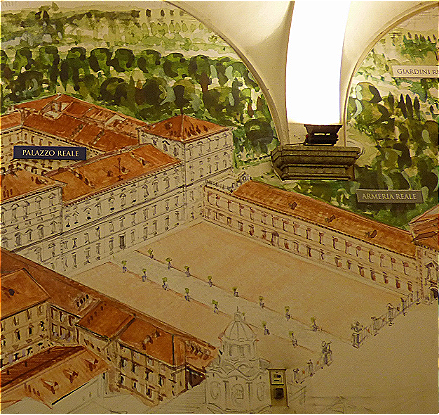
Today the Royal Armoury forms part of the Royal Museums of Turin, together with the Royal Palace, Savoy Gallery, Museum of Antiquities, Royal Library, Chapel of the Holy Shroud and Royal Gardens.
Beaumont Gallery
Most of the collection is displayed in the Beaumont Gallery, one of the most spectacular spaces in the Savoy complex.
The gallery was designed by Filippo Juvarra in 1733 to connect the Royal Palace with the State Secretariat buildings. The work was subsequently completed by Benedetto Alfieri.
Between 1738 and 1743, the vault was decorated by court painter Claudio Francesco Beaumont, after whom the gallery is named. The paintings depict episodes from the Stories of Aeneas, creating a solemn and richly decorated setting.
The display of equestrian armour, weapons and showcases beneath the great painted vault produces a particularly striking theatrical effect. The gallery itself is therefore an essential part of the visit.
Layout of the visit
The historic route includes several interconnected spaces:
- the monumental staircase designed by Benedetto Alfieri;
- the Beaumont Gallery;
- the Rotunda;
- the Medal Collection;
- spaces connecting the Armoury with the Royal Palace and Royal Library.
The display follows historical, typological and theatrical criteria. Some sections illustrate the technical development of weapons, while others recreate the image of cavalry and the Savoy court.
Visiting arrangements may change because of restoration work, redisplays or the organisation of the wider Royal Museums route.
Collections
The collections include weapons and objects dating from prehistory to the nineteenth century, with a particular concentration of medieval, Renaissance and early modern works.
The principal categories include:
- armour for warfare, parades and tournaments;
- equestrian armour;
- swords, sabres, daggers and short swords;
- lances, halberds and other polearms;
- bows, crossbows and accessories;
- pistols, arquebuses, muskets, rifles and revolvers;
- shields and parade shields;
- saddles, stirrups, horse bits and harness;
- flags and standards;
- Asian, African and American arms;
- dynastic, diplomatic and ceremonial objects.
Many objects feature engraving, gilding, inlay, embossing and decoration produced by highly skilled armourers and craftspeople.
Armour for warfare, tournaments and parades
Armour forms the most visually impressive part of the collection. Not all suits were created for the same purpose.
Armour intended for warfare had to protect its wearer while preserving sufficient mobility. Tournament armour could be heavier and reinforced in particular areas, depending on the type of competition.
Parade armour primarily served a ceremonial purpose. Engraved, gilded or blackened surfaces transformed steel into a visible symbol of the owner’s rank and wealth.
Displays of fully armoured riders and horses help visitors understand the visual impact of this equipment during tournaments, ceremonies and court events.
Particularly significant works and objects
Among the most important exhibits are:
- the Sword of Saint Maurice, a thirteenth-century dynastic relic preserved with a precious decorated scabbard;
- a fourteenth-century enamelled horse bit from Naples;
- warfare and tournament armour owned by or associated with the Savoy dynasty;
- the equestrian armour of Charles Emmanuel I;
- the sixteenth-century corslet of Count Girolamo Martinengo;
- a parade shield made for Henry II of France;
- a pistol attributed to Emperor Charles V;
- a richly ivory-decorated hunting musket;
- the sword associated with Napoleon during the Egyptian campaign;
- weapons owned by Charles Albert, Victor Emmanuel II and Umberto I.
Attributions, provenances and the display of individual objects may change following research, restoration or alterations to the museum layout.
Equestrian armour
The equestrian figures are among the Royal Armoury’s most recognisable displays. Rider and horse are presented with coordinated armour, saddles and harness, recreating the appearance of European heavy cavalry.
Horse armour, known as barding, protected the animal’s most exposed areas. It could include metal components for the head, neck and body, sometimes decorated to match the rider’s armour.
These ensembles demonstrate the exceptional technical ability of armourers, who shaped resistant steel plates to fit both human and animal forms.
Firearms
The collection also documents the development of portable firearms, from early manually ignited systems to wheellock, flintlock, percussion and repeating weapons.
Alongside military firearms are examples designed for hunting, duelling, travel and ceremonial display.
Decoration could include carved wood, ivory, mother-of-pearl, silver, gold and engraved steel. Some weapons were practical tools, while others were primarily luxury objects and diplomatic gifts.
Asian and non-European weapons
The Armoury also preserves arms and armour from Asia, the Middle East, Africa and the Americas.
This section allows visitors to compare different materials, techniques and approaches to defence and combat. It includes sabres, daggers, bows, shields, helmets, armour and richly decorated firearms.
Some of these objects reached the Savoy collections through diplomatic exchanges, official gifts, travel and collecting purchases.
Flags and standards
The collection contains more than 250 flags and standards, most associated with the Savoy dynasty, the army of the Kingdom of Sardinia and the wars of the Italian Risorgimento.
Historic textiles are exceptionally fragile and require controlled light, temperature and humidity. Consequently, not every example can be displayed simultaneously or permanently.
The flags document military units, campaigns, alliances, dynastic changes and political transformations between the former Savoy State and the Kingdom of Italy.
The Medal Collection
The Medal Collection originated in Charles Albert’s Cabinet of Medals. In 1832 the king purchased Domenico Promis’s important collection of ancient and medieval coins and appointed him its curator.
Between 1835 and 1838, Pelagio Palagi designed a dedicated room with Greek Revival furniture created to preserve and display coins, medals, seals and precious objects.
The collection contains approximately 33,000 items, although only a proportion can be shown to the public. It is closely associated with the Royal Library and Charles Albert’s cultural policies.
Access to this room may depend on visiting arrangements and the conservation requirements of the Royal Museums.
The Rotunda
The Rotunda, designed by Pelagio Palagi, stands at the end of the Beaumont Gallery and forms a nineteenth-century extension to the Armoury.
It occupies an area previously used as a theatre and later as a ballroom. It was intended for the display of arms, flags and objects associated with the more recent military history of the Kingdom of Sardinia and subsequently the Kingdom of Italy.
Its circular form and display create a theatrical conclusion to the gallery route.
Historical and cultural importance
The Royal Armoury provides an opportunity to study military history, art, technology and the representation of power together.
Armour illustrates developments in metallurgy and personal protection. Firearms document the evolution of mechanical systems, while precious materials and decoration reveal the collaboration of armourers, engravers, goldsmiths, carvers and other craftspeople.
The collection also reflects how the Savoy dynasty constructed its public image by preserving relics, personal weapons, diplomatic gifts and evidence of its military campaigns.
The Royal Museums complex belongs to the UNESCO-listed Residences of the Royal House of Savoy.
Visitor experience
The Beaumont Gallery produces a powerful visual impression: equestrian armour and rows of weapons are displayed beneath a fully painted Baroque vault.
To appreciate engravings, articulated mechanisms and decoration, visitors should proceed slowly and examine the showcases closely rather than limiting themselves to the overall view.
The Armoury is also rewarding for visitors without a particular interest in military history, since many exhibits can be regarded as genuine works of applied art.
The time required depends on the available route and desired level of detail. Between 45 and 90 minutes may be sufficient for the Armoury alone, while a complete visit to the Royal Museums requires several hours.
Accessibility
The Armoury forms part of a complex historic building. The Royal Museums provide accessible routes and connecting systems between the principal spaces, although some sections may require alternative itineraries.
Before visiting, checking the following is advisable:
- the accessible entrance currently in use;
- the route to the Beaumont Gallery;
- operation of lifts and platforms;
- accessibility of the Rotunda and Medal Collection;
- availability of seating and adapted toilets;
- any concessions for disabled visitors and companions.
Showcases, reflections and conservation lighting may make certain small details more difficult to see.
Location and transport
Entrance to the complex: Royal Museums, Piazzetta Reale 1, Turin.
The Armoury is part of the Royal Palace complex in the historic centre, next to Piazza Castello, Teatro Regio, Turin Cathedral and the Chapel of the Holy Shroud.
The nearest public-transport stops include Castello and Garibaldi, served by several bus and tram routes.
The complex is approximately twenty minutes on foot from Porta Nuova and Porta Susa railway stations and can also be reached by public transport.
Visitors arriving by car should consider the limited-traffic zone. Paid underground car parks are available nearby, but public transport is generally more convenient.
Tickets and useful information
The Royal Armoury forms part of the Royal Museums route. Admission may be covered by a combined ticket providing access to several sections of the complex.
Opening hours, prices, accessible routes and visiting conditions may change. Consulting the official website before visiting is therefore advisable.
Official website: museireali.beniculturali.it
Weapons, textiles and metal objects may be temporarily removed from display for restoration, research or conservation purposes.
Pros and cons
Pros
- Internationally important collection: it is one of the world’s foremost historic collections of arms and armour.
- Spectacular setting: the Beaumont Gallery is an architectural and decorative masterpiece.
- Impressive equestrian armour: the displays recreate the appearance of historic cavalry.
- Remarkable variety: the collection includes edged weapons, firearms, armour, flags and non-European objects.
- Outstanding artistic quality: many exhibits feature exceptional engraving, gilding and decoration.
- Dynastic importance: numerous objects are directly associated with the Savoy family and the kings of Italy.
- Technical interest: the displays reveal the development of metallurgy and weapon mechanisms.
- Part of the Royal Museums: it can be visited together with the Royal Palace, Savoy Gallery and Museum of Antiquities.
- Central location: it stands in Turin’s monumental historic centre.
- Interest beyond military history: its architecture and decorative arts broaden the value of the visit.
Cons
- Occasionally restricted route: access may depend on the general organisation of the Royal Museums.
- Abundant specialist information: without a guide, some technical differences may be difficult to understand.
- Reflections on showcases: these can hinder observation and photography of details.
- Low lighting: necessary for conservation, it reduces the visibility of certain objects.
- Not all collections are displayed: flags, coins and delicate objects may remain in storage.
- Possible partial closures: restoration and redisplay can alter the route.
- Lengthy complete visit: seeing all the Royal Museums in one day can be demanding.
- Accessibility should be confirmed: some connections within the historic complex may require alternative routes.
- Difficult parking: public transport is preferable because of the central location and limited-traffic zone.
Overall assessment
The Royal Armoury is one of the most fascinating collections within the Royal Museums of Turin. The quality of its arms and armour, objects associated with the Savoy family and the magnificent Beaumont Gallery create a highly impressive visit.
The museum does not merely celebrate combat: it presents the development of technology, the work of skilled craftspeople and the use of arms as symbols of political and dynastic prestige.
Reflections, conservation lighting and the abundance of exhibits can make it difficult to appreciate every detail during a rushed visit. Overall, the Royal Armoury is strongly recommended for anyone interested in history, art, mechanics, craftsmanship or Savoy culture.
Mini-glossary
Parade armour: richly decorated armour intended mainly for ceremonies and public appearances.
Corslet: a light suit of armour or group of metal protections covering the torso and other areas.
Barding: armour and ornamental equipment fitted to a horse.
Edged weapon: a weapon with a blade or point, such as a sword, sabre, dagger or spear.
Polearm: a weapon consisting of a blade or point mounted on a long shaft, such as a lance or halberd.
Blackening: a treatment that darkens and protects a metal surface.
Embossing: a decorative technique that shapes metal by working it from the reverse side.
Medal collection: an organised collection of coins, medals, seals and numismatic objects.

