



Bugleweed, Ajuga reptans (Lamiaceae)
Bugleweed (Ajuga reptans) is a perennial herbaceous plant belonging to the Lamiaceae family, native to much of Europe and widely distributed in temperate regions. It is valued primarily as an ornamental groundcover, appreciated for its dense, spreading habit and its ability to form decorative flowering carpets.
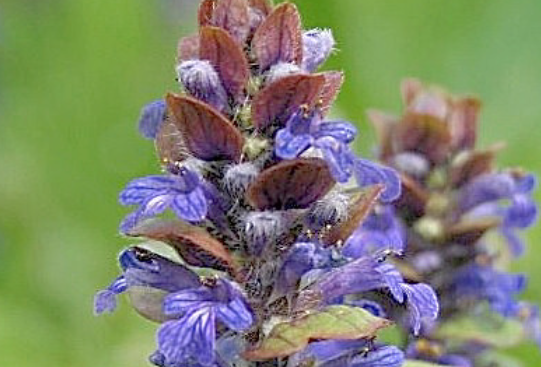 |  |
From a morphological standpoint, Ajuga reptans is characterized by:
– a creeping growth habit, with stoloniferous stems that enable rapid lateral spread;
– opposite leaves, oval to spatulate, typically dark green, with ornamental cultivars showing bronze or purplish tones;
– upright spike-like inflorescences, bearing small tubular flowers, most commonly blue to violet in color;
– a shallow fibrous root system, effective in stabilizing surface soil.
Flowering generally occurs in spring, creating visually striking ground coverage. The plant exhibits typical structural features of the Lamiaceae family and shows good ecological adaptability.
From a phytochemical perspective, Ajuga reptans contains:
– iridoid glycosides (including aucubin and catalpol);
– flavonoids and other polyphenolic compounds;
– phytosterols;
– tannins, associated with its traditional interest.
In ecological and horticultural contexts, bugleweed is valued for its hardiness, low maintenance requirements, and soil-covering capacity. It is commonly used in shaded gardens, woodland settings, and as an alternative to turf in low-traffic areas.
In terms of applications, Ajuga reptans is mainly used in:
– ornamental gardening, as a groundcover for borders, beds, and underplanting;
– landscape management, for surface erosion control;
– traditional herbal practices, mainly for external use in local contexts;
– sustainable landscaping projects, due to its resilience and spreading ability.
How to grow it
Bugleweed is considered easy to cultivate and suitable for both amateur and professional gardeners. Optimal conditions include:
– exposure: partial shade to light shade; tolerates full sun if soil moisture is adequate;
– soil: well-drained, moderately fertile to humus-rich soils;
– watering: regular during establishment, then moderate once established;
– propagation: by division of stolons or clumps, preferably in spring or autumn.
Once established, Ajuga reptans requires minimal maintenance and provides stable, long-lasting ground cover.
The combination of ornamental value, growth reliability, and botanical interest makes bugleweed a widely used species in temperate landscape design.
Botanical classification (APG IV system)
| Category | Data |
|---|---|
| Common name | bugleweed, common bugle |
| Botanical name | Ajuga reptans L. |
| Kingdom | Plantae |
| Clade | angiosperms → eudicots → asterids |
| Order | Lamiales |
| Family | Lamiaceae |
| Subfamily | Ajugoideae |
| Tribe | Ajuginae |
| Genus | Ajuga |
| Species | Ajuga reptans L. |
Indicative nutritional values per 100 g (fresh aerial parts of Ajuga reptans)
Average values estimated for fresh leaves and young stems. Food use is traditional and occasional, with typical quantities far below 100 g.
| Component | Approximate value per 100 g |
|---|---|
| Energy | ~ 30–40 kcal |
| Water | ~ 85–88 g |
| Total carbohydrates | ~ 6–7 g |
| — of which sugars | ~ 2–3 g (estimate for wild herbaceous plants) |
| Dietary fiber | ~ 4–5 g |
| Proteins | ~ 2–2.5 g |
| Total lipids | ~ 0.5–0.8 g |
| — saturated fatty acids (SFA – Saturated Fatty Acids) | ~ 0.15–0.20 g |
| — monounsaturated fatty acids (MUFA – MonoUnsaturated Fatty Acids) | ~ 0.10–0.15 g |
| — polyunsaturated fatty acids (PUFA – PolyUnsaturated Fatty Acids) | ~ 0.20–0.30 g |
| Sodium | ~ 15–25 mg (low) |
| Main minerals | potassium (≈ 250–350 mg), calcium (≈ 120–180 mg), magnesium, phosphorus, iron |
| Relevant vitamins | vitamin C, trace provitamin A (carotenoids), small amounts of B vitamins |
Nutritional use note
At typical usage portions (approximately 2–5 g of fresh leaves, traditionally used in rustic salads or decoctions), caloric intake is negligible.
The nutritional interest of bugleweed is qualitative, mainly related to dietary fiber, micronutrients, and phenolic compounds, rather than macronutrients or energy value.
Lipid profile note
Bugleweed shows a very low fat content.
SFA (Saturated Fatty Acids) are present in limited amounts; excessive dietary prevalence of SFA is generally considered less favorable for cardiovascular health.
MUFA (MonoUnsaturated Fatty Acids) and PUFA (PolyUnsaturated Fatty Acids) occur in small quantities and do not significantly influence daily lipid intake.
Medical applications (traditional and scientific interest)
| Area | Application |
|---|---|
| Traditional herbal medicine | Aerial parts used to support respiratory tract and oral cavity well-being |
| Astringent activity | Tannins traditionally used to help control secretions and minor bleeding |
| Traditional wound care | Topical applications used to support skin repair |
| Anti-inflammatory activity | Studies on phenolic compounds and iridoids of interest for inflammation modulation |
| Traditional digestive use | Decoctions used to support digestion |
Note: medical uses are primarily traditional or experimental and do not replace pharmacological treatments.
Cosmetic applications
| Cosmetic area | Function |
|---|---|
| Skin care | Extracts used for soothing, astringent, and balancing properties |
| Products for oily or impure skin | Support for regulating skin secretions |
| Natural cosmetics | Used in plant-based formulations for sensitive skin |
| Scalp care products | Traditional use for scalp comfort and balance |
Main INCI functions:
Skin conditioning
Soothing
Astringent
Protecting
Industrial applications
| Sector | Application |
|---|---|
| Herbal industry | Production of dry extracts, liquid extracts, and tinctures |
| Natural cosmetics | Botanical raw material for phytocosmetic formulations |
| Floriculture | Ornamental cultivation as a ground-cover plant |
| Phytochemical research | Study of iridoids, flavonoids, and tannins |
| Sustainable gardening | Use as ground cover for ecological soil management |
Studies
Ajuga reptans has been studied in the medical field for about fifteen years, mostly on guinea pigs, and scientific publications are not numerous.
We start from 1992 with an Italian study which found vasoconstrictor characteristics (1), then a 1996 study which discovered four anthocyanins (flavonoid family) in flowers (2) confirmed by a subsequent work by the same authors in 2001 (3), then a 2004 study finding out the effectiveness of Ajuga against mosquito-like insects (4) and another 2009 publication on the discovery of new steroids from the seedling (5). For those who would like to delve deeper, I suggest these two recent studies (6).

