



Buxus sempervirens L. (Common Box, European Boxwood)
Description
Buxus sempervirens (family Buxaceae), commonly known as common box or European boxwood, is an evergreen shrub or small tree native to southern and western Europe, northwestern Africa, and western Asia. It is a slow-growing and very long-lived species, naturally found in woodland, on limestone slopes, and in hilly areas, but it is best known as an ornamental plant cultivated for centuries for hedges, borders, and topiary.
The leaves are small, leathery, and persistent, while the wood is exceptionally hard, compact, and fine-grained, traditionally valued for carving, turning, and precision work. However, all parts of the plant contain toxic steroidal alkaloids, especially the leaves; boxwood should therefore not be used as food or in homemade herbal preparations.
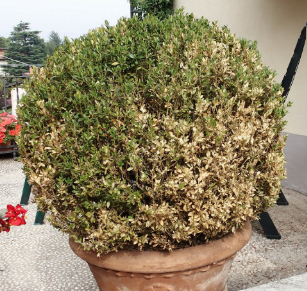
Botanical classification
Kingdom: Plantae
Clade: Angiosperms
Order: Buxales
Family: Buxaceae
Genus: Buxus
Species: B. sempervirens
Plant characteristics
- Habit: Highly branched evergreen shrub, usually 1–5 m tall; under favorable conditions it may develop into a small tree exceeding 6–8 m.
- Bark: Smooth and grayish when young, becoming darker and finely fissured with age.
- Leaves: Opposite, simple, oval to elliptical, about 1.5–3 cm long, leathery, glossy dark green above and paler beneath.
- Flowers: Small, yellow-green, and inconspicuous; the species is monoecious, with male and female flowers on the same plant.
- Flowering: Generally from March to May; flowers produce nectar and are visited by pollinating insects.
- Fruits: Leathery three-chambered capsules with three characteristic projections, splitting open at maturity to release the seeds.
- Seeds: Small, hard, dark, and glossy.
- Roots: Dense, shallow, and extensively branched.
- Longevity: Very high; undisturbed specimens may live for several centuries.
Chemical composition (main constituents of leaves, bark, and wood)
- Steroidal alkaloids: Buxine and numerous related alkaloids, responsible for much of the plant’s biological activity but also for its toxicity.
- Triterpenoid compounds: Secondary metabolites found particularly in the green parts.
- Flavonoids and phenolic compounds: Present in variable amounts, with antioxidant activity mainly observed in experimental studies.
- Tannins: Found especially in the bark, with astringent properties.
- Resinous substances and waxes: Contribute to the protection of the evergreen foliage.
Composition varies according to cultivar, season, plant part, and environmental conditions.
Cultivation and growing conditions
- Climate: Temperate; resistant to cold and relatively drought-tolerant once established.
- Exposure: Sun, partial shade, or bright shade; tolerates growing beneath trees and in gardens with limited sunlight.
- Soil: Prefers fertile, calcareous or neutral, well-drained soils; tolerates various substrates provided they are not permanently waterlogged.
- Irrigation: Regular for young plants; moderate for established specimens.
- Propagation: Mainly by semi-hardwood cuttings; propagation from seed is also possible but slow.
- Pruning: Tolerates frequent trimming extremely well, which explains its widespread use in topiary.
- Growth: Slow, producing very dense vegetation.
- Pests and diseases: Particularly vulnerable to the box tree moth (Cydalima perspectalis); fungal leaf and shoot blights may also occur.
Uses and benefits (traditional and documented)
- Ornamental: One of the classic evergreen shrubs for formal hedges, borders, and sculpted garden features.
- Topiary: Particularly suitable because of its slow growth, dense branching, and tolerance of repeated pruning.
- Wood: Extremely hard, heavy, homogeneous, and very fine-grained, suitable for high-precision woodworking.
- Historical medicinal uses: Leaves and bark were formerly used in folk medicine for fever and other conditions, but such uses are now discouraged because of toxicity.
- Ecological value: Spring flowers can provide nectar for insects.
Historical medicinal uses do not justify self-medication: the narrow safety margin of the alkaloids makes internal domestic use inappropriate.
Applications
- Gardening: Low and high hedges, borders, parterres, and evergreen dividers.
- Topiary: Geometric shapes, spheres, spirals, and decorative figures.
- Historic gardens: Traditional element of formal Italian, French, and English gardens.
- Carving and turning: Used for small objects, handles, turned components, and precision work.
- Musical instruments: Historically used for certain woodwind instruments and their components.
- Engraving: Its exceptionally fine grain made it particularly suitable for detailed wood engraving.
Harvesting and processing
- Ornamental material: Twigs and branches are mainly obtained during routine pruning.
- Wood: Obtained from mature trunks and branches; because of the slow growth, large dimensions are relatively uncommon.
- Seasoning: Wood must be dried slowly and evenly to minimize warping and cracking.
- Working: Suitable for highly precise turning, carving, and polishing.
- Storage: Plant material intended for ornamental use should be kept away from children and pets.
Environmental considerations
Natural stands of Buxus sempervirens are characteristic of certain European woodlands and shrub communities, particularly on calcareous substrates. Its slow growth and exceptional longevity make the conservation of mature specimens especially important.
In recent years, many natural populations and ornamental hedges have been severely damaged by the box tree moth (Cydalima perspectalis), whose larvae can completely defoliate plants. Integrated pest management and the protection of natural populations are therefore important for the conservation of the species.
Safety, contraindications, interactions
Boxwood is a toxic plant and should not be used as food or as a homemade herbal remedy.
- Toxic parts: All parts of the plant, particularly the leaves and bark.
- Main toxic constituents: Steroidal alkaloids, including buxine and related compounds.
- Ingestion: May cause nausea, vomiting, diarrhea, abdominal pain, weakness and, in severe poisoning, neurological and cardiovascular disturbances.
- Animals: Boxwood can also be toxic to pets and livestock if ingested.
- Herbal use: Not recommended; there is no justified domestic medicinal use that outweighs the risk of poisoning.
- Skin contact: Normal handling is generally well tolerated, although sap or plant material may cause irritation in sensitive individuals.
In the event of significant accidental ingestion, medical advice or a poison control center should be contacted promptly.
Common preparations (general, non-therapeutic use)
- Hedges: Regularly pruned plants used to create compact evergreen structures.
- Topiary: Repeated trimming into geometric or decorative shapes.
- Ornamental twigs: Occasionally used in plant arrangements, while avoiding any food-related use.
- Worked wood: Used for carving, turning, engraving, and small precision objects.
- Homemade medicinal preparations: Should be avoided because of the presence of toxic alkaloids.

