



Goji (Lycium barbarum L., goji berries / wolfberry)
Description
Goji berries are the fruits of shrubby plants of the genus Lycium, mainly Lycium barbarum L. and Lycium chinense Mill., belonging to the Solanaceae family, the same botanical family as tomato and pepper. Native to the arid and semi-arid regions of Asia (especially north-western China, Inner Mongolia and Tibet), goji plants are now also grown in other parts of the world, including Mediterranean Europe, where the climate allows good fruit ripening.
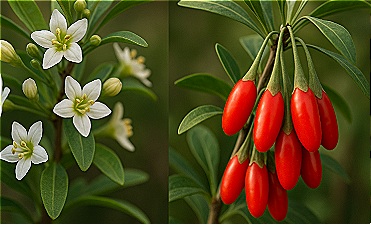
The goji shrub usually reaches 1–3 metres in height, with arching or drooping branches and lanceolate to narrow-ovate leaves, grey-green in colour, relatively fleshy. The flowers, typically violet to lilac, are small but distinctive, with a tubular corolla and five lobes. After pollination, berries develop: elongated-oval fruits that turn a bright orange-red at full maturity, with a juicy pulp containing numerous small, flattened seeds.
In Asia, goji berries have been used for centuries as both food and traditional medicinal ingredient, especially in Traditional Chinese Medicine, where they are regarded as a tonic for eyesight, liver and general vitality. In Western countries, consumption has grown more recently, mainly as dried fruit, often marketed as a “superfood”. Dried goji berries have a sweet-tangy taste, a soft yet slightly chewy texture, and are eaten on their own as a snack or incorporated into trail mixes, muesli, bakery products and drinks.
From a compositional standpoint, goji berries contain sugars, dietary fibre, protein, vitamins (notably vitamin C), minerals (especially potassium, plus iron, zinc and other trace elements) and a substantial amount of bioactive phytochemicals, including the characteristic Lycium barbarum polysaccharides (LBP), carotenoids (particularly zeaxanthin), flavonoids, phenolic compounds and betaine. This combination of nutrients and bioactives underpins their interest in nutrition, nutraceuticals and cosmetics.
Goji have been used in traditional Chinese medicine for about 2000 years. It is mentioned in the oldest Chinese book on herbs, the Shen Nong Ben Cao Jing, which attributes therapeutic properties to these berries for their properties of keeping the body in shape and prolonging life and in particular, to combat the lack of "yin" of the liver and kidneys.
Botanical classification
Common name: goji, goji berries
Main botanical name: Lycium barbarum L.
Other cultivated species: Lycium chinense Mill.
Botanical family: Solanaceae
Native range: Asia (China, temperate and semi-arid regions), now also cultivated in Europe and North America
Habit: deciduous, spiny, highly branched shrub
Height: about 1–3 m
Lifespan: perennial
Cultivation and growth conditions
Climate
Prefers temperate and temperate-continental climates.
Once established, it withstands winter cold well (several degrees below zero).
Tolerates hot summers if water is available.
Does not like very humid, rainy climates for long periods.
Exposure
Grows best in full sun, where it flowers and fruits abundantly.
Tolerates light partial shade, but with lower fruit production.
In very hot areas, light shading during the hottest hours can be beneficial.
Soil
A rather rustic, adaptable plant.
Ideal soils are:
medium-textured (loam, loam–sandy),
well drained,
moderately fertile.
Tolerates slightly calcareous and even relatively poor soils.
Does not like waterlogged, heavy or very clayey soils.
Indicative pH: 6.5–8.0.
Irrigation
Tolerates moderate drought, but for good fruiting:
keep the soil slightly moist during flowering and fruit set;
provide regular irrigation in the hottest and driest periods.
Avoid waterlogging, which promotes root rot.
In pots, check substrate moisture more frequently.
Temperature
Optimal growth range: 18–28 °C.
In open ground it resists winter cold (several degrees below zero).
Young plants should be protected from severe frost in the first winter.
Very high summer temperatures combined with scarce water can lead to flower and small fruit drop.
Fertilization
Not particularly demanding, but to increase yield:
incorporate well-matured compost or well-rotted manure before planting;
apply a light layer of organic amendment each year at the end of winter.
On poor soils, a balanced (N-P-K) fertilizer at moderate doses can be useful.
Avoid excess nitrogen, which promotes excessive vegetative growth at the expense of fruiting.
Crop care
Pruning is important to:
keep the shrub airy,
limit height,
encourage the formation of new fruiting shoots.
Usually carried out at the end of winter, shortening very long shoots and thinning the inner branches.
Remove excess suckers and any dead or damaged branches.
Control weeds around the collar, especially in the first years.
Monitor for typical Solanaceae pests (aphids, mites, some lepidopteran larvae) and fungal diseases in very humid climates.
Harvest
Fruiting usually occurs from summer to autumn, with staggered production.
Berries are harvested when they are fully orange-red, plump and evenly coloured.
Harvest is usually done by hand (berries are delicate) and must be repeated several times over the season.
Under suitable conditions, a mature plant can produce a substantial quantity of fruit.
Propagation
By seed:
sow in spring using fresh or well-stored seeds;
germination in a light, moist, warm substrate (seed trays or small pots).
By woody or semi-woody cuttings:
take stem segments in late summer or late winter;
root in a well-drained substrate kept slightly moist.
By basal suckers:
shrubs often produce shoots from the base that can be separated and transplanted.
Indicative nutritional values per 100 g (dried goji berries)
Per 100 g of dried berries (approximate values, depending on variety and drying method):
Energy: about 280–320 kcal
Water: 5–10 g
Total carbohydrates: 45–60 g (of which sugars about 40–50 g)
Total fibre: 10–15 g
Protein: 10–14 g
Total fat: 1–3 g
SFA (saturated fatty acids, whose excess from all dietary sources is associated with less favourable blood lipid profiles): modest amount (around 0.3–0.6 g)
MUFA (monounsaturated fatty acids): low levels
PUFA (polyunsaturated fatty acids, including n-6 and n-3 series important for inflammatory and cardiometabolic balance): present mainly as traces
Vitamin C: roughly 30–50 mg/100 g (variable; sensitive to drying and storage)
Provitamin A (carotenoids including beta-carotene and zeaxanthin): significant levels
Key minerals: potassium (around 800–1400 mg/100 g) plus calcium, phosphorus, iron, zinc in variable amounts
Since a typical daily serving is only a few grams, overall energy contribution is moderate, but the intake of micronutrients and antioxidant compounds can be meaningful in a varied diet.
Key constituents
Goji berries are characterised by a complex matrix of polysaccharides, carotenoids, vitamins and polyphenols:
Lycium barbarum polysaccharides (LBP): complex heteropolysaccharides of high molecular weight (often 5–8% of dried fruit) regarded as the main contributors to many antioxidant, immunomodulatory and cell-protective effects seen in experimental studies.
Carotenoids: especially zeaxanthin (often as zeaxanthin dipalmitate), but also beta-carotene, lutein and others, which may support visual function and act as antioxidants.
Polyphenols: flavonoids, simple phenols and phenolic acids (e.g. chlorogenic acid and related compounds) with radical-scavenging activity.
Vitamin C and other antioxidants: ascorbic acid and minor antioxidant molecules that help protect against oxidative stress.
Betaine: an osmoprotective compound under investigation for its effects on liver metabolism and homocysteine regulation.
Amino acids and peptides: contributing to the relatively high protein content, including several essential amino acids.
Organic acids and sugars: mainly glucose, fructose and sucrose, plus organic acids that contribute to flavour.
Production process
Cultivation and processing aim to preserve colour, nutritional quality and phytochemicals while ensuring safety:
Cultivation: goji shrubs are grown in regions with temperate to semi-arid climate, on well-drained soils. Plants are arranged in rows and regularly pruned to facilitate harvesting and control height. Organic and low-residue systems are particularly relevant because the fruit is typically eaten with the skin.
Harvesting: berries are collected when they reach a deep red colour and suitable sugar content. Harvest can be manual (to minimise mechanical damage) or mechanised in large plantations.
Pre-treatment: berries are sorted, damaged or mouldy fruit is removed, then berries may be gently washed and drained.
Drying: berries are dried in warm-air dryers, by controlled solar drying or by low-temperature technologies (including vacuum drying or freeze-drying) to preserve vitamin C, carotenoids and colour while reducing water activity.
Packaging: dried fruit is packed in moisture- and light-barrier packaging, often under modified atmosphere, to limit oxidation.
Further processing: production of juices, concentrates, purees, dry extracts and powders for supplements, as well as standardised extracts for cosmetic use.
Physical properties
Appearance (dried berries): small elongated-oval fruits, bright red-orange, with slightly wrinkled surface; when properly dried they are soft and elastic and rehydrate well.
Bulk density: medium-low, typical of dried fruit; the product is relatively light for its volume.
Residual moisture: typically <15%, enough to maintain some softness; higher moisture increases the risk of mould growth and quality loss.
Colour: primarily due to carotenoids (zeaxanthin, beta-carotene); sensitive to light, oxygen and high temperature, which may cause darkening over time.
Sensory and technological properties
Taste: predominantly sweet, with tangy notes and a mild herbaceous/fruity character; sweetness level depends on sugar content and drying degree.
Texture: chewy, slightly gummy; soaking in water, milk or other liquids softens the berries and makes them more versatile in recipes.
Aroma: delicate, fruity, with hints reminiscent of raisins and red fruits.
Technological functionality:
good stability when blended with other dried fruits and cereals, provided moisture is controlled;
ability to release colour and soluble compounds into teas and drinks, giving orange-reddish tones;
contribution to texture and chewiness in bars, granola and baked products.
Food applications
Goji berries are used in a wide variety of food preparations:
Direct consumption as a dried fruit snack.
Ingredient in trail mixes, breakfast cereals, muesli, porridge and yogurt toppings.
Component of cereal bars, protein bars and bakery goods (breads, muffins, biscuits), contributing natural colour and sweetness.
Ingredient in herbal teas and fruit infusions, often in blends with other botanicals, or in juices, smoothies and functional beverages.
In Asian cuisine, use of fresh or rehydrated berries in soups, broths and mixed dishes with meat or rice is well established.
Nutrition and health
Nutritionally, goji berries are relatively nutrient-dense, providing fibre, vitamin C, carotenoids (especially zeaxanthin) and minerals such as potassium and iron. The presence of LBP, polyphenols and carotenoids gives goji berries a marked antioxidant potential, documented by numerous in vitro and animal studies.
Scientific research has explored possible effects on immune function, glucose and lipid metabolism, neuroprotection, ocular health (given the role of zeaxanthin in the macula), and protection from oxidative stress. Some small clinical trials suggest improvements in subjective well-being, antioxidant status and selected metabolic markers with regular intake of goji products, but evidence is still limited and heterogeneous.
In practical terms, a moderate, regular intake can help increase dietary fibre, vitamins and antioxidants, especially when goji berries partly replace snacks high in added sugars and saturated fats. However, they should not be viewed as a “miracle cure” and should always be framed within an overall healthy lifestyle.
It is also important to consider potential interactions with medicines, particularly anticoagulants such as warfarin, and possible allergic reactions, as summarised below.
Portion note
For healthy adults, a reasonable reference serving of dried goji berries is:
about 20–30 g per day (roughly 1–2 heaped tablespoons),
consumed as part of a varied, balanced diet and taking total daily sugar intake into account.
For supplements containing concentrated extracts, it is essential to follow the dose recommended on the label and any advice from a healthcare professional.
Allergens and intolerances
Goji berries are not among the major regulated food allergens, but food allergy cases have been reported.
Cross-reactivity has been observed with other Solanaceae (for example tomato) and with some stone fruits (such as peach) in sensitised individuals.
Reported symptoms include urticaria, angio-oedema, gastrointestinal upset and, more rarely, more serious reactions; people allergic to tomato, peach or related fruits should introduce goji berries with particular caution or avoid them.
Commercial blends may contain traces of nuts, peanuts, sesame or gluten; labels should be checked carefully for “may contain traces of…” statements.
Storage and shelf-life
Store berries in well-sealed containers, away from humidity, direct light and heat sources.
A cool, stable room temperature helps preserve colour, aroma and vitamin C; in very hot or humid climates, refrigerated storage in airtight containers may be advisable.
Typical shelf-life: 12–24 months from production if the pack remains unopened. After opening, it is best to consume within a few months, carefully resealing after each use.
Signs of deterioration include musty or rancid odour, presence of condensation or moist clumps, visible mould growth (white/green spots) or marked darkening → in all these cases, the product should not be consumed.
Safety and regulatory
In the European Union, goji berries from Lycium barbarum and Lycium chinense are considered traditional foods and generally do not fall under “novel food” regulations, provided identification and use are consistent with historical consumption.
Key safety aspects include:
Drug interactions, especially with warfarin and other anticoagulants, where case reports have described increased INR and bleeding risk following concurrent consumption of goji juice or large quantities of berries.
Possible interactions with antidiabetic and antihypertensive medicines, where cautious medical supervision is advisable before frequent or high intake.
Allergy and cross-reactivity in predisposed individuals.
From a food safety perspective, particular attention is paid to:
Pesticide residues, as a large share of production is extra-EU.
Heavy metals and mycotoxins, especially if drying or storage conditions are poor.
Possible use of sulphites as preservatives (which must be declared on the label when used above regulatory thresholds).
Labelling
For a food product containing goji berries, typical labelling elements include:
Ingredient name, e.g. “dried goji berries (Lycium barbarum L.)”.
Specification of form (dried, rehydrated, powder, juice concentrate, etc.) and any relevant treatments (e.g. organic, with/without preservatives).
Country of origin or place of growing/harvest, when required.
Standard nutrition declaration (energy, fat, of which saturates, carbohydrates, sugars, fibre, protein, salt).
Any allergen-related statements (traces of nuts, gluten, etc.) and, if used, declaration of sulphites or other additives.
For dietary supplements:
indication of the plant part (fruit) and any standardisation (e.g. content of LBP, carotenoids, vitamin C);
recommended daily dose and general warnings (“do not exceed recommended daily dose”, “not to be used as a substitute for a varied diet”, “if you are pregnant, breastfeeding or taking medicines—especially anticoagulants—consult your doctor”).
For cosmetics, goji derivatives appear under INCI names such as Lycium Barbarum Fruit Extract, Lycium Barbarum Fruit Juice, etc.
Troubleshooting
Berries too hard or overly dry
Cause: excessive drying or very long storage.
Action: briefly rehydrate in water, milk or another beverage before use; for future production, adjust drying time and temperature.
Sticky or clumped berries
Cause: moisture uptake from the environment.
Action: check that packaging is properly sealed; if there is moderate moisture but no mould, gentle re-drying at low temperature may be possible; if mould is present, the product must be discarded.
Marked colour loss (strong darkening)
Cause: carotenoid oxidation, light and heat exposure, or very old product.
Action: improve packaging and storage conditions; use fresher batches when colour and carotenoid content are important.
Instability in baked goods or bars
Cause: moisture imbalance or interactions with other ingredients.
Action: adjust water content of the recipe, particle size of goji pieces, and pre-hydration to avoid excessive dryness or water migration.
Sustainability and supply chain
Most goji berries on the global market still come from China and other Asian countries, though European (including Italian) production is increasing, often with a biological/organic focus.
Key sustainability issues include:
use of pesticides and fertilisers in intensive systems;
water consumption in arid regions;
environmental impact of long-distance transport (carbon footprint).
A more sustainable supply chain emphasises:
organic or integrated production with monitoring of residues and soil quality;
full traceability from field to consumer;
valorisation of local or regional production where available;
proper management of processing by-products (seeds, skins, extraction residues) through composting or other circular-economy uses;
adequate treatment of washing and extraction wastewater, with monitoring of BOD/COD to limit environmental impact.
Main INCI functions (cosmetics)
In cosmetic products, goji is mainly used as Lycium Barbarum Fruit Extract and related derivatives obtained from fresh or dried fruit. Recognised functions include:
Skin conditioning: helping to keep skin in good condition, promoting softness and comfort.
Astringent: conferring a light feeling of firmer skin, useful in toners, serums and facial treatments.
Antioxidant / anti-age support: thanks to polyphenols, carotenoids and vitamin C, contributing to free-radical defence in synergy with other antioxidants in the formula.
Hair conditioning: in hair products, helping to keep hair shafts softer and more manageable alongside other conditioning agents.
Generally, Lycium Barbarum Fruit Extract is considered well tolerated for most skin types, provided that quality control and safety testing are appropriate for the concentrations used.
Conclusion
Goji berries (Lycium barbarum L., Lycium chinense Mill.) are small fruits with a long history of use in Asia and growing popularity in Europe as a micronutrient-dense food with high antioxidant potential. In dried form, they offer an interesting profile of fibre, vitamin C, carotenoids (especially zeaxanthin), minerals and bioactive polysaccharides.
Consumed in moderation within a balanced diet, goji berries can help diversify nutrient intake and increase dietary antioxidant sources, supporting overall well-being. At the same time, it is essential to maintain a realistic perspective, avoid “miracle” claims and carefully consider safety aspects, including allergies and drug interactions.
In the cosmetic field, goji extracts are valued as antioxidant and skin-conditioning ingredients, fitting well with the rising interest in plant-based and sustainable actives. A well-managed, traceable and environmentally responsible supply chain allows goji berries to be integrated into a modern, holistic view in which nutrition, health and skin care are seen as interconnected dimensions of overall health.

