



Rolando Villazón, complete biography, vocal interpretation and theatricality in contemporary opera
Profile
Rolando Villazón (Rolando Villazón Mauleón; Mexico City, Mexico, February 22, 1972) is a Mexican-born lyric tenor, among the most recognizable and debated personalities in contemporary opera.
He stands out for a distinctive combination of expressive intensity, strong theatrical drive, and an instinct-driven interpretive approach, which has contributed to renewing the image of the tenor in the 21st-century operatic landscape.
Training and early years (Mexico, Europe)
Villazón first trained in Mexico, studying both singing and theatre—fields that, from the beginning, intertwined in his conception of vocal art. His training was not exclusively musical, but included sustained attention to acting, gesture, and character-building.
Advanced training in Europe, especially in Central Europe, proved decisive for technical and stylistic refinement, allowing him to engage directly with the European operatic tradition.
International recognition and rapid rise
In the early 2000s, Rolando Villazón experienced a rapid international rise, establishing himself in the leading opera houses thanks to performances of strong emotional impact.
His breakthrough was linked above all to:
Mozart,
French opera,
Italian lyric repertoire.
In this phase, Villazón was praised for spontaneity of phrasing, vocal generosity, and extraordinary stage communication.
Interpretation and theatricality
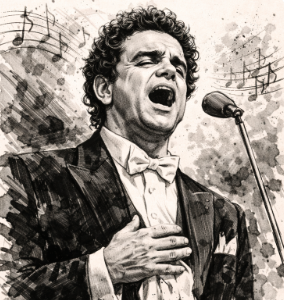
One of Villazón’s most characteristic features is his conception of opera as a total theatrical event. Singing is never separated from stage action, and vocal interpretation is closely tied to the dramatic construction of the character.
This approach manifests through:
intense physicality,
expressive emphasis on the text,
strong emotional involvement.
Such a stance has been widely embraced by audiences, while also sparking critical debate about the balance between expressivity and technical control.
Vocal crisis and artistic redefinition
Midway through his career, Villazón went through a period of vocal crisis, forcing him to scale back operatic activity and reassess his repertoire.
This phase marked a turning point: he began a conscious redefinition of artistic identity, moving toward:
lighter or more selectively chosen roles,
concert activity,
artistic direction and stage directing.
This trajectory demonstrates notable adaptability and artistic resilience.
Parallel activities: directing, outreach, and writing
Alongside his singing career, Villazón has distinguished himself as:
an opera director,
a presenter and music communicator,
a writer and storyteller.
These activities reflect a conception of the opera artist as a multifaceted figure, able to engage with audiences beyond the traditional stage.
Vocal style and distinctive characteristics
Core elements of Rolando Villazón’s style:
Strong emotional intensity as the engine of interpretation.
Highly expressive phrasing, sometimes pushed to the limit.
Total stage involvement.
Instinct-driven approach rather than an analytical one to musical text.
Immediate communicative power, especially in theatrical contexts.
Repertoire and selected discography
Opera
Mozart – Don Giovanni, Die Zauberflöte, La clemenza di Tito
Donizetti – L’elisir d’amore
Verdi – La traviata
Puccini – La bohème
Massenet – Werther
Gounod – Roméo et Juliette
Recitals and solo recordings
Italian Opera Arias
Gitano
México
Treasure of Bel Canto
Artistic and cultural impact
Rolando Villazón has helped redefine the image of the operatic tenor in the contemporary media context, bringing new audiences closer to opera through an emotionally direct language and strong stage presence.
Critical reading: Rolando Villazón between expression and reinvention
Villazón’s trajectory reveals a constant tension between expressive impulse and vocal sustainability. His career—marked by successes, crises, and transformations—represents an emblematic case in contemporary opera, where artistic identity is called to evolve continuously.
Rolando Villazón remains a significant figure for understanding 21st-century opera dynamics, not only as a singer but as a total interpreter and cultural communicator.

