



Anna Netrebko, complete biography, operatic career and vocal interpretation in contemporary melodrama
Profile
Anna Netrebko (Anna Jur’evna Netrebko; Krasnodar, Russia, September 18, 1971) is an internationally acclaimed lyric-dramatic soprano, widely regarded as one of the central operatic figures from the late 20th century through the 21st century.
Her career has played a major role in the renewed global visibility of opera, combining a voice of strong timbral impact with charismatic stage presence and a repertoire in continuous evolution.
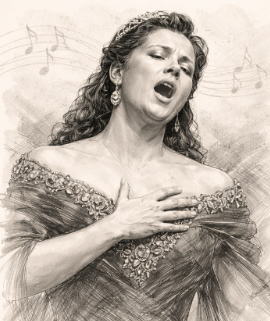
Training and early years (Russia, Saint Petersburg)
Anna Netrebko received her musical training in Russia, studying voice at the Conservatory in Saint Petersburg. During her student years she came into contact with the Mariinsky Theatre, where she was noticed and supported by Valery Gergiev, a decisive figure in the start of her professional career.
From the beginning, her voice showed natural amplitude, with a dark color, solid projection, and ease in the middle register, elements that progressively oriented her toward heavier dramatic roles.
Breakthrough on the international stage
Between the late 1990s and the early 2000s, Netrebko debuted and quickly established herself in the major international opera houses, emerging as a leading new protagonist of the lyric repertoire.
Her early performances were centered on the lyric-light to full lyric repertoire, with particular focus on:
Mozart,
Italian bel canto,
early Verdi.
This phase was marked by a bright vocal profile, fluent agility, and strong communicative immediacy.
Vocal evolution and repertoire expansion
A defining feature of Anna Netrebko’s career is the gradual transformation of her vocal profile, evolving toward a broad lyric-dramatic soprano.
Over the years her repertoire expanded to include roles of greater orchestral density and dramatic weight, especially within:
mature Verdi,
late Romanticism,
Slavic repertoire.
This evolution was accompanied by a progressive deepening of expressive weight in phrasing, with a reduction in virtuosic agility in favor of a more sculpted, theatrical vocal line.
Stage interpretation and theatrical dimension
Anna Netrebko is recognized for conceiving opera as a total theatrical experience, in which the scenic component is integral to musical interpretation.
Her characters are shaped through:
strong dramatic identification,
expressive use of body and gesture,
attention to the sung word as a narrative element.
This approach has contributed to redefining the image of the operatic soprano within the contemporary media landscape.
Verdi and Slavic repertoire
A central chapter of Netrebko’s career is the Verdi repertoire, approached with an emphasis on:
breadth of sound,
sustained dramatic tension,
incisive phrasing.
In parallel, she has maintained a strong connection to the Slavic repertoire, particularly Tchaikovsky, highlighting her vocal color and the emotional component of her singing.
Recording activity and media presence
Anna Netrebko’s discography includes:
complete operatic recordings,
solo recitals,
crossover projects and thematic anthologies.
Her media presence—supported by video recordings, cinema broadcasts, and digital distribution—has played a significant role in bringing a broader audience closer to opera, without abandoning the centrality of the traditional repertoire.
Vocal style and distinctive characteristics
Core elements of Anna Netrebko’s style:
Dark, immediately recognizable timbre.
Broad vocal projection, suited to large theatrical spaces.
Strong expressive and theatrical component.
Ability to adapt repertoire to the natural evolution of the voice.
Centrality of emotional impact, sometimes at the expense of strict stylistic orthodoxy.
Repertoire and selected discography
Opera
Mozart – Don Giovanni, Le nozze di Figaro
Bellini – I puritani
Donizetti – Lucia di Lammermoor
Verdi – La traviata, Il trovatore, Aida, Macbeth
Puccini – Manon Lescaut, Turandot
Tchaikovsky – Eugene Onegin
Recitals and solo recordings
Opera Arias
Sempre Libera
Verismo
Romanza
Artistic and cultural impact
Anna Netrebko has played a central role in the revitalization of opera as a global cultural phenomenon, demonstrating that melodrama can engage with contemporary languages without losing its historical identity.
Critical reading: Anna Netrebko between tradition and contemporaneity
Netrebko’s artistic trajectory reveals a constant tension between vocal tradition and the requirements of contemporary communication. Her figure embodies a modern soprano model in which vocal artistry intertwines with image, theatricality, and media presence.
Anna Netrebko remains a key figure for understanding the evolution of opera in the 21st century, both from an interpretive and a cultural perspective.

