



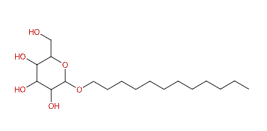
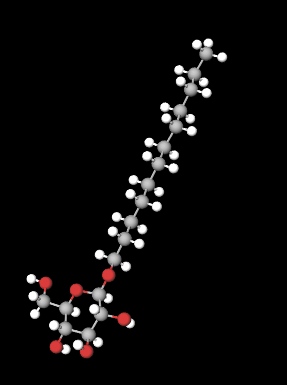
Lauryl Glucoside is a chemical compound, belongs to the alkyl glycosides and is generally made from natural fatty alcohols and glucose derived from renewable plants. It is an alkyl glucoside derived from the condensation of lauryl alcohol with glucose.The glycosides are completely biodegradable.
The name defines the structure of the molecule:
- Lauryl refers to the presence of a dodecyl group, which is a type of alkyl group consisting of 12 carbon atoms. It is derived from lauric acid, a saturated fatty acid found in various oils and fats.
- Glucoside is a glycoside derived from glucose. Glycosides are molecules in which a sugar is limited to a fraction of the non-carbohydrate, usually a small organic molecule. Glucosides are common in plants, but they can also be synthesized for use in a variety of products.
The synthesis process takes place in several stages:
- Preparation of alcohol. Lauryl alcohol can be obtained from natural sources such as palm or coconut oil or can be synthesized from petroleum.
- Glycosylation. Lauril alcohol enters into a reaction with glucose in a process known as Glycosidation. This process binds a glucose molecule to lauril alcohol, forming Lauryl Glucoside.
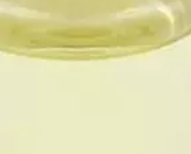
It occurs as a white to light yellow crystalline powder or in liquid form with a transparent to light yellow colour.
What it is used for and where it is used
It is a non-ionic, non-aggressive surfactant (removes dirt particles) and also acts as an emulsifier. It is completely biodegradable, compatible and has synergistic effects with all other types of surfactants. Produces a full-bodied and stable foam.
Cosmetics. Biodegradable non-ionic surfactant, cleaning agent in shampoos, liquid shower soaps, toothpastes.
Surfactant - Cleansing agent. Cosmetic products used to cleanse the skin utilise the surface-active action that produces a lowering of the surface tension of the stratum corneum, facilitating the removal of dirt and impurities.
Detergents. Dishwasher detergents
For more information:
Typical optimal commercial product characteristics Lauryl glucoside
| Appearance | Light yellow liquid or white paste |
| Boiling Point | 499.1±45.0 °C at 760 mmHg |
| Density | 1.07-1.09g/cm3 |
| Flash Point | 255.6±28.7 °C |
| PH Value (10% Aqueous) | 11.5-12.5 |
| PSA | 99.38000 |
| LogP | 3.15 |
| Free Fatty Alcohol % | ≤1.0 |
| Sulfate Ash % | ≤3.0 |
| Viscosity (MPa.S (40℃) | 2000 min |
| Vapour Pressure | 0.0±2.9 mmHg at 25°C |
| Index of Refraction | 1.509 |
| Degree of polymerization | 1.3-1.5 |
| Storage | -20°C |
 |  |
 |  |
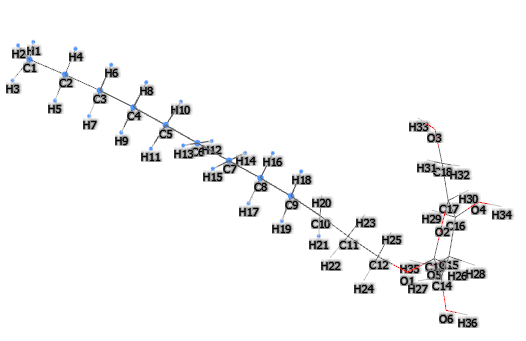
- Molecular Formula C18H36O6
- Molecular Weight 348.47484
- Exact Mass 348.25100
- CAS 27836-64-2 110615-47-9
- UNII 76LN7P7UCU
- EC Number 261-614-4 600-975-8
- DSSTox Substance ID
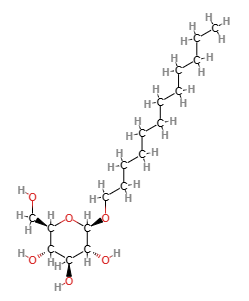
- IUPAC (2R,3R,4S,5S,6R)-2-dodecoxy-6-(hydroxymethyl)oxane-3,4,5-triol
- InChI=1S/C18H36O6/c1-2-3-4-5-6-7-8-9-10-11-12-23-18-17(22)16(21)15(20)14(13-19)24-18/h14-22H,2-13H2,1H3/t14-,15-,16+,17-,18-/m1/s1
- InChl Key PYIDGJJWBIBVIA-UYTYNIKBSA-N
- SMILES CCCCCCCCCCCCOC1C(C(C(C(O1)CO)O)O)O
- MDL number MFCD00063298
- PubChem Substance ID 24894182
- CHEMBL4068837
Synonyms:
- Dodecyl glucoside
- Lauryl polyglucose
- (2R,3R,4S,5S,6R)-2-dodecoxy-6-(hydroxymethyl)oxane-3,4,5-triol
- Dodecyl glucopyranoside

