



Evernia prunastri extract (oakmoss)
Description
Evernia prunastri extract, commonly known as oakmoss, is obtained from a lichen that grows on the bark of oaks, beeches and other deciduous trees in cool, humid European regions. The extract is typically obtained as a resinoid, absolute or tincture, with colour ranging from dark green to brown and a very characteristic odour: woody, earthy, mossy, damp-forest, with leathery and slightly smoky nuances. It is a classic ingredient in perfumery, especially in chypre, fougère and woody compositions.
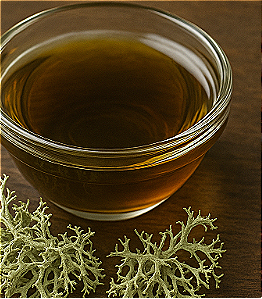
Common name: Oakmoss
Organism: Evernia prunastri (L.) Ach.
Kingdom: Fungi (functionally; lichens are symbiotic organisms)
Simbiosis between:
a fungus (mycobiont, Ascomycetes)
a green alga or cyanobacterium (photobiont)
Division (mycobiont): Ascomycota
Order: Lecanorales
Family: Parmeliaceae
Genus: Evernia
Species: Evernia prunastri
Note: Lichens are not plants but stable symbiotic organisms consisting of a fungus plus a photosynthetic partner that live as a single integrated system.
Cultivation and growth conditions
Because Evernia prunastri is an epiphytic lichen, it is not cultivated like agricultural crops. It grows naturally on the bark of trees—especially oak, but also fir and pine—in humid, unpolluted forest environments. Below are its ecological requirements.
Climate
Oakmoss thrives in:
cool to temperate climates,
areas with high atmospheric humidity,
regions with mild summers and not overly harsh winters.
It is highly sensitive to air pollution (SO₂, nitrogen oxides), so it grows abundantly only where the air is clean.
Sun exposure
Prefers:
filtered light or partial shade, typical of mixed forests,
bark surfaces not exposed to intense direct sunlight.
Excessive sunlight can cause dehydration and slow down growth.
Substrate / Soil
As an epiphyte:
it does not grow in soil,
it grows on tree bark (especially oak),
it is not parasitic—the bark is only a support surface.
Requires:
untreated, naturally textured bark,
slightly acidic surfaces.
Irrigation
It does not require irrigation. It absorbs water from:
rain,
fog,
dew.
Extended periods of dryness slow down its metabolic activity.
Temperature
Optimal growth: 5–18 °C
Tolerates winter cold down to –10/–15 °C when desiccated
Suffers in prolonged hot and dry conditions
Nutrition
Oakmoss does not absorb nutrients from the tree. It obtains:
minerals and moisture from the atmosphere,
carbon through photosynthesis carried out by the photobiont.
Because of this, it is an excellent bioindicator of air quality and disappears from polluted areas.
Crop care
In nature, it requires no management. To maintain or propagate it artificially:
avoid pollutants and dry air,
ensure diffused light and high humidity,
avoid frequent handling (it is fragile).
Growth is extremely slow: only a few millimeters per year.
Harvest
Traditional harvesting occurs:
by hand,
from naturally fallen branches,
or directly from trees (only where legally permitted).
After collection, oakmoss is:
dried,
aged for several weeks,
extracted (mainly via solvents) to produce the well-known oakmoss absolute, widely used in perfumery.
Propagation
Reproduction is slow and complex, typical of lichens:
natural fragmentation (small pieces re-grow),
lichen propagules (soredia, isidia),
spontaneous recolonization of new branches under ideal conditions.
There is currently no true large-scale agricultural cultivation of oakmoss.
Indicative nutritional values
Not applicable. This is a non-food ingredient intended exclusively for perfumery, cosmetics and fragrance applications.
Key constituents
Polysaccharides (lichenan and related structural carbohydrates)
Lichen acids (e.g. atranol, chloroatranol in traditional extracts; now strictly regulated and largely removed in purified qualities)
Aromatic alcohols, aldehydes and esters contributing to odour profile
Terpenoid compounds with fixative and olfactory functions
Trace constituents that provide the typical mossy, damp, woody character
Production process
Harvesting
Oakmoss is collected from tree bark in temperate forests.
In many regions, collection is regulated to avoid overharvesting and to protect local ecosystems.
Sustainable practice favours collection from fallen branches and controlled harvesting zones.
Extraction
Dried lichen is macerated in suitable solvents (ethanol or other approved organic solvents) to produce:
Oakmoss resinoid
Oakmoss absolute (further purified from the resinoid)
Tinctures (low-concentration ethanolic extracts)
The crude extract is filtered and concentrated under controlled conditions.
Standardisation / purification
Cosmetic-grade extracts are often purified to drastically reduce allergenic lichen acids (especially atranol and chloroatranol).
Specifications may include maximum allowed levels of these molecules according to current regulations.
Physical properties
Form: viscous resinoid, waxy mass, or viscous liquid (absolute), or hydroalcoholic solution (tincture)
Colour: dark green, olive, brownish or nearly black
Odour: very intense, mossy, woody, earthy, slightly leathery and damp
Solubility:
Good in ethanol and many perfume bases
Very limited in water
Stability: good if stored away from light, heat and air; sensitive to oxidation over long periods
Sensory and technological properties
Functions primarily as a base note and fixative in fragrances.
Adds depth, roundness and natural “forest floor” character to perfume accords.
Enhances longevity and diffusion of other fragrance components, especially floral, woody and citrus notes.
Key material for constructing traditional chypre and fougère accords, often combined with bergamot, patchouli, labdanum and woods.
Uses (non-food)
Fine perfumery (eau de parfum, parfum, colognes)
Fragranced cosmetics (creams, lotions, aftershaves) within regulatory limits
Soaps and shower products (especially traditional bar soaps)
Home fragrances (candles, room sprays, diffuser concentrates), subject to IFRA-type restrictions
Nutrition & health
Not applicable to dietary use (not intended for ingestion).
From a dermal perspective:
Oakmoss components, especially atranol and chloroatranol in unpurified extracts, are strong skin sensitisers.
Modern cosmetic use relies on allergen-reduced or “low-atranol” oakmoss, applied at very low dosage and under strict regulatory conditions.
Portion note
Not applicable to food.
Typical use concentrations in finished cosmetic or fragrance products are very low (often well below 0.1%, and lower still for leave-on skin products, depending on regulatory and IFRA guidance).
Allergens and sensitisation
Traditional oakmoss extracts contain potent fragrance allergens (especially atranol and chloroatranol), strongly associated with contact allergy.
Modern regulations require use of purified extracts with extremely low levels of these substances.
Even with purified grades, oakmoss-type ingredients are used at restricted levels and require careful safety evaluation in finished products.
Storage and shelf-life
Store in tightly closed containers, protected from light and heat.
Recommended storage: cool, dry environment (often in amber glass or coated metal containers).
Typical shelf-life: 24–36 months under proper storage, with periodic control of odour profile and colour.
Avoid prolonged exposure to air, which can lead to oxidation and potential change in odour profile.
Safety and regulatory aspects
In the EU and many other regions, oakmoss is one of the most strictly regulated fragrance ingredients.
Use of non-purified extracts with significant atranol and chloroatranol content is essentially prohibited in cosmetics.
Only purified oakmoss extracts with very low allergen content are allowed, at restricted maximum concentrations and typically in certain product types only.
Manufacturers must apply GMP and carry out safety assessments, often using up-to-date IFRA standards and cosmetic regulations as reference.
Labelling
INCI name: Evernia Prunastri Extract (for cosmetic ingredient lists).
Finished products must list all regulated fragrance allergens above their respective thresholds according to cosmetic law (e.g. on the INCI list).
Additional information may include:
Batch or lot number
Best-before or production date
Storage recommendations
Indication of “low-atranol” or purified quality where relevant (in technical documentation/COA rather than on consumer label).
Troubleshooting
Overpowering, “muddy” base note → dosage too high; adjust level or use more purified/rectified qualities.
Colour darkening in formula → potential oxidation or interaction with other ingredients; review antioxidants and packaging.
Skin irritation or sensitisation reports → review extract specification (atranol/chloroatranol content), total allergen load in formula and overall dosage; may require reformulation.
Incomplete solubility in alcohol → check grade and solvent ratio; gently warming and proper pre-dilution can help.
Sustainability and supply chain
Evernia prunastri grows slowly; overharvesting can damage forest ecosystems.
Sustainable sourcing includes:
Controlled quotas and regulated harvesting zones
Preference for lichen collected from fallen branches or pruning waste
Supplier certification and traceability schemes
Development of biotechnological, synthetic or nature-identical alternatives aims to reduce pressure on wild resources while reproducing oakmoss odour profiles.
Main INCI functions (cosmetics)
Fragrance (Aromatic) – characteristic mossy-woody note in perfumes and fragranced products.
Fixative – helps prolong the persistence of volatile notes.
Masking agent – can help mask undesirable base odours of raw materials in complex formulations.
All uses must comply with current cosmetic regulations and safety assessments.
Conclusion
Evernia prunastri extract (oakmoss) is a historically iconic material in perfumery, prized for its deep, mossy, woody character and strong fixative power. Due to its high allergenic potential in traditional forms, modern cosmetic and fragrance use is limited to purified, low-allergen grades and strictly controlled dosage levels. When responsibly sourced and correctly purified, oakmoss remains a unique and valuable building block for chypre, fougère and woody accords, adding complexity, depth and lasting character to fragrances.
Mini-glossary
GMP – Good Manufacturing Practices; quality and hygiene standards for production.
HACCP – Hazard Analysis and Critical Control Points; preventive safety system (more typical for food, but the concept of risk analysis is also relevant to cosmetic production).
INCI – International Nomenclature of Cosmetic Ingredients; standard naming system for cosmetic ingredient labelling.
Allergen-reduced / low-atranol – Oakmoss extract quality specifically purified to minimise atranol and chloroatranol content and reduce sensitisation risk.
Studies
Data obtained from this study clearly showed that Evernia prunastri methanol extract has significant anti-cancer effects that are believed to be partly due to antioxidant activity and the ability to induce antioxidants Evernia prunastri methanol extract. This is the first report indicating the anti-genetossic activities of Evernia prunastri methanol extract against various mutagenic agents (1).
This study evaluated for the first time the in vitro cytoprotective properties, based on the antioxidant activities, of the Parmeliaceae lichens Evernia prunastri and Usnea ghattensis and the mechanism of action of their major phenolic constituents: the evernic and usnic acids, respectively. In two models of central nervous system (2).
As with lichens in general, the antifungal and anti-biofilm activity of Evernia prunastri has also been confirmed (3).
Cosmetics
It is a fragrance inserted to impart a scent of mistletoe or tree. Unfortunately, it contains a known allergen: Chloroatranol (3-Chloro-2,6-dihydroxy-4-methylbenzaldehyde).
Safety
The patch tests with the mixes containing Evernia prunastri (oak moss) with a high content of chloratranol/atranol resulted in substantially more positive reactions than the corresponding tests with the mixes containing oak moss with a low content of chloratranol/atranol (4).
The most relevant studies on the subject have been selected with a summary of their contents:

