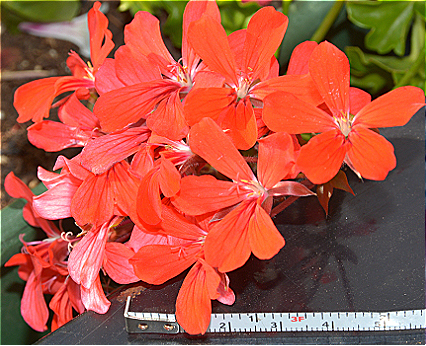
Ivy geranium red (Pelargonium peltatum): complete guide to Pelargonium peltatum (cultivation, care, common problems)
Description
The red ivy geranium (Pelargonium peltatum) is an ornamental plant in the Geraniaceae family, grown mainly in pots and hanging planters for its trailing habit and abundant flowering. In cultivation it is often managed as a seasonal plant, but it can behave as a perennial in mild climates or when overwintered in a protected environment. The term “red” refers to selected cultivars with red-toned inflorescences, with intensity influenced by light, nutrition, and temperature.
Botanical classification
Main plant characteristics
habit: trailing or semi-trailing, suitable for balconies and hanging baskets.
stems: flexible and partly succulent; they may break in strong wind if not managed properly.
leaves: peltate, smooth, slightly fleshy, with a cuticle that limits water loss.
flowers: arranged in umbels; flowering is more continuous if spent flower heads are removed.
sensitivity: it suffers from waterlogging and cold; it tolerates short dry spells better than excess water.
Chemical composition and structure
pigments: red flowers are mainly due to anthocyanins (flavonoids), modulated by light and nutrients.
polyphenols: presence of phenolic compounds with a protective role against stress and external agents.
volatile components: compared with other aromatic species in the genus Pelargonium, Pelargonium peltatum is generally less relevant as a source of industrially valuable aromatic fractions.
structure: tissues with moderate succulence and a developed cuticle, consistent with good management of dehydration under cultivation.
Cultivation and care
Exposure and climate
exposure: full sun to maximize flowering and compact growth; partial shade in very hot areas to reduce stress.
temperature: optimal growth in mild conditions; below 5–7 °c it may be damaged. When frost risk is present, overwintering in a bright, sheltered place is recommended.
Soil and pot
substrate: the key requirement is drainage. Use potting mix for flowering plants lightened with inert materials (perlite, pumice, or equivalent).
pot: choose containers with wide drainage holes; avoid saucers with standing water.
Watering
Fertilizing
aim: support flowering without excessive vegetative growth.
guideline: a fertilizer for flowering plants with adequate potassium and micronutrients; limit excess nitrogen, which favors leaves over flowers and increases susceptibility to stress.
Pruning and flowering management
removing spent flowers: improves flowering continuity and reduces the risk of molds.
light pinching: increases branching and plant density.
stem management: shorten overly long stems to improve airflow and reduce breakage.
Propagation
Common problems and quick solutions
yellow leaves and soft stems: often too much water or insufficient drainage. Reduce watering and improve the substrate.
poor flowering: lack of light, unsuitable fertilizer, or excess nitrogen. Increase exposure and rebalance nutrition.
mold on flowers and leaves: high humidity and poor ventilation. Remove affected parts and improve airflow.
pests: aphids, whiteflies, and spider mites may appear with heat and stress. Act early with control strategies compatible with home use and current regulations.
Uses and benefits
main use: ornamental for balconies, terraces, planters, and beds.
practical value: fast coverage of edges and surfaces, with strong visual performance in containers.
food note: it is not a plant intended for food use.
Applications (medical, cosmetic, other)
medical: it is not a species commonly used in standardized herbal medicine. Any traditional uses are not therapeutic indications.
cosmetic: cosmetic interest within Pelargonium mainly concerns aromatic species; for Pelargonium peltatum cosmetic use is generally marginal.
other: used in displays and landscaping in mild climates, with attention to drainage and winter management.
Environmental and safety considerations
human safety: possible skin irritation from contact with sap in sensitive individuals; wear gloves during pruning and cutting.
pet safety: accidental ingestion may cause gastrointestinal upset; prevent access for cats and dogs that chew plants.
sustainability: prioritize preventive management (drainage, airflow, correct watering) to reduce chemical interventions.
References__________________________________________________________________________
Alonso AM, Reyes-Maldonado OK, Puebla-Pérez AM, Arreola MPG, Velasco-Ramírez SF, Zúñiga-Mayo V, Sánchez-Fernández RE, Delgado-Saucedo JI, Velázquez-Juárez G. GC/MS Analysis, Antioxidant Activity, and Antimicrobial Effect of Pelargonium peltatum (Geraniaceae). Molecules. 2022 May 26;27(11):3436. doi: 10.3390/molecules27113436.
Abstract. In recent years, the increase in antibiotic resistance demands searching for new compounds with antimicrobial activity. Phytochemicals found in plants offer an alternative to this problem. The genus Pelargonium contains several species; some have commercial use in traditional medicine such as P. sinoides, and others such as P. peltatum are little studied but have promising potential for various applications such as phytopharmaceuticals. In this work, we characterized the freeze-dried extracts (FDEs) of five tissues (root, stem, leaf, and two types of flowers) and the ethyl acetate fractions from leaf (Lf-EtOAc) and flower (Fwr-EtOAc) of P. peltatum through the analysis by thin-layer chromatography (T.L.C.), gas chromatography coupled to mass spectrometry (GC-MS), phytochemicals quantification, antioxidant capacity, and antimicrobial activity. After the first round of analysis, it was observed that the FDE-Leaf and FDE-Flower showed higher antioxidant and antimicrobial activities compared to the other FDEs, for which FDE-Leaf and FDE-Flower were fractionated and analyzed in a second round. The antioxidant activity determined by ABTS showed that Lf-EtOAc and Fwr-EtOAc had the lowest IC50 values with 27.15 ± 1.04 and 28.11 ± 1.3 µg/mL, respectively. The content of total polyphenols was 264.57 ± 7.73 for Lf-EtOAc and 105.39 ± 4.04 mg G.A./g FDE for Fwr-EtOAc. Regarding the content of flavonoid, Lf-EtOAc and Fw-EtOAc had the highest concentration with 34.4 ± 1.06 and 29.45 ± 1.09 mg Q.E./g FDE. In addition, the minimum inhibitory concentration (M.I.C.) of antimicrobial activity was evaluated: Lf-EtOAc and Fwr-EtOAc were effective at 31.2 µg/mL for Staphylococcus aureus and 62.5 µg/mL for Salmonella enterica, while for the Enterococcus feacalis strain, Fwr-EtOAc presented 31.2 µg/mL of M.I.C. According to the GC-MS analysis, the main compounds were 1,2,3-Benzenetriol (Pyrogallol), with 77.38% of relative abundance in the Lf-EtOAc and 71.24% in the Fwr-EtOAc, followed by ethyl gallate (13.10%) in the Fwr-EtOAc and (Z)-9-Octadecenamide (13.63% and 6.75%) in both Lf-EtOAc and Fwr-EtOAc, respectively.
Coronado-López S, Caballero-García S, Aguilar-Luis MA, Mazulis F, Del Valle-Mendoza J. Antibacterial Activity and Cytotoxic Effect of Pelargonium peltatum (Geranium) against Streptococcus mutans and Streptococcus sanguinis. Int J Dent. 2018 Nov 28;2018:2714350. doi: 10.1155/2018/2714350.
Abstract. Objective: To evaluate the in vitro antibacterial and cytotoxic properties of the methanolic extract of Pelargonium peltatum (geranium) against Streptococcus mutans (ATCC 25175) and Streptococcus sanguinis (ATCC 10556). Methods: Three extracts of P. peltatum were prepared using the leaf, stem, and root. Nine independent assays were prepared for each type of extract with chlorhexidine at 0.12% as the positive control. The agar diffusion method was performed to determine the antibacterial properties of each extract. The minimum inhibitory concentration (MIC) was determined using the microdilution method, and the cytotoxicity was analyzed by means of the MTT reduction test using a MDCK cell line. Results: The root extract had the highest antibacterial effect with a mean result of (27.68 ± 0.97) mm and (30.80 ± 0.55) mm against S. mutans and S. sanguinis, respectively. The minimum inhibitory concentration for the leaf and root extracts was 250 mg/mL for S. mutans and 125 mg/mL for S. sanguinis. Cytotoxicity assays showed that both extracts had a low cytotoxicity at high concentrations. The cellular viability was highest for the root extract at 95.3% followed by the stem extract at 80.8% and finally the leaf extract with 75.4%. Conclusions: These findings show the antibacterial properties of the methanolic extracts of P. pelargonium against S. mutans and S. sanguinis. These extracts were not cytotoxic at high concentrations.
Perner H, Schwarz D, Bruns C, Mäder P, George E. Effect of arbuscular mycorrhizal colonization and two levels of compost supply on nutrient uptake and flowering of pelargonium plants. Mycorrhiza. 2007 Jul;17(5):469-474. doi: 10.1007/s00572-007-0116-7.
Abstract. Two challenges frequently encountered in the production of ornamental plants in organic horticulture are: (1) the rate of mineralization of phosphorus (P) and nitrogen (N) from organic fertilizers can be too slow to meet the high nutrient demand of young plants, and (2) the exclusive use of peat as a substrate for pot-based plant culture is discouraged in organic production systems. In this situation, the use of beneficial soil microorganisms in combination with high quality compost substrates can contribute to adequate plant growth and flower development. In this study, we examined possible alternatives to highly soluble fertilizers and pure peat substrates using pelargonium (Pelargonium peltatum L'Her.) as a test plant. Plants were grown on a peat-based substrate with two rates of compost addition and with and without arbuscular mycorrhizal (AM) fungi. Inoculation with three different commercial AM inocula resulted in colonization rates of up to 36% of the total root length, whereas non-inoculated plants remained free of root colonization. Increasing the rate of compost addition increased shoot dry weight and shoot nutrient concentrations, but the supply of compost did not always completely meet plant nutrient demand. Mycorrhizal colonization increased the number of buds and flowers, as well as shoot P and potassium (K) concentrations, but did not significantly affect shoot dry matter or shoot N concentration. We conclude that addition of compost in combination with mycorrhizal inoculation can improve nutrient status and flower development of plants grown on peat-based substrates.