



Vanilla Bourbon grains: properties, uses, pros, cons, safety
(Vanilla planifolia)
Definition
Bourbon vanilla beans are the dried and cured pods of Vanilla planifolia (family Orchidaceae). The term “Bourbon” identifies a historical commercial style associated with Indian Ocean production areas (a “classic” aromatic profile), obtained through a controlled curing/fermentation process that develops the characteristic aroma.
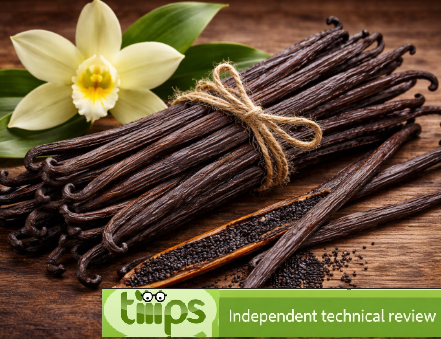
Main application fields include: food (natural flavoring and premium ingredient), cosmetics (raw material for extracts or fragrant/conditioning powders in specific formulas), medical/pharmaceutical (limited use as a flavor/excipient in some preparations), and industrial use (extraction of aromatic compounds for ingredient supply).
Production process
After harvesting at maturity, the pods undergo a typical sequence: controlled enzymatic inactivation (thermal step), sweating/fermentation (aroma development), gradual drying to the target moisture, and conditioning during storage to stabilize the aromatic profile. Lots are then selected by length, flexibility, moisture content, and sensory quality; for industrial applications they may undergo milling (powder) or extraction (hydro-alcoholic, hydro-glycolic, or other, depending on intended use).
Identification data and specifications
| Characteristic | Value | Note |
|---|---|---|
| Common name | Bourbon vanilla beans | In practice: “cured” pods |
| Botanical name | Vanilla planifolia | Family: Orchidaceae |
| Plant part | Fruit (pod) | Aromatic raw material |
| Origin | Botanical | Quality linked to origin and curing |
| Commercial form | Whole pods; cut; powder | Powder requires particle size control |
| Key parameters | Moisture; aromatic content; grade (length/appearance) | Specifications depend on channel (food/cosmetic) |
| Contaminants/quality | Microbiology; foreign bodies; residues | Stricter controls for sensitive uses |
| Cosmetic functions (indicative) | Skin conditioning; perfuming (if as extract/derivatives) | Depends on form (extract/powder) |
| Caloric value | About 288 kcal/100 g | Relevant only for food use; actual intake is very low |
Physicochemical properties and composition (indicative)
| Characteristic | Indicative value | Note |
|---|---|---|
| Physical state | Solid (flexible pods) | Flexibility is a practical quality indicator |
| Solubility | Not applicable to whole pods | Use involves infusion/extraction |
| Stability | Good if protected from light, heat, and humidity | Sensitive to loss of volatiles and mold |
| Main components (macro-categories) | Carbohydrates; fiber; volatile aromatic fraction | Nutrients are marginal at use doses |
| Aromatic compounds (representative) | Vanillin; p-hydroxybenzaldehyde; vanillic acid | Profile varies with curing and origin |
| Other phenolics (representative) | p-coumaric; ferulic; caffeic | Present at variable levels |
| Variability note | Medium–high | Depends on maturity, curing process, and storage |
Main uses
Food
Bourbon vanilla beans are used as a natural flavoring in custards, ice creams, baked goods, chocolate, and beverages. Practical use includes infusion in aqueous or fat phases, or use of the seeds. Aromatic yield depends on cutting, time/temperature, and matrix.
Serving note
In home/industrial use, quantities are generally low (on the order of grams or fractions of a gram per serving), so the effective caloric contribution is usually negligible.
Safety (allergens, food)
Not a typical label allergen. In sensitive individuals, idiosyncratic reactions may occur. The main quality-related risk is contamination (molds if moisture is high) and foreign bodies: supplier selection and storage management are critical.
Storage and shelf-life
Store in a tightly closed container, protected from light and heat, with controlled humidity to prevent mold and loss of volatiles. Shelf-life depends on grade and packaging.
Labelling
In food, use a denomination consistent with applicable regulations (vanilla pods, Bourbon vanilla, etc.). For extracts or preparations, wording depends on extraction type and concentration.
Cosmetics
In cosmetics, direct use of the whole pod is less common; more often derivatives such as extracts or carried powders/infusions are used in products with sensorial positioning and, depending on quality and dossier, a contribution to skin conditioning. Compatibility depends on the base (aqueous, hydro-alcoholic, hydro-glycolic, emulsified) and the preservative system.
Medical and pharmaceutical
Possible use as a flavor/excipient in some non-critical preparations, subject to suitable specifications and controls.
Industrial use
Raw material for extraction of aromatic components and preparations for ingredient supply (flavors, bases, compounds), with focus on batch-to-batch consistency and quality standards.
Functional role and use rationale
In food, the primary value is the contribution of aromatic compounds (a “round” and persistent profile). In cosmetics, when properly carried, it can contribute to sensoriality and “botanical” positioning, with attention to stability and formulation compatibility. In all cases, final quality is driven by curing, moisture, contaminant control, and protection of volatiles during storage and processing.
Formulation compatibility
In food systems, vanilla interacts with fats and sugars, influencing perception and aromatic persistence; high temperatures and prolonged processing can reduce volatiles. In cosmetics, extracts and infusions may show criticalities related to color, residual odor, haze, and compatibility with preservatives/polymers; accelerated stability testing and packaging behavior should be verified.
Pros and cons
Pros
Recognizable, premium aromatic profile that supports product differentiation.
Versatile across many food matrices and applications.
Processing flexibility (infusion, seeds, extracts) adaptable to the manufacturing process.
Cons
Batch-to-batch quality variability (curing, moisture, origin).
Sensitivity to improper storage (aroma loss, mold).
Higher cost compared with standardized flavors; yield depends on extraction technique in the recipe.
Safety, regulatory, and environment
Allergen
Not a typical fragrance allergen. In cosmetics and food, tolerability should be evaluated as a function of dose and matrix; consider possible individual sensitivities.
Contraindications
Use caution on very reactive skin if cosmetic derivatives (extracts/infusions) are used in high-percentage leave-on products. In food, avoid using pods with signs of deterioration or mold.
Regulatory/quality note
For food and cosmetic uses, compliance with applicable requirements (purity, microbiology, contaminants) is relevant. In industrial processes, GMP/HACCP (good manufacturing practices and a food safety management system) are decisive to prevent contamination and ensure consistent quality.
Practical/formulation troubleshooting
Aroma loss during baking: reduce time/temperature, add vanilla in cooler phases or post-bake where possible.
Flat or low-persistence notes: optimize extraction (time, fat-containing matrix), verify lot quality and moisture.
Mold or abnormal odors: discard the lot, correct storage (humidity and closure), select suppliers with robust microbiological controls.
Haze in cosmetic extracts: review solvent/carrier, filtration, and compatibility with polymers and preservatives.
Cultivation
Vanilla planifolia is a tropical orchid grown in warm, humid climates; pod quality depends on pollination, maturation, agronomic practices, and especially the post-harvest curing process, which determines aroma development and product stability.
Conclusion
Bourbon vanilla beans (Vanilla planifolia) are a high-value aromatic raw material whose application outcome depends decisively on lot quality, the curing process, moisture management, and protection of volatile compounds during storage and processing. In food they provide a strong sensorial driver when extraction and process are controlled; in cosmetics their use is more coherent via derivatives (extracts/infusions) after verifying stability and formulation compatibility. Supplier selection and quality controls remain the main drivers to achieve reproducible performance and safety.
Mini-glossary
Curing: set of controlled steps (thermal, sweating/fermentation, drying, conditioning) that develop vanilla aroma.
Volatiles: aromatic fraction that can be reduced by heat and unsuitable storage.
GMP/HACCP: good manufacturing practices and a food safety management system; critical to prevent contamination and ensure consistent quality.
Quality standards: practical grading criteria (moisture, flexibility, defects, contaminants) that determine fitness for use.
Studies
Vanillin itself has not shown antioxidant properties; however, together with other compounds it has nutraceutical properties, hence its wide use (1).
The dispersion of phytochemical data across all analyzed Vanilla species has been determined by three main components (2).
The results of intraperitoneal administration of eugenol and vanillin suggest that their appetite-stimulating effects may occur through stimulation of olfactory receptors (3).

