



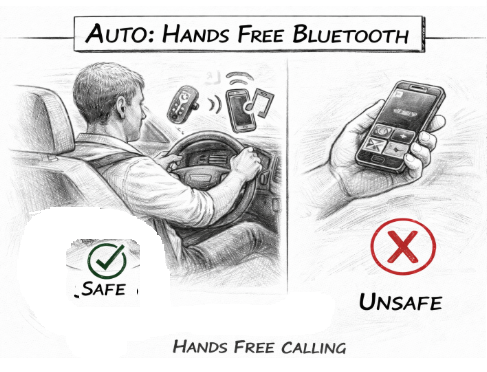
The Bluetooth hands-free system is a connectivity feature that lets you place and receive calls in the car (or on other devices) without using your hands, transferring audio and controls between the smartphone and the head unit wirelessly.
At a technical level, the system relies on Bluetooth profiles dedicated to telephony: the most common is HFP (hands-free profile), which manages call control (answer, hang up, line status) and bidirectional voice audio. For the phonebook and contact synchronization, PBAP (phone book access profile) is often used; for messages/notifications, MAP (message access profile) may be involved, while music streaming and media commands rely on A2DP and AVRCP.
Voice quality depends on multiple factors: microphones (placement and number), front-end capture electronics, and a DSP (digital signal processing) chain that applies echo cancellation (to prevent loudspeaker audio from feeding back), noise reduction (wind, tire/road noise, vibrations) and, in higher-end systems, multi-mic beamforming techniques to focus on the driver’s voice.
On the Bluetooth link, speech can be encoded with narrowband codecs (e.g., CVSD) or wideband codecs (e.g., mSBC) when supported, improving intelligibility and naturalness. Wideband availability depends on both the vehicle unit and the smartphone, and on successful HFP negotiation.
Setup involves pairing (bonding) and subsequent automatic reconnection. Modern devices typically use SSP (secure simple pairing) with key exchange; multi-device behavior (priority rules, “last connected,” multipoint) varies by brand and can affect stability and connection time.
During use, the hands-free system integrates controls on the steering wheel or screen (answer, reject, mute, phonebook access) and may support voice commands via assistants, but the overall experience depends on software integration and the smartphone’s permission model.
Typical limitations include latency, profile compatibility, microphone quality, and the cabin’s acoustic conditions. At higher speeds or with windows open, the signal-to-noise ratio worsens and the DSP may become too aggressive, making the voice sound metallic or less natural.
In automotive environments, Bluetooth hands-free often coexists with platforms such as Android Auto or CarPlay: in these cases audio routing may be handled differently, and some issues (mono call audio, inconsistent volume, dropouts) can result from conflicts between the Bluetooth stack, USB transport, and routing policies.
From a practical standpoint, a well-designed hands-free system aims for fast connection, stable audio without dropouts, effective echo cancellation, non-intrusive noise reduction, and an interface that minimizes driver distraction. Privacy handling also matters: access to contacts and messages should be granted only when needed and through clear permissions.
In summary, a Bluetooth hands-free system is a combination of protocols (profiles), hardware quality (microphones and amplification), and DSP algorithms: when these three layers are well integrated, it enables clear and safer communication with reduced driver workload.

