



AEB – Autonomous Emergency Braking:pros, cons, problems
The anti-collision system (often referred to as AEB – Autonomous Emergency Braking, or “automatic emergency braking”) is a set of ADAS functions aimed at avoiding a crash or, if avoidance is not possible, reducing its severity through warnings and, as a last step, automatic braking.
The functional chain starts with perception: the vehicle typically uses a forward radar, a camera, and sometimes additional sensors (e.g., lidar on some platforms) to estimate distance, relative speed, and trajectories of vehicles, pedestrians, or cyclists. Sensor fusion combines measurements to improve reliability and reduce false positives/negatives.
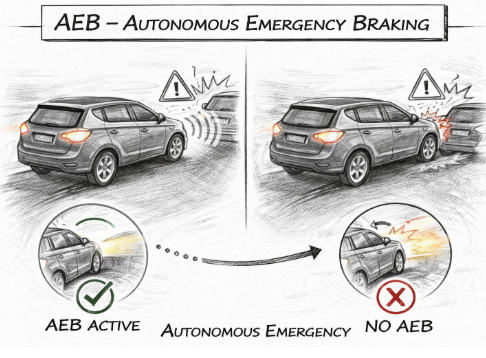
Based on these data, the algorithm computes risk indicators such as TTC (time to collision), remaining distance, and impact probability, also accounting for vehicle dynamics (speed, acceleration, steering angle). When risk exceeds calibrated thresholds, the system triggers a multi-stage strategy.
The first stage is a warning to the driver (visual, audible, and/or haptic). If the driver’s response does not arrive or is insufficient, the system may precharge the braking circuit and increase brake assist, reducing response time.
The final stage is AEB: the control unit commands autonomous deceleration via the brake module (ABS/ESC) and also coordinates engine torque request (torque reduction) to maximize effectiveness. In some implementations, braking is modulated based on available evasive options and stability constraints to avoid destabilizing maneuvers.
Performance varies by scenario: many systems are optimized for rear-end collisions between vehicles (car-to-car) and, in more advanced versions, include pedestrian/cyclist detection even under reduced lighting. Extensions such as intersection AEB, cross-traffic detection, and turning mitigation exist, but depend on the sensor suite and software.
Operational limits are significant: heavy rain, fog, glare, contamination on radar/camera surfaces, tight curves, cut-ins, low-reflectivity obstacles, or complex scenes can degrade state estimation. For this reason, the system always requires driver supervision and does not replace human control.
From a vehicle-integration standpoint, anti-collision functions interface with the powertrain, brakes, steering (if evasive support is available), instrument cluster, and HMI. Calibration is a trade-off between “intervene early” and “avoid unnecessary intervention”: an overly aggressive system produces false alarms and erodes trust; an overly conservative one reduces emergency benefit.
In safety terms, the most measurable effect is a reduction in rear-end crashes and low-to-medium speed impacts, with lower damage and fewer injuries. Even when it does not prevent the crash, reducing impact speed by a few km/h can significantly lower the energy that must be dissipated.
In summary, the anti-collision system is an ADAS that combines sensors, predictive algorithms, and actuation on brakes/engine to manage collision risk. It performs best in “standardized” scenarios with clean, well-calibrated sensors, but it remains a support feature: driver attention and prudent driving remain essential.

