



The airbag is a passive-safety device that, in the event of a crash, inflates within milliseconds to create a “cushion” contact surface between the occupant and the rigid parts of the cabin, reducing the risk of trauma to the head and chest and, in some configurations, to the limbs.
An airbag does not replace the seat belt: it works as a complementary system (SRS, supplemental restraint system). The belt controls occupant kinematics and keeps the body in the intended position; the airbag manages the remaining energy and increases the body’s deceleration distance, lowering peak loads.
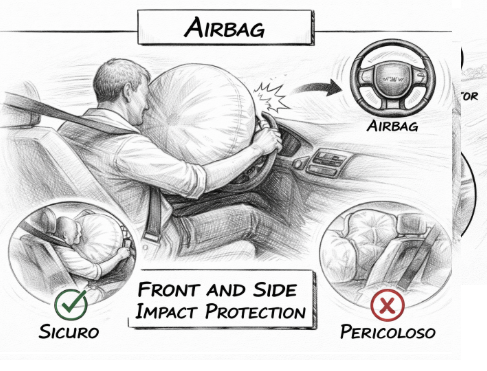
The system consists of an airbag ECU, crash and dynamics sensors (accelerometers, sometimes pressure sensors or front satellite sensors), dedicated wiring, and an airbag module with a gas generator and cushion. Deployment occurs when the ECU detects a deceleration pattern consistent with a significant impact and determines that firing is necessary and beneficial.
Inflation is provided by an inflator: in modern solutions, stored-gas or hybrid gas generators are common, releasing gas rapidly into the cushion. The airbag then “vents” through calibrated holes to control stiffness as the occupant loads the bag.
There are multiple types: frontal airbags (driver and passenger), side thorax airbags, curtain airbags for head protection, center airbags (between driver and passenger), and, on some vehicles, knee airbags. Each type is designed for a specific crash scenario and a specific body region.
In advanced systems, the logic is “adaptive”: thresholds or deployment strategies can change based on parameters such as estimated crash severity, belt use, seat position, passenger-seat occupancy, and occupant classification (weight sensors/OCS). In some cases there are dual-stage airbags with modulated deployment.
Operational limits are important: in very minor impacts deployment is not intended (to avoid unnecessary risk and cost), and in complex crashes protection depends on impact direction and correct interaction with the belt and the vehicle structure. Incorrect occupant positioning (too close to the steering wheel, a child in front without an appropriate restraint, belt not worn) can increase risk.
From a maintenance standpoint, SRS components are continuously self-monitored: an illuminated airbag warning lamp indicates a fault or system disablement and requires a dedicated diagnostic check. After deployment, the airbag module(s) and often the pretensioners must be replaced according to manufacturer procedures.
In summary, the airbag is a key passive-safety element: it reduces injury severity by creating a deformable barrier and dissipating energy, but it delivers maximum effectiveness only when integrated with seat belts, correct occupant posture, and age- and size-appropriate restraint systems.

