



TCS (traction control system): pros, cons, safety
The TCS (traction control system) is an electronic traction-control function designed to reduce or prevent wheel slip of the driven wheels during acceleration, especially on low-grip surfaces such as wet roads, snow, ice, or dirty asphalt.
The core principle is straightforward: when a driven wheel rotates noticeably faster than the other (or faster than the vehicle’s estimated speed), the system interprets this as a loss of traction.
To detect it, TCS mainly uses the wheel-speed sensors (the same ones used by ABS) and communicates with the engine management ECU and, often, the braking control unit.
Intervention typically occurs in two ways, often combined: engine torque reduction (partial cut/inhibition of fuel injection, ignition timing retard, electronic throttle management) and selective braking of the slipping wheel.
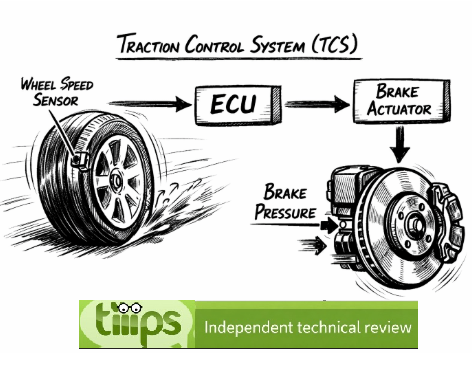
Selective braking also acts as a “virtual limited-slip differential,” helping transfer torque to the wheel with more grip through an open differential.
TCS does not increase the available grip, but it optimizes the use of existing grip by keeping slip within a range where the tire generates the best longitudinal traction.
In practice, it improves traction, directional stability, and overall vehicle controllability during acceleration, reducing fishtailing and loss-of-control events.
On modern vehicles it is integrated into the broader ESC/ESP architecture, which also manages stability in cornering, making interventions more consistent and predictive.
Calibration is critical: an overly intrusive TCS can “choke” power delivery and slow progress, while a system that is too permissive can allow excessive slip, increasing tire wear and risk.
For this reason, many manufacturers provide drive modes (Eco/Normal/Sport/Snow) that adjust thresholds and intervention aggressiveness.
In some scenarios—such as starting off in deep snow or mud—partial deactivation can be useful to allow a limited amount of wheelspin that helps the vehicle move.
From a hardware standpoint, TCS usually does not require dedicated new actuators if the vehicle already has ABS and electronic engine control: it leverages the modulated brake hydraulics and controllable engine torque.
Key inputs processed include wheel speeds, accelerator position, engine speed, gear/ratio, requested torque, and sometimes yaw/acceleration signals when integrated with ESC.
Typical faults involve wheel-speed sensors, wiring, tone rings, or issues within the ABS/ESC module; in such cases, a warning light may indicate that traction control is unavailable.
In summary, TCS is an active-safety system that improves traction effectiveness and acceleration stability, with especially clear benefits on slippery surfaces and in variable-grip conditions.

